Tag Archives: Kick-ass!

TIFF: Blue Jay

For 16 glorious hours, Blue Jay was my favourite movie at TIFF. Then I watched La La Land and I was in cinematic, technicolour heaven. I’ll tell anyone who will listen every single day of my life that I’m a lucky, lucky girl. Getting to watch 2 astounding, knock-your-socks-off films? Frosting on my fucking cupcake.

Blue Jay is nearly an anti-La La Land. It’s a small, quiet, black and white film that’s not destined for the Oscars, or even really theatres (a small run in LA and NY, and then Netflix by the end of the year – lucky us!). But it is superb.

bluejay_03-h_2016It stars Mark Duplass and Sarah Paulson, almost exclusively. They play high school sweethearts who bump into each other 20 years later. Agony and ecstasy, right there on the screen. And heaping spoonfuls of awkwardness, don’t forget that. Because they were in luuuuurv. The real deal. And now they don’t even know each other. It reminded me of a friend who had recently posted on Facebook that it was her ex-husband’s birthday, a date she can’t help but remember even if she no longer even knows if he’s alive. Isn’t it weird that we can lose track of people who used to be our whole worlds?

For Jim and Amanda (Duplass and Paulson), once they get over their initial weirdness, it’s almost like no time has elapsed at all. They’ve both moved on, new cities, big jobs, other lovers. And yet they can pick up where they left off, the magic reappearing in an instant. It’s like opening up a dorky little hole into time and space, hurtling these two pushing-40-year-olds back to their glory days in high school, when things were light and fun, thecaa09d60-5f6f-0134-3e92-0ad17316e277 sex was hot and heavy, and Annie Lennox was everything. Jim and Amanda will take you down your own worm hole, and if you don’t end the movie thinking about your own First Love, then you my friend have a cold, cold heart.

I picked this movie on two words alone: Mark Duplass. But Sarah Paulson is luminous; she fucking shoots starlight out of her face. The two together have incredible chemistry, and it’s obvious they work-shopped their characters together to perfection – the nostalgic backstory, their lovable eccentricities, the subtle hints to what caused their demise. Duplass and Paulson each deliver career-best performances. No kidding.

If you have ever loved and lost, this movie is for you. If you didn’t marry your high school sweetheart, this movie is for you. If you married him and left him, this movie is for you. If you appreciate things like smart dialogue, meticulous observation, authentic and vulnerable performances, and little bursts of spontaneity that are pure joy on celluloid, this movie is for you.


Oh fer fuck’s sake, just see it. It’s for everybody. It’s perfect.
TIFF: Jackie

Jackie is a beautiful film by Pablo Larrain that focuses on Jacqueline Kennedy in the minutes and days following her husband’s assassination.

Larrain is a Chilean film maker, which makes him at outsider to American politics. He poured over documents and was fascinated to read about this day that every age-appropriate American remembers so vividly: when the car turned, the location of the grassy knoll, the flag-wavers lining the street, the bullet’s trajectory – and always sitting beside the president, his wife, Jackie. e02adc223bf38b822b3e250330bde15cLarrain thought to himself, what if it was the other way around. What if he was sitting beside her? And in that thought was born a beautifully conceived film that puts its female character front and centre.
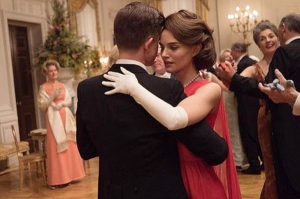
Larrain thought the script was good but sent it back with a note to cut every and any scene that she wasn’t in. The camera would be on Jackie the whole time. Obviously a film with such unerring focus would need an actress who could carry it, and Natalie Portman is that actress. This is her best role since Black Swan and honestly it may be her best role, full stop. She inhabits Jackie like a second skin. She doesn’t get caught up in the trappings of impersonation, she just embodies the grace, the thoughtfulness, and the mystery of one of America’s most beloved and glamourous first ladies.

Despite being a favourite in the press, Jacqueline Kennedy is perhaps unknowable. She was always careful about her public persona and was closely guarded when speaking on record. The film makes this abundantly clear through scenes with a journalist (Billy Crudup) about a week after tragedy has struck. She edits her remarks, strikes things from the record, and demands final approval before a single word is printed. Noah Oppenheim’s script is 14996precise and offers up tantalizing looks behind the closed doors of Camelot.

Peter Sarsgaard, as Bobby Kennedy, is a charming lurker. Greta Gerwig in her most un-Gerwig role to date is restrained and almost unrecognizable. I’d heard that Natalie Portman gave a stellar performance in Jackie but I was unprepared for how good the film would be as a whole. This isn’t just a candidate for Best Actress but I believe, for Best Picture. It’s so well-orchestrated, each piece comes together perfectly to make a very satisfying picture. JFK, one of the world’s most recognizable politicians, is a mere shadow in this film. Jackie gets her moment in the sun, which makes Natalie Portman the star at the centre of this movie’s universe.

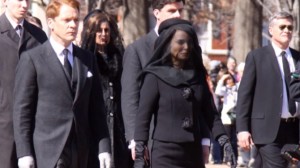
She deserves all the acclaim she’ll receive. She’s brave and courageous here, mixing grief and poise in an intoxicating cocktail that you won’t be able to tear your eyes from. She’s magnetic. She shimmers with loss and outrage as she protects her husband (and more importantly: his legacy) from the vultures already climbing over his coffin. Jackie feels very much like an insider’s peek-a-boo on what has to be an iconic yet little-understood moment in history. Finally we experience JFK’s assassination as Jackie felt it – as the gruesome murder of her husband and the father of her two young kids. She sat beside him, scooping his brains back into his skull, calling to him even as she knew he was already dead. His blood is still fresh on her dress as LBJ is sworn in just 43 minutes later, Kennedy’s body resting just a few feet away. What to tell the children? What to tell the nation? It’s absolutely fascinating. Stephane Fontaine’s cinematography allows us to get very close to the grief, while also appreciating its context: Air Force One, the White House, the Lincoln convertible. Jackie manages to be both historic and quite personal, and Larrain ushers us ably into both worlds. Both Portman and Larrain resist the temptation to over-emote. Like the former first lady herself, restraint, control, and self-possession are at its heart.

TIFF: Denial

denial_04Movies based on true stories were a recurring theme for us at TIFF 2016. Our festival experience included five B.O.A.T.S. in a row. My favourite of those was Denial. As a lawyer, I may be slightly biased toward legal dramas, but if you have even a passing interest in law and order (or Law & Order) then you’ll enjoy Denial.

Denial tells the tale of a defamation lawsuit brought by David Irving, British holocaust denier, against Deborah Lipstadt, American university professor. The claim is brought in England, and as a result in order to defend herself, Lipstadt is faced with proving that Irving is a liar.denial

Director Mick Jackson attended our screening and participated in a Q&A session afterward. Jackson confirmed that the courtroom scenes were word-for-word reenactments of the trial transcripts.  That was a great choice by the writers as it makes the scenes feel authentic in pace, tone and style. It was refreshing to me that the real-life scenes were allowed to stand by themselves.

Don’t get me wrong, I enjoy the over-the-top moments a la Col. Jessep’s crossexamination in A Few Good Men, but those don’t actually ever happen in real life. Real life is much more subtle.  Denial embraces that subtlety wholeheartedly and in doing so sets itself apart from your typical lawyer movie.denial-timothy-spall

Rachel Weisz puts on her best American accent and convincingly plays targeted Professor Lipstadt as a driven, determined and difficult-to-deal-with client, and Timothy Spall is wonderfully despicable as Holocaust-denier Irving. But my favourite performance by far was Tom Wilkinson as Lipstadt’s barrister, Richard Rampton, Q.C. Wilkinson is just so fun to watch in the courtroom scenes and in the strategy sessions with Weiss and the rest of team Lipstadt, led by Andrew Scott (who, thanks to his role in Sherlock, I was sure would turn out to be the evil mastermind pulling Irving’s strings). He conveys confidence while at the same time hinting at underlying conflict. I can only hope my British accent develops to the point where one day I sound as lawyerly as Wilkinson.

While I practice my accent, you should definitely watch Denial. I give it a score of eight unhandleable truths out of ten.


TIFF: Mascots

Christopher Guest has long since held an esteemed spot in my heart and my DVD shelf for his improv-heavy mockumentaries. He wrote and starred in the grandfather of them all, Spinal Tap, but came on as director as well for his classics Waiting For Guffman, Best In Show, and A Mighty Wind. He’s poked fun at small town theatre, dog shows, and folk music, and after an agonizing decade-long hiatus, he’s back with Mascots.

As you  might guess, Mascots does indeed take on the little-explored world of mascotery: you know, the guys at football games dressed up in the big fuzzy suits, trying to get the spectators to cheer and do the wave. The fun is more images.jpgsincere than scathing, but no less amusing for its kindness. Christopher Guest’s body of work is so aligned with what I find funny that Mascots was my number 1 pick for TIFF, ahead of La La Land or Nocturnal Animals or Loving. I was delighted to be able to attend the world premiere, but somewhere in a secret place down near my toes I was worried that perhaps his latest just wouldn’t measure up. With a ten year break, would the chemistry still be there?

I needn’t have worried. Biiiiiiiig sigh of relief. It’s funny! So funny I’m in immediate need of a re-watch. The laughs from one joke often drowned out the next – and what a pleasant problem to have! Mascots is vintage Guest, and he’s got a lot of the old troupe assembled for more.

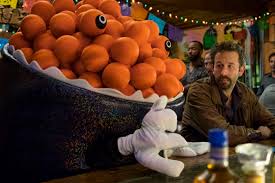
Jane Lynch, Ed Begley Jr, and Don Lake play judges at this year’s Golden Fluffy awards. They’re former mascots themselves and are pleased to judge this year’s finalists in a cut-throat competition. Chris O’Dowd is “The Fist,” hockey’s bad-boy mascot. Parker Posey is a dancing armadillo. Tom Bennett is a football club badger. Christopher Moynihan is a plush Plumber. It sounds absurd and it absolutely is, but that’s what has always worked so well in Guest’s movies: he takes a hobby that exists on the fringes and is practiced mascotswith total obsessiveness, and he shows us the incredible underbelly. It’s fascinating. Like a car wreck or a wonky boob job, you can’t help but stare.
In the case of Mascots, Guest seems to take a particular interest in the proceedings, giving ample screen time to the “performances.” This is way more earnest than we’re used to seeing from him, but it works, largely because the actors commit with such deadpan abandon. It takes a lot of guts to make a movie the way Guest does – he doesn’t know what he’ll end up with until the camera stops rolling and he starts cutting in the editing room. He relies on a deep pool of talent – too deep, as most only get to shine for a line or two. I want more Balaban, more Willard. And definitely more Corky St. Clair, a role Guest reprises from Waiting for Guffman. If we can’t have it all, though, Guest and company still give us a pretty fair shake. I left the theatre with rosy cheeks and a bounce in my bottom.

The good news is that just two films into my Toronto International Film Festival experience, I’d already found a film to love. The even better news: you’ll love it too, and soon – it’ll be out on Netflix October 13th.

TIFF: Barry

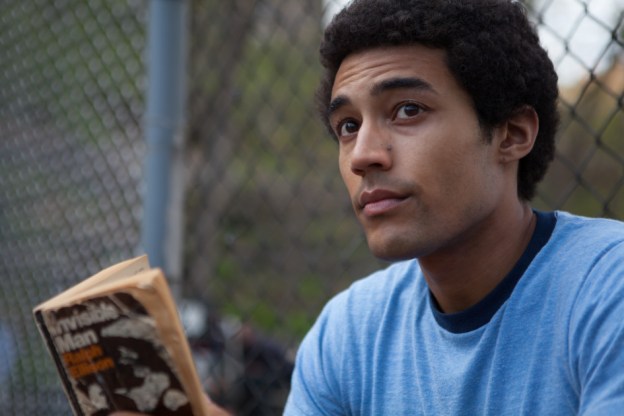
It’s 1981 and Barry is just starting his junior year at Columbia University in New York. His estranged father is Kenyan and his mother is a white American. Some of his friends insist that he is fortunate to be mixed race because he should be able to fit in everywhere but for Barry it feels like he can’t fit in anywhere. Barry is the story of a young man finding his identity and searching for self-acceptance.

By the way, “Barry” is short for Barack. Yes, that one. Starring in his first feature film, Australian actor Devon Terrell is brave enough to portray the 44th President of the United States while the real one is still in office. It’s an impressive performance. Yes, he looks and sounds like him (though Avi Nash as Barry’s friend Saleem does an even better impression in two of the film’s funnier scenes). The real trick though is making the emotions seem believable while mimicking the future president’s signature speaking style without looking like he’s auditioning for Saturday Night Live. Terrell succeeds at convincingly playing a 20 year-old college student who swears, gets drunk, and gets punched in the face for chatting up another guy’s girl while never letting you forget that he is in fact playing the Barack that we know.

Director Vikram Gandhi and writer Adam Mansbach are less concerned with reminding you that young Barry will one day become the first black President. They are mostly concerned with the internal struggle of young men of mixed race in the US and use the details of the real Barack Obama’s life mostly to provide interesting context. I’ll admit that the context worked for me. I would have surely found this movie less gripping without knowing that this same young man’s historic inauguration will one day inspire hope for a brighter future for millions of Americans. (Not to mention around the world).

If you can believe Oliver Stone’s Snowden, which I saw at the festival the day before, Edward Snowden watched President Obama’s inauguration with a renewed faith in government. As he told filmmaker Laura Poitras, he really allowed himself to think that this is a leader who could bring some real change. As it turned out, when it came to illegal surveillance of law-abiding citizens, Snowden watched things go from bad to worse under Obama’s watch.

It can be hard to reconcile the idealistic young man of Barry with the president that we see in archival footage in Snowden. How do you claim a passion for social justice while sanctioning (or, at the very least, defending) illegally spying on your own citizens? Don’t get me wrong. I still love him and will miss him no matter who wins in November. But he is the President of the United States and every president has a certain amount of blood on their hands.

I understand that you don’t get to occupy the highest office in the land without getting your hands dirty. I’m just saying that there’s a story there, between the events of Barry and the events of Snowden. Barry, deliberately paced and completely unpretentious, has a story worth telling as does Snowden, which was self-important but undeniably gripping. But somewhere out there there’s got to be a movie that tells the story of the journey from hero of a nice little indie to the villain of an Oliver Stone movie. That’s the movie I’d really want to see.

TIFF: La La Land

Damien Chazelle has bested himself, and everyone else. With just 3 feature films to his name, he has established himself as a visionary, an innovator, a pusher of boundaries, a seeker of beauty.

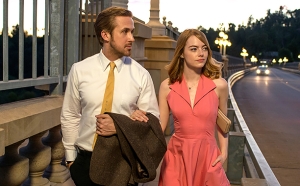
Sean was immediately aflame with praise. He wasn’t just finding a spot in his top ten of the year for it, but dusting off old standbys in his all-time list to make room.  And let me remind you that this is a musical. Not normally Sean’s cup of tea. Sean needs one of three La La Land (2016) Sebastian (Ryan Gosling) and Mia (Emma Stone)things to love a movie: sports, explosions, boobs. La La Land has none of those. It has singing and dancing and old-fashioned romance. Yet Chazelle has breathed new life into the genre, with riots of primary colour, energy so vivid you can taste it, and music that evokes deep troughs of emotion. And by ‘breathed new life’ I mean that he’s actually found a way to bring great musicals from cinema’s past into modern times. Forget made-for-Broadway musicals like Chicago or Into The Woods, their theatre sets turned into movie sets – it’s more reminiscent of Singin In The Rain. La La Land takes place in the streets of Los Angeles and Chazelle takes advantage of its sprawling landscape, and its glittering skyline.

Emma Stone and Ryan Gosling, in the two lead roles, don’t just burst randomly into song. You very quickly get to sense that they sing when ordinary words just won’t do. They play Seb, a jazz pianist, and Mia, an aspiring actress, both a little down on their luck when the meet. The song and dance make up their courtship. The pair do not meet-cute; they meet-ugly several times until it takes: toes tap, together. New love is exhilarating. You feel as though you could sing your lover’s name from the rooftop, as if you could dance on air. It just so happens that in La La Land, they do these things literally. And it’s glorious. The fluid, ethereal dance steps will remind you of Fred and Ginger. Chazelle weaves magic, and a touch of fantasy, into their story, and even though you may never have waltzed among rs-248320-emma-stone-ryan-goseling-la-la-land-sing-dance-trailerthe stars in your sweetheart’s arms, you sort of know how it feels. But this great passion never lasts. It tapers off. Songs repeat. Sean felt himself longing for the exuberance of the beginning of the movie, and realized that was the point. Seb and Mia were missing it too.
If you’ve watched the gorgeous trailer, you’ll recognize the song that Ryan Gosling sings. The lyrics go: “City of stars, are you shining just for me?” But the movie reminds you that L.A. isn’t just a city of stars, it’s a city of dreams, and Seb and Mia are there to chase theirs. They haven’t come to Los Angeles to find love, but to find meaningful work. To become famous and\or successful. La La Land is about following your dreams, and it’s about the cost of following those dreams.

So Sean, whose movie reviews often consist of just three words (“It was good”) can’t shut up about this film. He’s fumbling to find the right words, but he knows he hasn’t just seen a good film, but experienced something unforgettable. I, on the other hand, have been oddly silent in the 24 hours since we saw it. Not for lack of trying, it’s  just that every time I open my face to speak, more tears fall out of it. And lest you start to worry that this is some tragedy wherein Ryan Gosling ends up shot, it’s not. These aren’t just tears of sorrow, but of joy and of wonder. This movie has made me feel. It has made me feel all the feels. I can’t even make it through this review with any dignity. La La Land is why I go to the movies. It’s unselfconscious and unabashed, a cake among pies, and as soon as I’ve finished weeping, I want another slice.


If you’re as desperate as I am to keep reading (and talking! and weeping!) about this wonderful movie, please visit our discussion section – SPOILERS – be warned.


TIFF: Snowden

I feel much better now. If you read my Amanda Knox review, you may remember that I was close to TIFF burnout last night. Well,  I did what I hate doing: I made the tough choice of skipping my Midnight Madness movie last night and finally got some good sleep. Nothing like watching four more movies to make an unsettling documentary but a distant memory. I’m excited about TIFF again.

Seeing Oliver Stone take the stage to introduce Snowden (which I’ve been dying to see) didn’t hurt. Stone hasn’t made a particularly good movie in awhile and, come to think of it, has never really made a film that I love, but seeing him at TIFF still feels like a big deal. And, thankfully, my concerns about whether or not he could handle this tricky material were unnecessary.

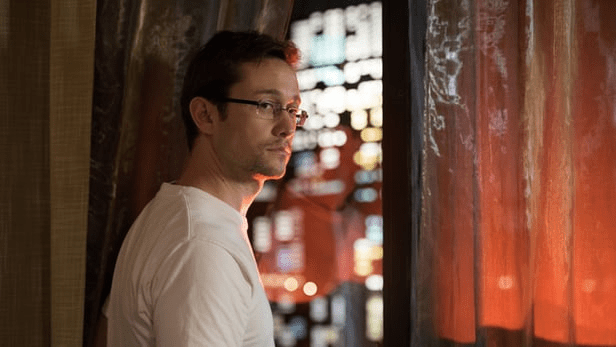
I mean, it’s not perfect. It tries to do way too much and is about 20 minutes longer than it really should be. But it tells and/or speculates about the story that I felt 2014’s Oscar-winning documentary Citizenfour missed out on. It tells us about Snowden the man. Wonderfully played by Joseph Gordon-Levitt, Snowden is easy to root for and easy to relate to. I’d even argue that Stone’s film does a better job of  making the case that all of us should care about illegal NSA surveillance. Even if we feel we have nothing to hide.

Of course, this isn’t a documentary and it’s easier to inspire outrage in a dramatization of events. Snowden isn’t a substitution for Citizenfour, which is an important documentary that everyone should see. It is, however, an interesting and worthy companion piece that will likely make you appreciate Snowden’s sacrifice even more and think twice about getting changed in front of your laptop.

TIFF: Amanda Knox

It’s so great to be back at the Toronto International Film Festival! I felt nostalgic the moment I stepped off the train. The rushed breakfasts, the possibility of a close encounter with your favourite celebrity, the feeling that I’m finally starting to know my way around this once intimidating city, and the hope of catching one of the year’s best films keep me coming back every year. And, for the first time, I get to share the experience with my parents. So why am I tempted to just skip my next movie and go to bed early?

Partly, it’s because I woke up at 4 a.m. yesterday to catch my train and got back to my hotel at 2:30 a.m. this morning after a Midnight Madness screening. Partly, it’s because I’ve been catching four screenings a day since I got here. Both good reasons I think for me to be getting close to early TIFF fatigue but Amanda Knox, which just had its world premiere at the Festival, is another big reason why I couldn’t sleep last night.

Though it was apparently international news back in 2007, I really don’t remember Knox’s story. Amanda Knox was in her early twenties when she was arrested and convicted of murdering her roommate while vacationing in Italy. This wonderful documentary follows her road to exoneration over a period of several years.

What’s unsettling about this film is what apparently captivated the media nearly a decade ago. It’s Amanda. Young, pretty, charismatic, and full of life, she doesn’t look or sound like she’d be capable of such a heinous crime. So when she looks directly into the camera and calmly says, “Either I’m a psychopath in sheep’s clothing, or I’m you,” I get the shivers.

As a true crime documentary, Amanda Knox is every bit as gripping as Netflix’s Making a Murderer. But, despite having only a fraction of the running time with which to do it, it manages to give a more balanced look at the case than the controversially one-sided Netflix phenomenon.  Knox and her Italian now ex-boyfriend and co-defendent are interviewed extensively, as is the Italian homicide detective that maintains their guilt to this day. You’re bound to like and trust some of the interviewees more than others but, according to the filmmakers, each of them have seen the film and every one of them feels that they have been represented fairly.

I still don’t know what happened that night nine years ago. Maybe that’s why the police, media, and public turned on Amanda so quickly. Not knowing is scary. It keeps us up at night (or, in my case, last night). The good news is that, even if you couldn’t make it to Toronto this year, you’ll get a chance to decide for yourself. Amanda Knox will be on Netflix later this month.


Looking for more on Netflix? Try

Audrie & Daisy

Where To Invade Next

Hell or High Water

This movie is more high-noon western than high-octane thriller, but there is indeed a heist at its heart.

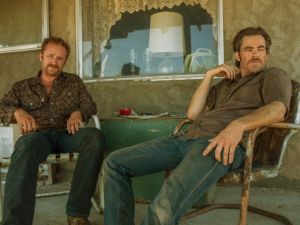
Two brothers, Toby, tall and handsome (Chris Pine), and Tanner, short and surly (Ben hell-or-high-water-chris-pine-ben-fosterFoster), have little in common except for the rough past they come from, which they are both desperate to escape. Toby has spent the last few years caring for their mother while the family ranch slips away. Tanner has spent the past year since he’s been released from jail tempting the fates to put him back. Now they’re working together to save the family ranch from default – and will do so by robbing a bunch of Texas Midland bank branches, and paying the bank back with its own stolen money.

The only catch: sheriff Marcus (Jeff Bridges) is close to retirement but not keen to go, and this one last case is not going to be the blemish on his career. He chases the brothers all over Texas until he pinpoints the next branch they’re about to hit, and lies in wait.

Hell Or High Water is superbly acted. You can’t even say with certainty which of the three leads steals the film, but they’re all making the right choices, the quiet choices that make for the most interesting of character studies. That said, the secondary characters – and hell, even the one-liners – are all praise-worthy here. And I am obliged, once again, to worship at the altar of Jeff Bridges, chronically underrated but truly one of the wonders of the world.

The pace helps set this movie apart. It’s not fast or furious: it blows by at about the speed of a tumbleweed in a gentle breeze, which means you have time to get to know everyone, 97178_044and in getting to know them, maybe you actually care. There is a certain sympathy accrued for both the cops and the robbers. It’s the kind of movie that made the car ride home extra engaging, as we figured where they all stood on the Bad Guy Scale. Toby, for example, is robbing the bank that robbed him. He’s doing it to give his kids a future. But he’s using a gun, which means people could get hurt. So is he good, bad, or somewhere in between? 49% good? 51% good? 75% relatable? 100% justified?

One thing’s for sure: the blackest hat of all is reserved for the banks. The Big Short was last year’s testament to the American Dream’s foreclosure, and although my hat’s off to Adam McKay for making a narrative film out of a nonfiction book (and I don’t mean a biography – this baby was characterless, plotless, and read more like a textbook, by which I mean full of facts and figures, but not remotely dry or boring), it never really resonated with me. Hell or High Water puts a name and a face to poverty, and calls it a disease. An epidemic, even. Director David Mackenzie has accomplished something significant here, dragging the good old Western into the 21st century, a time of economic anxiety, where the little towns look even more derelict and neglected than they did in the wild, wild west. There’s an ache to this film cultivated by fantastic dialogue and scenic shots, handily catapulting itself into my top 5 of 2016.

Cloudy With A Chance of Meatballs

I’m at a wedding today, one I’m helping to coordinate, so I know the brides and I are all hoping that it won’t be cloudy, nor will there by any weird weather events. Blue skies and sunshine please.

I saw Up in theatres with my best friend Rachel in the spring of 2009. The previews included a trailer for a movie I’d never heard of before – Cloudy With a Chance of Meatballs. With our dorky 3D glasses on, the meatballs looked big and bad and only a glance between us was needed to establish that this is where we’d be when it came out in September of that year.

I did see Meatballs in theatres, with Sean. Rachel was dead by then. She died very suddenly on this day 7 years ago, the result of a motorcycle accident. She left behind a 9 year old daughter and was just a couple of weeks away from turning 30. She was buried in a sundress that I bought her. She was always older than me but now I’m older than she ever got to be. I’ve been without her for longer than I knew her, but her loss still smarts.

Meatballs was possibly the first movie I saw with Sean. He and I met just a month before Rachel died. He never knew her in life; they only “met” when he accompanied me to the hospital to say my goodbyes, but that swollen face and broken body weren’t her.

I’ve never been able to be objective about this movie. I like it. It has Mr. T. and that’s pretty objectively great. But it’s also a way to have one last date with the fabulous Miss Rachel. I never got to throw her that surprise birthday party, or be the maid of honour at her wedding. But I did see this movie, and I know she saw it with me.