When I watch the Oscars, I watch for 2 reasons: to see all the dresses, and to win money off my dearest friends. I often don’t agree with the choices, or even that awards should be given for art at all. At least half the time I think the host is a drag and the speeches are pretentious. But I’ll give respect where respect is due: it’s not easy to take home an Oscar. You can’t even earn an Oscar by acting, no matter how hard you try. No, an Oscar must be bought, and Oscars don’t come cheap.
Variety has estimated that an Academy Award will set you back somewhere in the vicinity of 3-10 MILLION DOLLARS. It’s not George Clooney who’s paying out of pocket, mind you. It’s the studios. An Academy Award will likely give their movie a push in the box office, or  certainly in at-home rentals (Clint Eastwood’s Million Dollar Baby went from just $8.4 million pre-nomination, to gross over $90 million after its Best Picture win). It’ll put a fancy gold sticker on the DVD box in stores. And it’s a shiny piece of hardware not only for their office, but for any movie poster coming out of their studio for the next several years. Prestige!
If you’re anything like me, you may have cringed over some blatant Oscar name-dropping. Take Collateral Beauty for example (this is the first and last time it’ll be mentioned in the same sentence as Oscar this year, poor dud). The trailers likely introduced the stars as “Oscar winner Helen Mirren”, “Oscar winner Kate Winslet”, “Oscar nominee Edward Norton,” “Oscar nominee Will Smith,” “Oscar nominee Keira Knightly,” “Oscar nominee Naomie Harris,” and “plain old Michael Pena.” Well, okay, not so much the plain old, but you catch my drift. It’s always a little embarrassing when inevitably someone in the cast has been left out. Michael Pena might be a little put out with his ranking, but on a movie like this, the studio will do everything in its power to remind you that the cast is stellar (the story: well, that’s another question – hopefully we’ve blinded you with all the Oscar talk!).
Two rounds of ballots go out to Academy members. The first went out to secure nominations. Now everyone can vote on who will actually win. People are encouraged to only vote if they know enough about the category to make an informed choice (possibly the costumer knows little about visual effects), and are encouraged to see all of the  nominees in order to judge accurately. But these Hollywood types are busy people! They can’t be hitting up the cinema like us regular folk! Solution: studios can send out free screeners so big important people can watch the contenders in the privacy of their own homes. It will cost the studio about $300 000 to do that (it’s a lot of free DVDs – and there’s always a chance of piracy) but that’s just a drop in the bucket when it comes to buying an Oscar.
Next you have your print and TV ads, billboards and all the rest of the ‘For Your Consideration’ items to be paid for: all kinds of crap with the movie’s name tarted out all over it. And then there’s the constant round of balls, parties and teas, plus the special screenings with the stars in attendance, and all the talk shows and private lunches and everything else that come with pressing the flesh and hoarding votes. An Oscar campaign is like a political campaign. You have to be bold and ruthless. You have to want it, and you have to tell everyone you’re running. But you also have to pretend not to want it too much, while basically begging for every vote you can get.
If you’re really serious about toppling over, say, Natalie Portman, you may even hire an Oscar consultant. Yup, that’s a real job, and it’s their heavily-paid job to predict what voters are thinking, and try to swing it in your favour. Meanwhile, you’re going to rack up ridiculous airmiles, wear millions of dollars in outfits and jewels (about half a mil per event), and talk about the same damn movie over and over at press junkets for a good 9-10 months. You can make a human baby in less time!
Since we’re in the nitty gritty of Oscar voting now, there are some rules as to what the studio can do officially, so they’ve invented ways around, of course. The Santa Barbara film festival exists only to give fake awards to actors and industry in order to remind Academy voters who they are (this year, Barry Jenkins, Damien Chazelle, Denis Villeneuve, and Kenneth Lonergan ALL received Outstanding Director – suspicious much?).
If that made Damien Chazelle nervous then he could always start a whisper campaign about how Kenneth Lonergan needs to coat himself in pickle brine in order to fall asleep.  That sounds like I’m joking and indeed I’ve never heard anything about Lonergan and any kind of pickle, but Harvey Weinstein is famous for being – er – quite competitive, stopping at nothing, including the nasty rumour mill, and lavishing expensive gifts on Academy members just out of the “goodness” of his heart, no strings attached (except vote for my movie or I’ll blackball you forever).
This year there is arguably a three way frontrunner for best picture: La La Land, Manchester By The Sea, and Moonlight. So all three will ramp up spending in order to compete.Manchester was made by Amazon, who has deep pockets and is looking to establish itself as a powerhouse. Moonlight on the other hand was an indie film, with a budget of just 5 million. This is where the personal touch comes in: it’s not enough to take out print ads (what are those?) – studios are making sure that the stars are available for selfies with each and every voter. Brie Larson, who took home best actress last year for Room said that her worst Oscar fear was “getting pinkeye” – she shook a LOT of hands, and god knows where they’ve been!
Harvey Weinstein is pretty much responsible for the modern, despicable Oscar campaign. He pours lots of money into wins, and he gets results: over 300 Academy Award nominations to date. 1990’s My Left Foot was Harvey’s first big campaign and he went hard: he had Daniel Day-Lewis testify to the Senate for the Disability Act; he chased people on holiday; he even set up screenings at the Motion Picture Retirement Home. He spent a record setting amount securing a Shakespeare in Love upset over Saving Private Ryan, and insisted the British crew move to Hollywood for the duration of award season. In 2002 he mounted a smear campaign against A Beautiful Mind, accusing the film of editing out the biography’s mention of homosexuality, and later pointed to “Jew-bashing passages” from the book. To take advantage of a loophole, he rereleased City of God 3 times to eventually secure it some nominations; it was first eligible in 2002 but received nothing, so Harvey kept it in theatres for 54 long weeks. He targeted Jewish voters for nominations for The Reader by screening at Jewish cultural events and seeking endorsements form the Anti-Defamation League and from Holocaust survivor Elie Wiesel. While campaigning for Inglorious Basterds, he engaged a whisper campaign against The Hurt Locker, hiring soldiers to come forward and call out the film’s lack of realism. When The King’s Speech went up against The Social Network, he had Jennifer Lopez and Mick Jagger host star-filled events. With The Artist, he reached out to Charlie Chaplin’s granddaughters. In 2013 he went so far as to hire Obama’s campaign manager to bolster The Silver Linings Playbook.
Harvey’s not quite a pioneer though. The first real campaign reaches back to 1945 when 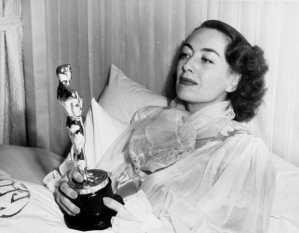 Joan Crawford hired a press agent to get her a win for Mildred Pierce. He kept her name in the news and planted items in the gossip columns. Still, she was too nervous to attend the ceremony, fearing a loss. Her agent, however, dispatched hair and makeup to her home while he covered for her: a fever of 104 degrees, I believe he said. She won, and when press raced to her house, she was sitting up in bed, full hair and makeup, sexy negligee, and an Oscar cradled in her arms. Success!
Nowadays you have to have swag. When The Descendants was up for an Oscar, it sent out personalized ukuleles to members. More perplexingly, the team behind Lincoln sent out turkey roasting pans. Universal sent out iPod shuffles that just happened to be pre-loaded with music form Les Miserables. Disney sent out toy bows and arrows for Brave. None of this is exactly legal, but studios are willing to bend the rules to secure wins, and why on earth would the gift recipient ever complain? So yeah, the Oscars are a complete sham – or worse: they’re a 4-hour movie commercial.

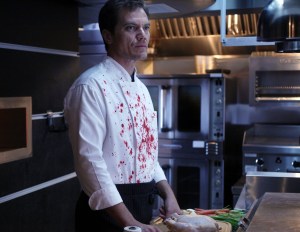 Then Lola’s new boss (Justin Long) drops an opportunity in his lap: an interview in Paris, which is conveniently where rapey ex-boyfriend (Michael Nyquist) lives. Two birds, one stone? The movie is billed as a “psychosexual noir love story” but all you had to tell me is “Michael Shannon.” That man makes some damn interesting choices and I’ll always go along for the ride.
 It’s hard to believe it was about three years ago that
 d remember just as Zach Galifianakis’ Joker suggested.
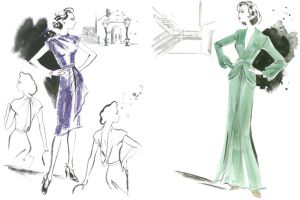 mother. She moves from cocktail parties with politicians to London’s air raids. But with such disparate films as Who Framed Roger Rabbit and Saving Private Ryan under her belt, you might say that Johnston was up to the task. We are first introduced to Cotillard in Allied as she’s wearing a purple dress ” I wanted her to look sexy and beautiful, but not in a “base sexy” way, so we put the sex [appeal] in the back because I knew we were going to see her first from the back. It’s a beautiful Italian fabric; very fine, very delicate silk with this silver shimmer through it, which picks up on the highlights on her.” Later, Cotillard is seen in a green evening gown “I wanted to do a classic column-style dress—very statuesque. I wanted the fabric to be quite liquid. When she’s on the move, she’s got this liquid quality to her,
 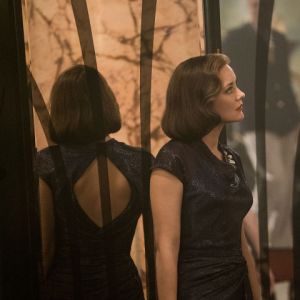 which silk satin does beautifully. Because it was nighttime, the light hit all those highlights [in the fabric]. Again, it’s this sort of old-fashioned quality, but it also had to be quite functional; she had to be able to run in it and do all those things. At one point she actually had a weapon underneath it, in the skirt, so there was a lot of stuff about that [laughs].” The costumes in Allied are indeed very beautiful, but that was something that sometimes felt disingenuous to me – like it didn’t quite fit into a movie set during wartime. The character does transition into more tweeds when she’s at home during the raids, but she’s always just a little too glamourous for my understanding of the time. Johnston has a long history of working with Allied director Robert Zemeckis and Steven Spielberg; she received her previous Oscar nomination for Lincoln.
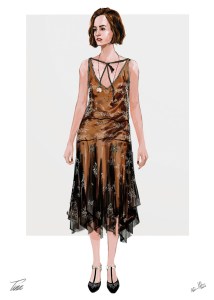 surreal, just what J.K. Rowling had ordered. She’s worked on Chicago, Memoirs of a Geisha, and Alice In Wonderland, for all of which she won Oscars. The secret to her success? “I’m controlling like that. I look at and approve every fitting, no matter who anybody is, and I am very controlling in how I want everything to look. It’s important: it matters, and you never know what you’re going to see. I learned a long time ago that you can’t control what happens with pieces you care about unless you’re there, so I’m there.” Fantastic Beasts takes place in 1920s NYC, in a universe where magic exists. “I love the fantasy stuff, I love that. That’s why I took on this movie. I like the challenge of it, and I like integrating fantasy into a period like this. You get to step out of it slightly and make something that’s a version of that time. Which is what movies have always done: in a way, they glamorise time.” How does she get her inspiration? “I reread a couple of [F Scott] Fitzgerald books,
 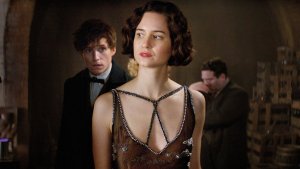 which are always fun to go back to because he’s very descriptive about the frenzy and the romance of the period. It has so much heart that it’s helped me, and this story has so much heart.” She tracked down period pieces from all over the world, hunting in all the best costume shops, but lots had to be made from scratch as there just aren’t a lot of period wizarding outfits to be had, no matter how hard one scours. Eddie Redmayne’s signature peacock blue overcoat is one-of-a-kind.
 character, and each costume had to be built around the padding. “The performance costumes had a very specific aesthetic. They were overblown and a lot of her clothes she would’ve made herself or her friends made, so there was an amateurish feeling about them. But then also the way she dressed in her daily life had that quality of being childish and over-decorative.” Boyle used a consistent colour palette of “naive pastels”to bring Florence to life, and to delineate different costumes for different aspects of her life, all of which were fairly theatrical. Stephen Frears is full of praise for her work: “I barely need to speak to her as I know what she’s doing is going to be dazzling. I’ve worked with her for 25 years, so I’m very lucky.” Florence made all sorts of garish costumes and it’s a complete delight to see them recreated
  on the big screen, along with her penchant for accessorizing within an inch of her life. “I worked incredibly closely with Meryl every step of the way, we had a lot of discussion early on about how she would express her inner emotions in her clothing. [Florence] was a supreme performer, so her clothes were gorgeously outrageous. They were high camp but with a softness so she drew people in. And she had no embarrassment about how she looked.”
 got the goods to back it up. Photos and footage of the first lady are so iconic that if even one brass button was out of place, people would notice. She worked with Chanel to get the famous pink suit down to perfection, even hand-dying the wool to achieve the perfect shade of pink (the actual dress is preserved in the National Archives and wasn’t available for consultation). Historical accuracy was important, but for filming purposes, so was duplication: “All the “original” pieces are handmade in our workshop. We needed to create more than one – we made five of the
  pink dress, for instance. Chanel supplied the buttons, the chain of the inside jacket, (“couture” detail for the weight of the jacket, and a signature…), and a label, in case the jacket would fall down [onto] the floor.” Since the film jumps between colour and black and white, the dresses sometimes had to be done in different shades so that our eye would not perceive a difference. Every piece in the film was true to Jackie herself “The elegance she showed in every situation, even while relaxing on holiday, proves this: she was never captured by surprise not looking perfect.”
 dresses, after all? It would be an unlikely win for sure – in the past 20 years, 17 have been period films, 2 were fantasy-based, and last year was post-apocalyptic Mad Max. It might be argued that Chazelle’s La La Land doesn’t exactly feel strictly contemporary. With so many references and throw-backs to old Hollywood musicals, La La Land exists in a stylistic world of its own. Mia and Seb wore classic, timeless looks, and Zophres embraced a fusion of styles. “In my mind, there’s a bit of an arc to Mia. It starts off grounded in reality and by the time you get to the epilogue, she’s wearing that fantasy
  white dress when they’re dancing in Paris. I put a lot of fabric and I wanted it to feel like air.” Zophres looked to old Hollywood for inspiration and was deeply rewarded. “The two models for Mia were Ingrid Bergman (a poster adorns her bedroom wall) and Judy Garland. I found a pink halter dress for one of the montages that’s similar to the one Ingrid Bergman wore for her Hollywood screen test. For the Planetarium peak, Damien and I both landed on green because we both loved the image of Judy Garland in ‘A Star is Born,’ where she wears almost like a jade green dress.”
 decide that since they’re so good at pretending, they may as well get married in real life too. They’re warned that “field romances” rarely prosper, but critics be damned, they marry anyway, with London blitzing away in the background.
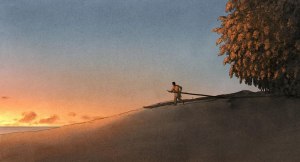 retiring music throughout, but manages to speak directly to your heart. That’s sort of the catch with this film, you have to let go of the normal film-going experience, and just feel your way through this one.
 trial aren’t wrong, they’re explored with new understanding, through a lens of his being a black man, sort of, but not really.
 the LAPD be acquitted in he Rodney King beating. Here was a chance to right that wrong and make the system work for a black man for once. Everyone conveniently forgot that OJ had spent his entire adult life distancing himself from the black community and they made him a civil rights hero. His lawyer, Johnnie Cochran, played the race card and he played it hard “dealt it from the bottom of the deck” it’s said. And he got off. But instead of relishing his incredible good luck, OJ’s life continued to derail until he found himself in court once again, this time found guilty and sentenced to some 33 years in prison, whether or not his crimes truly warranted it. This, again, was retaliation rather than justice.
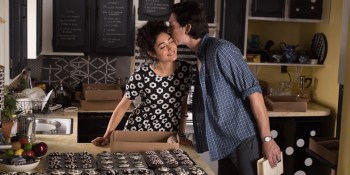
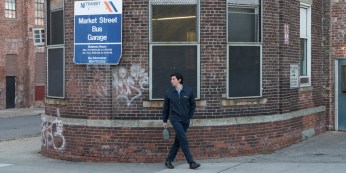 Paterson (Adam Driver) is a conscientious bus driver. He doesn’t even loathe his passengers, which I find hard to believe. He’s not exactly immune to daydreaming; he writes poetry, thinks it up while driving, writes it down on his breaks in his secret notebook. My first impression was that he isn’t much of a poet – writing words in an uneven column does not a poet make. But he chews on them, refines them, until they start to sound like true beauty.
 berries, the fat being anything from whitefish, or reindeer tallow, or moose, or walrus, or cariboo, plus sugar, milk, and Crisco.]
 ASSHOLES WATCHING MOVIES