

This movie needed to be written by someone who got past the first lecture at the M. Night Shyamalan school of plot twists. Or better yet, someone who didn’t make 12-year-olds talk like pretentious idiots and make their principal respond to the kids using flower child slang.
Actually, the principal was mildly entertaining, if I’m being honest, even though his character was just one in a long line of tired cliches this movie threw at me. Clueless mother and her secretly kid-hating boyfriend, a school bully who’s a dick for no reason but will come around by the end, and a bunch of random poppy songs that the kids probably stopped listening to six months ago, with the Strumbellas’ contribution agonizingly censored to sing about “dreams” and “hearts” instead of “guns”.
This movie has absolutely nothing to offer to adults and even the hordes of tween terrors in attendance seemed restless during my screening. The first few fart jokes got a reaction, but after a while the kids stopped giggling at the rude sounds that everything seemed to make, including school bells as well as a cartoon gorilla landing on a zombie driving a motorcycle. As well, the big twist confused the kids both in front of and behind me, probably because it was contrived, unnecessary and rendered the movie even more nonsensical, and I would not have thought that to be possible until it happened.
Visually, there are interesting animated bits and some creative and colourful pranks that function as diversions, as long as you don’t think about any of it too much. Not only are the pranks impossibly large to have been pulled off overnight, how do these students gain entry into their school after hours, spend entire nights inside undetected, and pull these all-nighters for weeks on end without dozing off in class once?
It would be generous to call Middle School a lazy and half-baked adaption of a popular book series. Incidentally, I had to drop in the “half-baked” reference because the film painstakingly identifies Lauren Graham, the clueless mom, as a sous-chef, and then I swear she was making beef-a-roni in a food processor at 6 a.m., which must qualify as professional misconduct. And that’s not a one-off thing. The Middle School experience is 90 minutes of incomplete thoughts and unanswered questions.
Middle School: The Worst Years of My Life gets an F and a month’s worth of detention, and even that is too lenient.
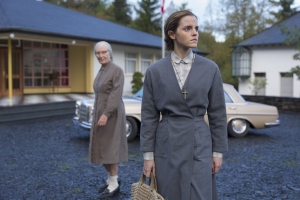 goes, putting herself at the mercy of a nutbar pedophile cult leader and his woman-beating cronies. This is the kind of movie into which you can never lose yourself entirely because you keep pulling yourself out of it to yell at the protagonists. You know in a horror movie the whole theatre is practically yelling “Don’t go in there” but of course she goes in there, even though we all knew better? And she gets diced into a million bite-sized pieces? Well this is one of those movies, except it isn’t a horror, and there’s no excuse for doing what it does. Bad writing, I suspect, and a movie that doesn’t really know what it wants to be when it grows up. With two idiot protagonists who keep making the dumbest decisions ever, you won’t care whether they live or die. And for a film that’s trying to shed some light on a pretty gruesome chapter in Chilean history, it’s also succumbing to the misplaced love story temptation. Because nothing overcomes a cruel dictator like True Love between nitwits.
 outside of it would have time catching up to them in a hurry. Inside their cozy little loop, they can be as peculiar as they like without repercussion. Or they could until a peculiar gone rogue (Samuel L. Jackson) invents monsters to hunt them. That’s why Abe (Terence Stamp) chooses to live outside the loop – true he has to leave behind his love, but he keeps her and everyone else safe by hunting the monsters in turn. But in his old age, Abe meets an ugly demise and his eyeless body is discovered by his teenaged grandson, Jake (Asa Butterfield ), the only one suspicious enough (or peculiar enough?) to avenge his grandfather’s death.
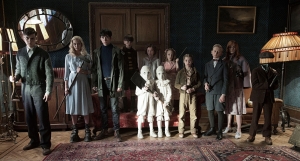 black man he’s cast in a leading role EVER, and you know he’s playing a villain. Jackson aside, Tim Burton’s casting takes on a very pale shade of white. His sets may be designed in technicolour but Tim Burton himself only dreams in caucasian. And it’s not really Tim Burton’s fault. We’re the dummies who have accepted this unthinkingly for years. He’s had huge ensemble casts with not even a tan among them and I for one haven’t even thought to question it.
 Africa. The whole point of this film is rooted in poverty. A chess club is started in Katwe because of poverty – because mothers are too afraid of medical expenses should a child break a bone during soccer. So a board game is just more appealing. One of the big draws in getting the children to come in and learn the game is that the chess is served up with a free cup of porridge.
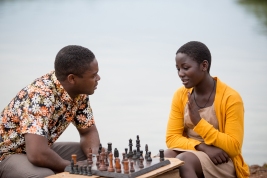 enough to represent Uganda internationally. As she begins to win, and to travel, she glimpses the life that could be hers if her chess game complies. But now that she’s playing not just to win, but to change her life, and support her family, it’s a lot of extra pressure any little girl’s shoulders.
 Disoriented. I walked out of the theatre disoriented. Was it the strobe light effect while the power failed? Was it the glass shards being pulled by Kurt Russell out of his own foot? Was it the bone sticking out of a redshirt’s leg? Was it that 11 people died and I wondered how the other 115 on the rig survived?
 Mike Williams (Mark Wahlberg) gets bloody. Jimmy Harrell (Russell) gets bloodier. The stand-in for greedy BP, Donald Vidrine (John Malkovitch), does not get as bloody as you’d hope. They are some of the lucky ones. Deepwater Horizon takes us into the heart of the mess. Tons of mud, oil, fire, explosions, and rag dolls flying all over the screen. It is hard to watch but not too hard to follow. We are provided with title cards and a grade school explanation of the Deepwater Horizon’s mission. They help the exposition fly by so we can get to the destruction faster.
 starts believing it, truly believing that her beauty is important and holds power over other people, that’s when things start to bubble.
 up with that head-stomping scene in Drive. And all the other scenes in Drive. I described Neon Demon to Sean as “less plot than Drive, and with super models” and also as “this year’s weird movie” to which he replied “Beasts of the Southern Wild weird?” and I answered “No, more like
  not really either of those two things. Surprise third option! I definitely didn’t hate it. Lord it has some of the coolest images I’ve seen in a film, ever. Gorgeous. Stunning. It’s one of the boldest things I’ve ever seen on film and I’m giving lots of credit to Refn’s cinematographer Natasha Braier (what! a female cinematographer??) Together, Refn and Braier create an unforgettable world that is hyper-real, extreme in both its beauty and its grit. The colour palette tells a story all on its own, progressing seamlessly from beginning to end.
 found it to be kind of empty. Like there’s obviously an allegory here, about our culture’s emphasis on female beauty, and on a certain kind of white girl skinny beauty in particular. And the dangers of narcissism. And female cattiness, which I almost hate just on principle. But this movie didn’t make me think. Like, at all, beyond “Oh, that’s gross.” So treat it like a high fashion magazine with pretty pages to flip through. I just can’t give it much more credit than that.
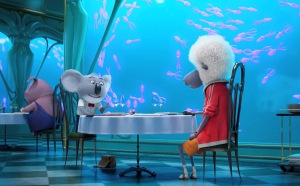 living. The theatre’s bankrupt. He hasn’t had a successful show in – well, maybe ever. The bank’s about to swoop in and take it from him, so in a last ditch effort to save it, he plans a singing competition.
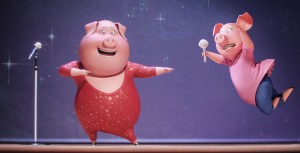 Gunther, a flamboyant dancing pig (Nick Kroll) partnered with Rosita, a shy momma pig with a big voice (Reese Witherspoon); an arrogant crooner of a mouse (Seth McFarlane); and a timid teenaged elephant with stage fright (Tori Kelly).
 Catrin (Gemma Arterton) hired to write “slop” (ie, the female dialogue) appeases him by enlarging the role of the drunk uncle just for him. Convincing her boss Tom (Sam Claflin) to let her do this is as infuriating and degrading as you’d imagine – until he starts to fall in love with her, of course.
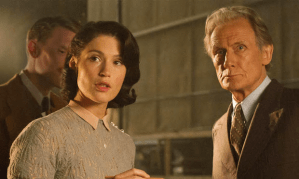 She mustn’t get too attached to feeling useful or creative. The war makes everything tenuous.
 The good news is, it’s on Netflix now, and you can satisfy your curiosity as to how Norwegians handle disaster flicks. The easy answer: a lot like us. Sure they sound a bit like the Swedish Chef (yes I really am this ignorant!), but they’re privy to all the same tropes that we are:
 geologist who knows what’s coming, only no one will believe him. Classic case of ignored scientist syndrome. His wife Idun (Ane Dahl Torp) and son Sondre (Jonas Hoff Oftebro) are at a resort hotel in town. He and his young daughter Julia (Edith Haagenrud-Sande) are of course elsewhere so of course when the alarm finally does sound, it’s too late for most, and this family will have to further test the odds by dividing them.
 ASSHOLES WATCHING MOVIES