
Sandy Powell is already a renowned costumer designer: she was awarded the  OBE (Officer of the Order of the British Empire) in the 2011 Queen’s New Years Honours List for her services to costume design and the film industry for her work on films such as The Crying Game, Rob Roy, The End of The Affair, and The Other Boelyn Girl. She’s been nominated for an Academy Award 12 times already and won three – for Shakespeare in Love, The Aviator, and The Young Victoria – but she’s not up for one this year, she’s up for two!
Comparing her Oscar-nominated efforts for 2015, Powell said “On ‘Cinderella,’ the biggest challenge is living up to everyone’s expectations: How can you do another version that will be as iconic and not disappoint. On ‘Carol,’ the challenge was more time and money. Totally different worlds.” Different worlds, but she made her mark on both. Powell has a long history of working on period pieces, with Harvey Weinstein noting “Sandy’s great gift is her ability to make historical costumes look contemporary. She manages to be both true to the  period and modern.” Powell would agree. “Unless of course the film requires it, I’m not interested in an exact replica of the period. I look at the period, how it should be, how it could be, and then I do my own version.” And that’s how you win awards.
A costume designer thinks up the costumes – not just what a character might likely be wearing, but how that outfit could enhance the character’s personality, or reflect a time period or social status. There’s often a lot of thought to colour – indeed, colour can reflect the plot, or help us distinguish good guys from bad guys. Tone and texture help create the world a character lives in. A costume may also distort or enhance the character’s body – Julia  Roberts famously thanked a costumer for giving her cleavage in Erin Brockovich. Sandy Powell, while working on Interview with the Vampire: The Vampire Chronicles, said “It was different. Tom Cruise was lovely to me, but there were many discussions about his height in relation to Brad Pitt’s. There are always vanity concerns.”
The costume designer has a whole wardrobe department working under them to realize the film’s look. They’ll also be consulting and influencing the makeup and hair stylists as well. A wardrobe department consists of set costumers (usually for each of the lead characters), key costumers, and a costume supervisor. The tasks are split between the “making wardrobe”, the people who use the designs to create or acquire the costumes in pre-production (before filming) and the “running wardrobe”, the people who maintain costumes during filming and make sure they’re available each day of filming.
“As a costume designer,” says Powell, “you need to be able to sew. Not be the greatest tailor or sewer in the world but you have to know how things are constructed otherwise you can’t talk to your tailors and your cutters and your seamstresses. You have to be able to understand their job to tell them what to do. You can’t just not have any knowledge of construction.”
The assistant designer helps the designer with research, shopping, rentals and fittings for all characters; the designer is creating a vision which will be informed by all kinds of inspiration. The costume supervisor is in charge of  coming up with a realistic budget (Sandy Powell had a 2 million dollar budget for The Aviator!), keeping track of all the receipts, and managing the demands of the production schedule (like, which costumes will be needed on which day). The set costumer is in charge of costume continuity – if someone removes a sweater in the first part of the scene, it needs to stay off. And if someone is shot, their jacket needs to have a bullet hole thereafter. That kind of thing. The key costumer will supervise the set costumers and maintain the principle costumes for the lead actors’ wardrobes. The truck costumer is the person inside the wardrobe trailer at the shoot; they make sure the costumes for the actors are in their personal trailers\dressing rooms when they’ll need them, clean or dirty as the shoot requires. A dresser helps with fittings and alterations, and getting all those extras into their costumes.
There are dozens of people thinking about what jeans will do the job, and how they’ll look, and how distressed they should be, and if they need to be hemmed, and where to buy them, and if they’re affordable, and what wonders they’ll do for someone’s bum, and how to transport them to the set, and if they’ll need to be ironed or if wrinkly is more the thing, and of someone will need help wriggling into them, and if they’ll need to be washed at the end of the day, or if they’ll smell like horse, or need blood splatter. Someone did a piss-poor job of the jeans job on the set of War of the Worlds, because Tom Cruise, who played a lowly construction worker, was spotted wearing a $300 pair of jeans while operating a crane. Not bloody likely, and not likely to occur on Powell’s watch, either. Ever humble, though, she insists “a costume designer’s contribution is to help make some believable characters, that’s all.”
Sandy Powell is responsible for the beautiful look of Cinderella – and while Cinderella’s ball gown is obviously a showstopper, I was even more enamoured with Cate Blanchett’s eye-catching pieces.
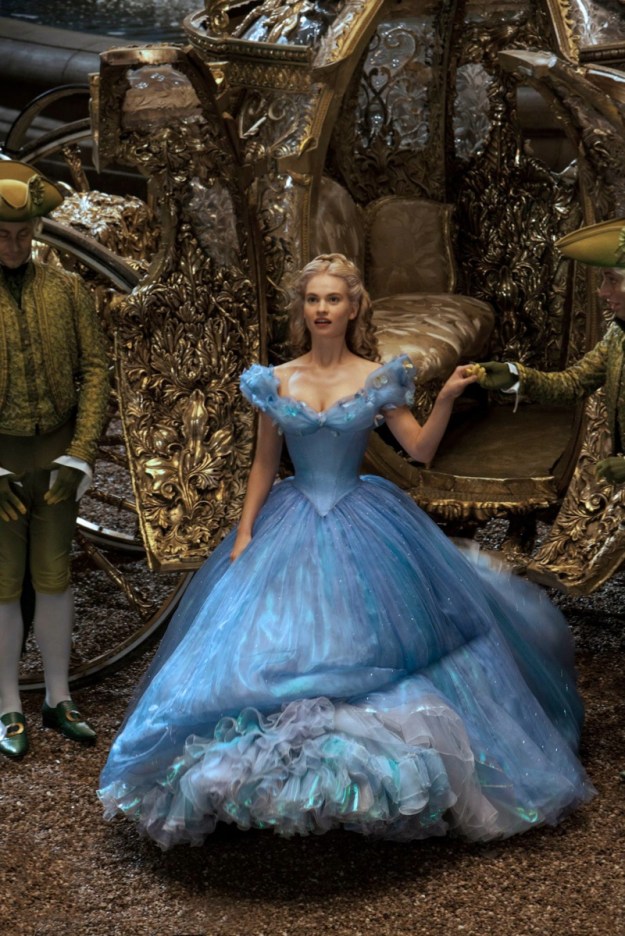
To make this one dress took Powell perhaps 4 to 5 months. “First of all, there’s a crinoline over a wire cage. Then there are petticoats with hundreds and hundreds of miles of frills to give it the volume and the lightness. On top of that are the really fine layers of fabric.” Those layers of fabric are not just blue, but greens and lilacs and aquas that together achieve that beautiful, perfect blue.

Between Cinderella, the fairy godmother, and the wicked stepmother, Sandy Powell used 1.7 million Swarovski crystals.
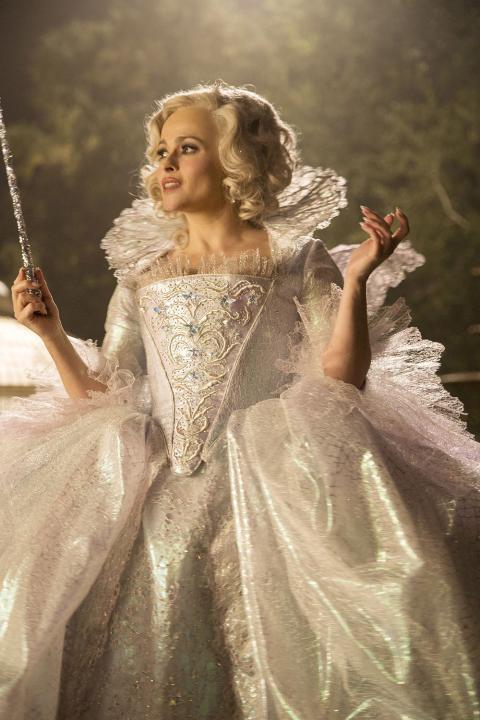
The fairy godmother dress actually had LED lights that made it twinkle.
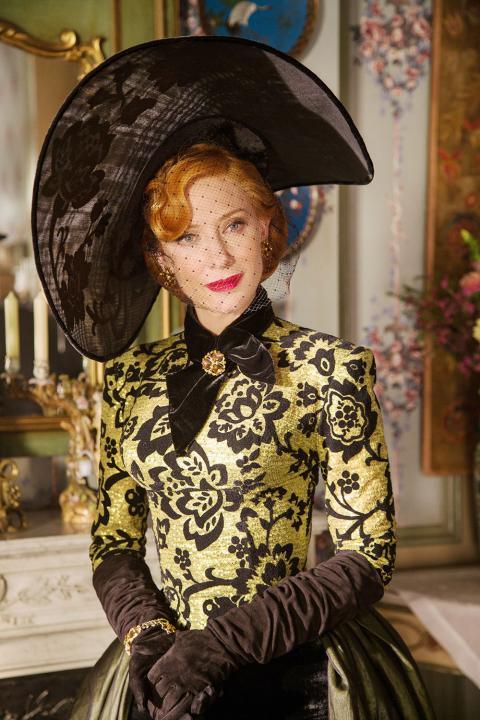
The wicked stepmother’s jewel tones had some surprising inspiration. “I wanted her to look like a traditional wicked characters. I based her on people like Marlene Dietrich and Joan Crawford in the 1940s as if they were doing a 19th century period piece, and getting it all a little bit wrong. I wanted her colors to be strong and I wanted always there to be an element of black, so she’s always wearing some black.”
And the shoe?

Powell visited the Northampton Museum and Art Gallery in England where she searched the archives for old, period shoes and found a beautiful pair from the 1890s that were “incredibly elegant and had a ridiculously high five-inch heel. I knew I wanted to use that shape—just in glass. They lent me the shoe. I made a 3D copy of it and worked with Swarovski to really get that shape and turn it into a faceted crystal shoe.”
But let’s not forget Powell’s equally stunning work on Carol.
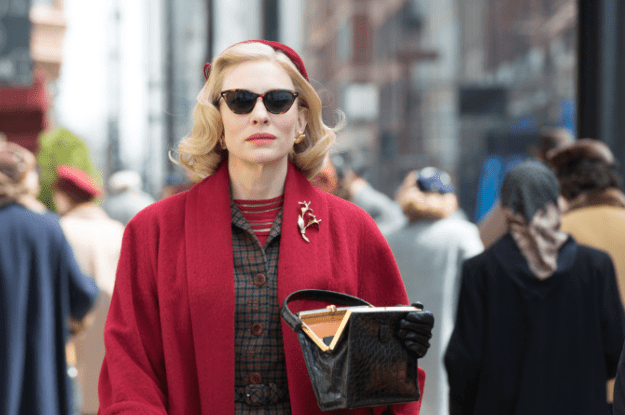
“For Carol, I looked at a lot of fashion magazines, including Vogue and Harper’s Bazaar, from the period exactly from the months that we were shooting — the winter months in 1952 going into 1953 — and that pretty much that gave me all the shapes, all the color tones, everything that I needed.”

“I looked at the specific fashion photographers like Gordon Parks, Clifford Coffin and Cecil Beaton, and if you pick up any magazine from 1952, that is the silhouette you will see. In order to  create that silhouette, I had to start with the undergarments. That’s not Cate’s natural silhouette — she doesn’t have pointed bosoms [laughs]. Believe it or not, a lot of the jacket shapes are actually padded over the hips to give that hip shape and the small waist and the bras provide that shape of the bosom. So you create the silhouette from the foundation garments and build the clothing over the top.”
But if you’re thinking she’s a shoe-in for the Oscar, I’m not quite confidant you’re right. She’s got strong competition from Paco Delgado for The Danish Girl, Jenny Beavan for Mad Max: Fury Road, and Jacqueline West for The Revenant. I don’t think anyone’s a lock in this competition!
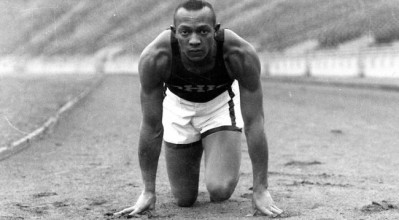 ocrisy by showing us the second-class citizenship of Owens even when he’s America’s hero. If that was the aim, Race falls well short. Painting Hitler and the Nazis as the bad guys is easy, and Race goes that route. But the real story is more damning and I wish Race had told it as it happened. At a political rally in October 1936, relatively soon after his triumphant return to the U.S. with four gold medals in hand, Owens said, “Some people say Hitler snubbed me. But I tell you, Hitler did not snub me. I am not knocking the President….but remember that the President did not send me a message of congratulations because people said, he was too busy.” Hitler reportedly shook Owens’ hand after his victories, while Franklin Delano Roosevelt couldn’t find the time to send Owens a congratulatory telegram.
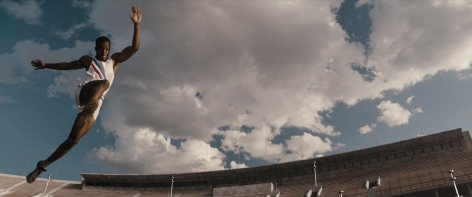 sing his amateur status he was reduced to racing against horses for show. Later, Owens got by as a dry cleaner and gas station attendant (though “got by” may be generous as he declared bankruptcy and was prosecuted for tax evasion). All in all, it’s a very sad statement. Today, Owens is rightfully regarded as a legend but it seems that during his lifetime he was not treated like one, to say the least. Race hints at that fate but doesn’t focus on it, and that’s a shame.
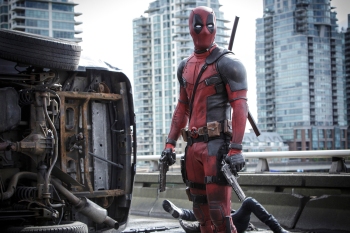 Deadpool delivers, plan and simple. It is big, loud and stupid, just like it should be. After all, the main character(a) is insane; (b) is immortal; and (c) knows he is a comic book character. There’s really not any need for pretense – we came to see craziness and that’s what Deadpool gives us, from start to finish.
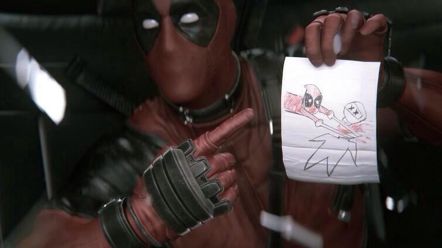 without another superhero origin story. It’s not necessary, it’s lazy, AND I’m pretty sure they already did Deadpool’s origin in Wolverine: Origins (though I’m also pretty sure they screwed it up). So Deadpool makes a misstep there but it’s forgivable since it keeps us laughing while it spins its wheels. And really, the comedy is the whole point anyway so it’s not a major complaint, it’s just my critical two cents.


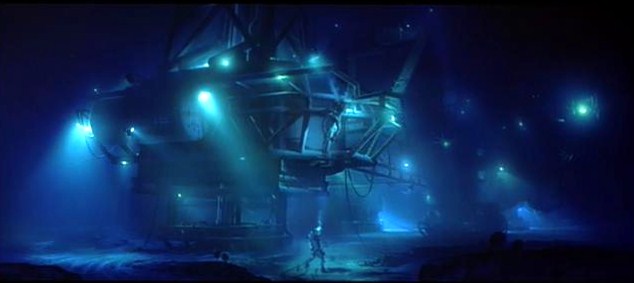
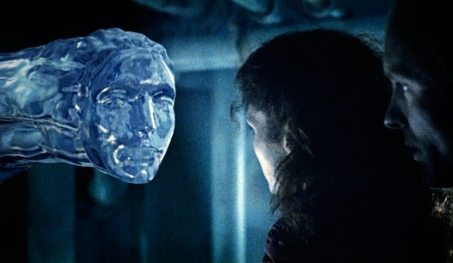 destroying waves to look right. Technology had advanced significantly by 1993, and so a special edition was released with 25 minutes more footage, including the ending as it was originally conceived. The CG effects hint at what is to come from Cameron and ILM (or, by the time the special edition was released, what had already come). The tentacle water effects in particular are very close relatives of the T-1000’s liquid metal goodness in T2 and they seem to hold up a lot better than most early CG (maybe because CG is used so sparsely in The Abyss).
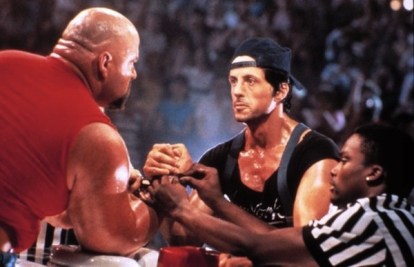 ch I just found out is on Netflix. Especially because Jay is still on oxycontin recovering from her back surgery.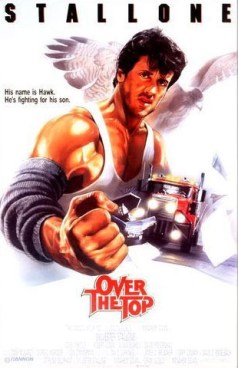





 completely imploded. Protests are aborted, physical injuries are sustained, lawsuits are commenced (Greenpeace v. Greenpeace!), turncoats are identified, and shots are taken liberally at one another. Essentially, it’s an episode of Big Brother starring a bunch of 65-year-old grouches.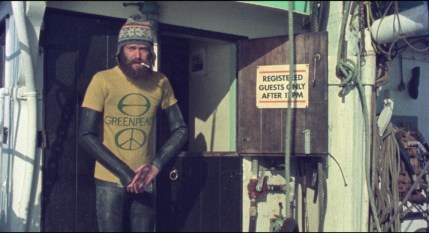
 ASSHOLES WATCHING MOVIES