
Monthly Archives: November 2017

Skull Makeup Tutorial Inspired by Pixar’s Coco

k7for2glzmz8mqdcanmhPixar’s Coco is about a little boy who crosses into the colourful Land of the Dead in order to resolve a family issue. To celebrate this movie’s release, and to learn a little more about the culture behind it, I visited local makeup artist Tammy Fonseca, and had my own transformation into a Catrina.

Dia de los Muertos is a national holiday celebrated in Mexico on the first two days of November. On November 1st, the boundary between the worlds of the living and the dead is believed to be thinnest. It is an occasion to celebrate your dead loved ones – not a time to be sad or scared, but to be joyous, as you would be on a birthday. Families make altars called ofrendas that are decorated with marigolds, photos, and ornate sugar skulls. They might bring gifts to their loved one’s grave, basically all the deceased’s favourite stuff. If you were visiting my grave, you’d have to pay music way too loudly, and toast with extra-dry martinis in my honour. If I was visiting my grandmother’s grave, I’d wear knit slippers and say shitty things about my mom. It’s just a nice way to remember the person you loved by doing the things they loved. You laugh and tell stories and play music.

If you get dressed up, a calaca is a skeleton, a calavera is a skull, and a calavera de azucar is a sugar skull (which is a frosted, skull-shaped treat made from sugar paste and colourfully decorated). The most famous calavera of all is “La Calavera Catrina,” a high-society skeleton lady dressed in a big flower hat, from a 1910 etching by Mexican artist José Guadalupe Posada. It was meant to remind us that money or no, we’re all the same in death. She has become the most iconic symbol of Dia de los Muertos. Since death is viewed not as an end but as the continuation of life, dead relatives are not mourned by celebrated. Painting your face as a calavera or catrina is a way of telling death you aren’t afraid.

This Mexican ritual is a loving tribute to their ancestors but is also an essential part of aa95ddf7325204f319fad2427ee0bd0c--book-of-life-sugar-sugarkeeping the old ways alive and vibrant in their culture today.  So when we watch a movie like Coco, or the similarly-themed The Book of Life, we can think about where this dazzling imagery comes from, and know that each of the bold colours in Coco’s vibrant palette means something:

Yellow – Represents the sun &unity; like in death, under the sun, we’re all the same

White – Represents spirit, hope & purity.

Red – Represents blood and life.

Purple – Represents mourning, grief and suffering.

Pink – Represents happiness.

A face with lots of purples may therefore be a tribute to someone more recently passed, or gone too soon, whereas a face of pink might mean that their loved one’s suffering is alleviated in death and the family is ready to celebrate and honour their life’s accomplishments.

Tammy is an accomplished makeup artist who got her start studying architecture. Now she draws blueprints of faces before she begins painting them. It took her 2.5 hours to paint mine.

DSC_0196

Tammy has been making people beautiful for a long time but started painting skulls when she was inspired by an episode of American Horror Story (The Walking Dead has also inspired her – guess what else she paints?). Aside from your typical horror, she’d love to get her hands on a comic book movie to really make her mark, and her dream is to work on a Cirque du Soleil production.

Tammy’s favourite celebrity makeup looks are Kate Winslet and Liz Taylor. A lover of art, she of course finds inspiration all around her, and when I asked about the temporary nature of her work, she was nonplussed: “people and bodies are my canvasses.” True, and yet I felt true sorrow when I watched it rinse down the drain of my shower. Her work has been featured in Imira and Luxe Ottawa Magazine. She looks to beauty bigwigs Lisa Elbridge, Vanessa Davis, and Argeni Pinal for inspiration.

I was really pleased to have met Tammy and to experience what it’s like to sit in the makeup chair and become someone else. Now it looks like I belong in the world of Coco, which is out in theatres this week. Feel like seeing how the sausage is made? You can watch a slideshow here.

Wonder

Auggie is a very special little boy. Born with a genetic condition called Treacher Collins syndrome, Auggie’s facial deformities are the least threatening of the complications but they’re what make him look so different. He’s most comfortable when he’s wearing an astronaut helmet that keep prying eyes and hurtful comments at bay. For the first ten years of his life he’s had countless surgeries and has been schooled at home, but he’s about to start middle school for real, and a classroom of students is more daunting to him (and his mom) than any operating room.

Wonder is based on the wonderful YA novel by R.J. Palacio, which you should, should, should definitely, definitely read. But happily, this is a rare case where the movie does MV5BMTIwOTUwNTEtYzMwNS00N2YxLTg0ZWYtNzM0YzVjOWYwZWM5XkEyXkFqcGdeQXVyMjg5NDY3Mw@@._V1_SY1000_SX1500_AL_the book justice. And even happilier, the movie doesn’t suck, period, which was a major concern of mine. It seemed far too easy to just let it coast on its sentimentality. But while director Stephen Chbosky doesn’t have a lengthy track record to ease my worrisome nature, he does have one credit under his belt that’s all I really needed to hear: he adapted and directed The Perks of Being a Wallflower, which he’d also penned.

Wonder is a much different beast, however. First, it necessarily involves casting the perfect but very young star. A bad child actor in a lead role will ruin the whole thing, and in this case you have to find someone who can convey a whole range of complicated emotions from underneath a mask of scars. Chbosky went with Jacob Tremblay who’s already proven his chops with the most trying and powerful of roles in Room; Chbosky calls him “a once-in-a-generation talent” and I think he may be right. But we can’t discount the fact that Chbosky surrounds Tremblay with talent.

The secret to Wonder’s success, both in novel and in film, is that yes, it tells the story from the perspective of a sweet and brave 10 year old boy who’s been through hell and is still going through it. BUT it also shares the stories of the people around him. His mother Isabel (Julia Roberts) has had to pause life itself in order to become his warrior. His father Nate (Owen Wilson) copes with humour and cries by himself. His big sister Via (Izabela Vidovic) feels like a mere planet revolving around Auggie, the sun. A disease like Auggie’s is a family affair, energy-stealing, all-encompassing, leaving no one unaffected. And no one likes to complain about that because it seems petty in the face of something life-threatening, but it’s true and Palacio’s book as well as Chbosky’s film really add legitimacy to a family suffering as a unit. Even Auggie’s only friend isn’t untouched – being his friend is a social sacrifice most 10 year olds won’t be strong enough to make. Another formidable young actor, Suburbicon‘s Noah Jupe, lands and aces this role.

Wonder is not about the suffering though; that would be too easy. It’s about overcoming that suffering, in ways that are clunky and ungraceful and sometimes accidental. That’s why Auggie’s family seems so real, and why so many real families with sick kids can relate to the material. It’s emotionally raw stuff and you may find that it touches a nerve. But it’s got a takeaway message of positivity that’s irresistible, and will help justify the numerous soggy kleenexes in your lap.

The Hitman’s Bodyguard

The following paragraphs will make you think I haven’t seen The Hitman’s Bodyguard; let me assure you, I have. But I will struggle to summarize its plot. Or even locate the plot from between all the gratuitous explosions. I think it goes like this: Ryan Reynolds was once the caviar of bodyguards, but he let some VIP get shot in the brains, and now he’s been downgraded to the spam of bodyguards, which is really, really embarrassing and he’d do just about anything to be caviar again.

Meanwhile: Samuel L. Jackson is a hitman who is safely in prison. BUT he’d also be an excellent witness in an international court of law against a crazed, genocidal Hitmans-Bodyguard-The-5-NewsBelorussian dictator (Gary Oldman). So he cuts a deal: if they let out his wife (Selma Hayek), he’ll give testimony. The only catch is that every other witness has been systematically murdered. Sam Jackson nearly is as well, but one of Ryan Reynolds’ disgruntled CIA exes calls him in at the last minute to try to get Jackson to the Hague in one piece.

I suspect that this movie is bad because it never slows down long enough for you to ask yourself whether you’re enjoying things. The thing feels like it’s been edited by a two year old high on 5 juice boxes. It relies HEAVILY on the odd couple banter between Ryan and Sam, but if this is a Deadpool wannabe, it should wannabe harder. I feel like I just ran an obstacle course and I’m just so grateful to have crossed the finish line I cannot recall a single event along the way. Bleeding eardrums, I think. Some tulips? A car that smells like ass. The Hitman’s Bodyguard may not be an actual movie but just a compilation video of Reynolds’ and Jackson’s greatest hits. Lots of motherfuckers. Lots of explodey explosions. I refuse to overthink this one.

Justice League

“What movie are you seeing?” the waiter asks.

“Justice League!” I answer with all the enthusiasm of someone who has been waiting for this night and all the sheepishness of someone who is fully aware that this movie is going to suck.

“I didn’t even know that was out yet. Are you a fan of Marvel?”.

“DC,” I quickly correct him.I remind myself not to be offended, that it’s an easy mistake for anyone with a life to make.

“Whatever,” he replies.

That’s the thing though. It’s not whatever. For many comic fans, the rivalry between the two publishers is as bitter as that between Star Trek and Star Wars. And I’m a DC guy. It’s not that I can’t admit when Marvel does something right. I can admit that their movies- especially within their respective shared universes- have generally been much better than DC’s. It’s just that Iron Man, Thor, Captain America, and Spider-Man will never mean as much to me as Superman, batman, Wonder Woman, Flash, Cyborg, or even Aquaman.

I’m such a DC guy that I could even find something to love in the colossal messes that were Batman v. Superman and Suicide Squad. I have rooted for this universe since it began with Man of Steel and celebrated when they finally did something amazing with Wonder Woman. But there’s something about Justice League that’s hard for even me to defend.

Maybe I’m just getting tired of making excuses for mediocre movies. Or myabe it was just different sitting next to Jay. I couldn’t help putting myself in her shoes and worrying about how painful this must be for her. Because a fan can find lots love if they’re feeling generous but those who haven’t read the comics are sure to have a harder time. Those who are unfamiliar with the Flash, Aquaman, and Cyborg are counting on this movie to give them a reason to care about them  and it’s here where Justice League fails the most.

Ben Affleck continues to be a much better Batman than I ever would have expected him to be and he’s in most of the film’s best scenes. Wonder Woman continues to feel like a fully realized character mostly thanks to Gal Gadot’s performance and all the good work that she and Patty Jenkins did in her much better stand-alone film. The new characters are a little more awkward. Ezra Miller’s charm goes a long way in making Barry Allen/The Flash likeable (although, for the record, TV’s Flash is better) but his backstory feels vague and rushed and we don’t know nearly enough about who he even is or what makes him special. Aquaman and Cyborg get barely any introduction at all. They’re just there.

The good news is that Justice League is shorter and more focused than Batman v. Superman and Suicide Squad were and is almost never boring. The bad news is that it’s not nearly as exciting as it should be, especially considering what a dream come true this big-screen live action team up really is for me and so many others. There’s just not nearly enough attention paid to what makes these characters great and what’s worse is that there is even less attention paid to their relationships with each other. The Zack Snyder era of DC movies has not ended on a high note.

Murder on the Orient Express

Hercule Poirot is a world-renowned detective, known almost as much for his venerable mustaches as for his excellent deductive skills. On the way home from solving yet another case successfully, his train gets stuck in the middle of nowhere thanks to an avalanche, and that’s not the worst thing that’s happened aboard the Orient Express. Overnight, there has been a murder most foul. One of the dozen or so passengers is dead, and another must be his murderer. With Hercule Poirot unluckily aboard, can his or her identity remain secret? It seems unlikely.

MV5BMTU4NjU5NDYxNl5BMl5BanBnXkFtZTgwNzgyODg0MjI@._V1_SY1000_CR0,0,1497,1000_AL_Kenneth Branagh directs himself as Agatha Christie’s famed Poirot, and he’s equally right in both roles. He leads an all-star cast including Daisy Ridley, Johnny Depp, Josh Gad, Judi Dench, Michelle Pfeiffer, Penelope Cruz, Willem Dafoe and more. The only thing you can complain about with such an ensemble is that we spend precious little time with any one of them – Dench is particularly underused.

Branagh shoots on 65mm film and the result is luxurious and beautiful; I could barely take my eyes off the scenery, and indeed, the script gave me little reason to. I’m still not sure what genre of movie Murder on the Orient Express was trying to be. There might be a mystery at its core, but the audience feels no particular sense of urgency in solving it. There’s almost zero tension, which seems like a failure when a murderer is trapped among a gaggle of vulnerable potential victims, each with a neck ripe for slicing. And though I commend Branagh’s attempt at making Poirot sag a little under the pressure of his special skill set, the character seems largely untouched by the story unraveling before him. Leached of the emotional heft probably its due, the story never delivers any punch. There’s no real suspense. So while every shot is perfectly composed and the film is a stylistic triumph, it just doesn’t do justice to Christie’s plot.

A Bad Moms Christmas

Bad Moms gets one thing right: moms get saddled with making the holidays perfect. The cooking, the cleaning, the gift buying and gift wrapping. Christmas, or whatever you celebrate, wouldn’t happen without the women in your life pulling it together. And making the holidays wonderful for everyone else makes it less wonderful for yourself.

They’re called boundaries, people, and they’ll go a long way in making not only the holidays more tolerable, but your relationship with your mother more healthy. Boundaries are a gift you give yourself. For your own sanity, I suggest they be plentiful underneath your tree this year.

Amy (Mila Kunis), Kiki (Kristen Bell), and Carla (Kathryn Hahn) are back and they’re “taking back Christmas.” Apparently what we grown women have secretly been missing from the holiday season: dry-humping Santa and getting drunk at the mall. Um, nope. Yet a-bad-moms-christmas-1920x1080-christine-baranski-mila-kunis-susan-10345again, this movie misses its mark with me. I think it’s pandering and condescending and incredibly obvious that was written and directed by MEN. But I’m not a Bad Mom, I’m a Good Aunt. And the role of Good Aunt is really easy: you buy lots of presents, you let them get away with everything three notches above murder, and you give them 100% of your time and attention once or twice a month. Being a mom, bad or not, is infinitely harder because parenting is about the details. So if carving out 104 minutes to sneak away to one of those fancy movie theatres that serve wine is all you can muster for yourself this holiday season, have at it.
The Bad Moms are confronted not just with the Mount-Everest-sized expectations of a season hallmarked by extravagance and perfectionism, but by the presence of their mothers, who are of course overbearing shrews (Cheryl Hines, Susan Sarandon, and Christine Baranksi). I don’t really relate to that because a) my mother dotes on her grandkids but is actually respectful of people’s space – my sisters will literally fight over whose house she’ll be waking up in come Christmas morning, and b) I am, again, a Good Aunt, and not a Bad Mom, which means my mother wouldn’t even notice me over the holidays unless I deliberately walk between her and one of her grandkids. Good Aunts are persona non grata during the holidays; you’ll notice the film never once cuts to a Good Aunt who is relaxing on her all-white couch, sipping spiked hot chocolate, surrounded by very fragile and carefully curated gold ornaments. Holiday movies will have you believe that children are the only reason for the season. And that harried single mothers who, as recently as 6 days ago, have “taken back Christmas” must still provide a home that looks as though Pinterest has tastefully regurgitated Christmas all over it for her darling kiddos.

The magic of Christmas is a hard thing to define and impossible to bottle. So whatever you do to make the holidays special, thank you. And whatever you do to cut corners, good for you. And if you’re desperate enough to make this movie be part of your celebrations, that can be our little secret.


Harrison Ford

So I’m watching the Joan Didion documentary on Netflix the other day and who pops up but Harrison Ford. Double take. Harrison Ford?

Harrison Ford was born in Chicago in 1942. His paternal grandparents were Irish Catholic and his maternal grandparents were Jewish immigrants from Minsk. When asked which religion he was raised in, he often answers “Democrat” but if you press him, “As a man I’ve always felt Irish, as an actor I’ve always felt Jewish.”

Ford was active in the Boy Scouts of America and earned its second-highest rank, Life Scout, which is how Indiana Jones came to have the same rank in The Last Crusade. He worked at Napowan Adventure Base Scout Camp as a counselor for the Reptile Study merit badge. No wonder he was a “late bloomer.”

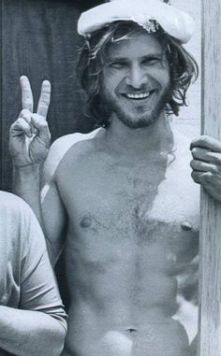
He studied philosophy at Ripon College in Wisconsin and took a drama class in his senior year as a way to get over his shyness. He caught the acting bug and moved to 727f29dfc0dc6a384507c9b1f560298c--harrison-ford-young-harrison-ford-carpenterL.A. but it was a long, long time before the acting bug caught him back. He had a contract where he did a lot of background and bit parts, and most of those are lost to the either; his first known role is of course uncredited but he played a bellhop in Dead Heat on a Merry-Go-Round (1966). His first credited role was a year later in the western A Time For Killing – he appears as Harrison J. Ford. He needed the initial to distinguish himself from a dead silent film star but in fact, Harrison does not have a middle name and so the J. stood for nothing and was soon dropped.

Frustrated with the crappy roles, Ford became a self-taught carpenter (he had a wife and two sons to support). He became a stagehand for a little band you may have heard of, The Doors, and he built a sun deck for actress Sally Kellerman, a recording studio for Brazilian band leader Sergio Mendes, and did a home renovation for, ahem, Joan Didion, with whom he remained close friends. He also expanded an office for a certain Francis Ford Coppola who then found roles for him in his next two films, The Conversation (1974) and Apocalypse Now (1979) in which he played an army officer named “G. Lucas.”

Coincidence or not (not), George Lucas hired Harrison Ford  – get this – to read lines with actors who were auditioning for his next film, Star Wars. Lucas was won over by Ford’s excellent line reading and eventually offered him the part of Han Solo, Harrison Ford and Carrie Fisher on Fifth Ave outside The Plawhich would make him a star of a franchise that has now spanned 5 decades. Jesus. He was paid somewhere in the neighbourhood of $20M for the last installment, plus a 0.5% share of revenues; he was paid $10k for the first one, and was glad to have it.

Then of course came Indy. Spielberg wanted him from the get go, but Lucas, having just worked with him in both American Graffiti and Star Wars, preferred Tom Selleck. Selleck fell through and another iconic role landed in Ford’s lap, not to mention another decades-spanning franchise (with another scheduled for 2020 – with a new Blade Runner currently in theatres, this guy has to hold the record for the most absurdly spaced sequels ever).

Sequels are a theme common to his personal life as well – he is, after all, on his third wife. He was married to Mary from 1964-1979 and they had two sons, Benjamin and Willard. Then came Melissa (who wrote the script for E.T. – Harrison had a cameo as the school principal but it was cut), married from 1983-2001, with whom had two more kids, Malcolm and Georgia. Presently he’s with #3, Calista Flockhart, whom he met at the 2002 Golden Globes. He got around to proposing on Valentine’s day 2009 and they were married in June 2010 in Santa Fe, because that’s where he was filming Cowboys & Aliens at the time. They coparent her adopted son Liam together. He’s got 3 grandkids.

Harrison Ford has adopted many interests. From the set of Indiana Jones, he took up an interest in archaeology and now serves as a General Trustee on the Governing Harrison-Ford-Calista-Flockhart-Cute-PicturesBoard of the Archaeological Institute of America. He’s also the  vice-chair of Conservation International, an American nonprofit environmental organization, which as led to two species being named after him: a newly discovered spider now called Calponia harrisonfordi, and an ant henceforth known as Pheidole harrisonfordi. He also got to name a butterfly, and he named it after his daughter, Georgia.

He’s also really into flying. He’s a pilot, licensed to fly planes and helicopters. He’s got a big ole ranch in Jackson Wyoming – 800 acres, although he’s donated half as a nature preserve. Local authorities often call on him to pilot rescues for distressed hikers (one such rescue was later mortified she learned she’d barfed in Harrison Ford’s plane). He started his training in the 1960s but couldn’t afford the $15\hour cost; it wasn’t until the mid-90s when he bought himself a used plane and asked his pilot to give him lessons. This time his money held out until he was a confident pilot. He’s had a few critical incidents; in 2015 he broke his ankle and his pelvis in an accident. Not to make light, but he’s also been injured on the Millennium Falcon, and that one was definitely grounded at the time.

Harrison Ford has been nominated for an Oscar just once, for Witness, but lost to William Hurt.

Star Wars costar Alec Guinness could never remember his name:  “I must off to studio and work with a dwarf (very sweet – and he has to wash in a bidet) and your fellow countrymen Mark Hamill and Tennyson (that can’t be right) Ford. Ellison (? – No!) – well, a rangy, languid young man who is probably intelligent and amusing. But Oh, God, God, they make me feel ninety – and treat me as if I was 106. Oh, Harrison Ford – ever heard of him?”

After having lunch with friend Jimmy Buffett, Ford found himself jealous of his stud. So, at the age of 55, he went to the mall and had his ear pierced at Claire’s Accessories, just like all the 11 year old girls. Speaking of Jimmy Buffett, Ford once provided whip cracking sound effects on Buffett’s song Desperation Samba (Halloween in Tijuana).

The Mosquito Coast is his favourite of his own films.

He is credited with “creating” a fan favourite scene in Raiders of the Lost Ark (1981) because he was suffering from a bout of dysentery at the time of filming: during the scene in Cairo with the swordsman in black, the script called for a much longer fight, but because he was sick, he quietly asked director Steven Spielberg if they could shorten the scene. Spielberg’s reply was that the only way it could be done would be if Indy pulled out his gun and “just shot the guy”. The rest of the crew, unaware of the change, laughed heartily, and it made the cut.

He plays golf with Bill Clinton and went to high school with Hilary.

Harrison Ford turned down a part in Jurassic Park, which went to Sam Neill. He turned down Kurt Russell’s part in Vanilla Sky. He turned down Schindler’s List. He turned down the role of Mike Stivic on All in the Family, citing the bigotry of Archie Bunker was too offensive. He turned down the Jack Ryan role in The Hunt for Red October. Dragonfly (2002) was written specifically for him but he turned that one down too. He turned down Michael Douglas’s role in Traffic. He turned down Proof of Life, The Perfect Storm, JFK, Dick Tracy, Who Framed Roger Rabbit, and The Patriot because it was too violent. He turned down Syriana, and that’s the one he regrets.


What We Did On Our Holiday

Abi and Doug take their kids on a little holiday to Scotland where grandpa Gordie is celebrating a big birthday – and possibly his last. It’s the cancer, you see, which is why Abi and Doug are determined to keep a wee little secret from his dad: they’re divorcing. Have been acrimoniously separated for quite some time. So of course they’ll have to enlist their three precious children into this lying scheme of theirs, and of course that’s not going to be easy. The eldest child is just starting to think that lying is wrong, and being forced to lie by the people who have always taught you not to is just a little hypocritical. The two littler ones are just straight up liabilities. So this is going to be a fun holiday!

I clicked on this because I saw Rosamund Pike plays Abi (and David Tennant her ex-husband) but was most pleased to find Billy Connolly playing grandpa Gordie. He brings such a unique energy to things, I was immediately swept off my feet. And this MV5BMTc0Mjg1OTAxNV5BMl5BanBnXkFtZTgwNzgxNjYwNjE@._V1_SX1500_CR0,0,1500,999_AL_is not exactly an excellent movie. But Connolly is pretty much everything you could ask for and more, and the kid actors are a goddamn delight. They’re mouthy and disarming – the kind that completely enchant you, unless they’re yours. But they’re not, so you can sit back while your own are in bed and watch their antics, guilt-free. Because oh yes, there will be antics. It’s a silly little film that, in the end, I enjoyed quite thoroughly. It’s a notch above a time-waster; a movie that doesn’t need to be seen with any pressing urgency but if you come across it randomly you might find yourself pleasantly surprised, as I did.

Billy Connolly was diagnosed with Parkinson’s and prostate cancer right before filming began. He kept that to himself. He has stepped out of the spotlight since and his health is failing; he shocked people with his altered appearance when he made time to do a Red Nose video for charity earlier this year. I can’t quite bear to contemplate a world with Connolly in it. If you’re a fan of his, maybe watch this movie now, while the memories are still good.

One Of Us

Oh, Facebook. You’re so full of junk. Tonight my colleague hustled Matt out of the rtrthroom because she wanted to share something for “just the ladies.” Turns out, it was a GIF she’d seen on Facebook: Name your vagina by using the last movie you watched. Of course, instead of being boring and truthful (and smart and scrolling by without comment), women (and men) are falling over themselves to come up with the best titles they haven’t recently, or ever, seen: No Country For Old Men, Lethal Weapon, Sausage Party. Feel free to take you best shot in the comments section. As for me, well, I couldn’t quite remember the name of the last movie I’d seen – only that it was a documentary on Netflix about Hasidic Jews. I was a little worried.

Turns out the title is quite ordinary: One Of Us. But the watching of it is quite extraordinary. I mean, I really love documentaries that open the door to a world I know little about, and this one definitely does that. The Hasidic Jewish community is insular, secretive, closed. And that’s exactly the way they want it. They believe it’s what keeps them safe. They believe it was the only way they could rebuild after the Holocaust, and maybe they have a point. But what it means today is that the community is strictly guided by “laws” written by old, male rabbis that everyone must adhere to, or be excommunicated by all the friends and family they’ve ever known. The Hasidim live as their ancient peoples lived, and you can imagine that’s not easily accomplished in 2017. Though most sects have their own particular rules, no internet and no TV is usually a no-brainer; they don’t want to be “contaminated” by secular (ie, the rest of us) society.

And don’t even get me started on the oppressive rules for women (instead, let the documentary get started, it’s quite a bit more knowledgeable than I am). One of Us gleans its knowledge from 3 ex-Hasidim who have left the community with varying degrees of success. A young woman left her abusive husband but the community won’t let her children escape with her. One man dreamed of being an actor and left for L.A., and hasn’t seen his kids since either. Another, much younger, is struggling to find acceptance in a world he knows virtually nothing about. The very existence of Wikipedia was a watershed moment for him.

The film will make you shake with rage and empathy. The courage to leave, and then to come forward, must be abundant. The consequence is ostracism of course, but there are darker threats too. Made by Heidi Ewing and Rachel Grady, directors of another favourite, must-see documentary, Jesus Camp, there’s a lot of truth uncovered here. There are still some questions left unanswered though: why are these crazy unfair Orthodox courts even legal? I get religious freedom and cultural sensitivity, but what about keeping kids safe?

One of Us is well made, with well-chosen subjects. It tries to be fair and open, but mostly it just tries to engage us, the viewers, and it definitely, definitely succeeds.

Darling Companion

Beth is feeling a bit like a neglected wife; her husband Joseph is a workaholic surgeon and her kids are grown. So it’s kind of perfect timing when she finds an injured dog by the side of the road. Nursed back to health, the aptly named ‘Freeway’ becomes her loyal and constant companion. When Freeway’s vet marries Beth’s daughter, the whole family comes together for the happy occasion – until Joseph manages to lose the dog and suddenly the family is down one very important member.

Beth (Diane Keaton) refuses to leave until she’s searched every corner of the back woods where Freeway was last seen. Her sister-in-law (Dianne Wiest) chooses to stay by her side, as does her new beau (Richard Jenkins), and her son (Mark Duplass). Finally feeling the guilt of his inadequacy, Joseph (Kevin Kline) stays back too, and the search party is more like search couples therapy.

It’s co-written and directed by the fabulous Lawrence Kasdan so I wonder how on earth that name paired with this cast could have sailed past me. What was I doing in 2012 that I couldn’t make room for a little Diane Keaton in my life? And the thing is, who better to relate to her character than myself, a woman who would most assuredly go full Billy Madison should any of my dogs ever go missing.

Alas, this is the least successful of Kasdan’s films and it’s not just for the lack of light sabers. I get what he’s trying to do: there’s a fraying marriage, a freshly minted marriage, and new romances for both the young and not so young. It all revolves around this missing dog, but it’s a lot to handle for a film with such a sweet and simple premise and the tone is sometimes a little too “family movie” for my taste or perhaps anyone’s. But dogs have such an uncomplicated relationship with us, in comparison. They like to cuddle and to be fed. They are never not 110% bowled over to see you come, whether you’ve been away 5 minutes or 5 days. Kasdan was inspired to write the script after he adopted a dog himself, and promptly lost him.

This is Kasdan’s first indie film and the cast, featuring three Oscar winners and two more nominees, were so moved by the story they agreed to work for scale. Even if it wasn’t his most successful, Kasdan lists it as his most gratifying, and I suppose in a long and lustrous career, that’s worth something too.