Author Archives: Jay

Private Life

Rachel and Richard are a couple their niece Sadie looks up to – their tiny NYC apartment has cachet because of they live and work in the arts. When she drops out of college, it is natural for her to turn to them for support and a place to crash – much cooler than her parents’ place in the suburbs.

But as Sadie’s parents know, Rachel (Kathryn Hahn) and Richard (Paul Giamatti) aren’t exactly living a carefree life. They are deep in the throes of a fertility struggle. They’ve tried everything, and they’re still trying multiple strategies at once, which requires MV5BMTUyNTMyODc4Nl5BMl5BanBnXkFtZTgwMjk5ODg1NDM@._V1_SX1500_CR0,0,1500,999_AL_careful juggling and judicious lying (the adoption people want to hear that IVF is behind you). Like any couple wanting a baby they can’t have, they’ve suffered heartbreak. As the technologies and treatments proliferate, so too does the potential for loss. These people have suffered in ways my privileged uterus hasn’t even heard of – including a catfishing scam I can only wonder at. Still, Rachel and Richard persist, even in the face of their family’s disapproval and the strain on their bank account and the stress on their marriage. But they balk when the doctor suggests an egg donor – or Rachel does, feeling cut out of the deal. But then the young woman living in their home starts to feel like an option – it’s just a delicate matter of how to ask the vulnerable, tetherless niece to do something that will affect her profoundly for the rest of her life? Is that even fair?

This is a movie about fertility, but even more so, it’s a movie expressing rage against the lie that women can have it all. Rachel has delayed kids for career and the price is high. Her husband is sympathetic but ultimately this is her worth as a woman being questioned and her body betraying them, even as she ravages it with attempt after attempt. Private Life is about the ebb and flow of hope and what it does, long-term, to a marriage.


22 July

22 July 2011. Anders Behring Breivik triggered a car bomb in the government district of Oslo that killed 8 and injured 209. Two hours later he had ferried over to the island of Utoya where a summer cap for the youth division of the Labour Party was held. You likely heard about it on the news, at the very least. Breivik was dressed in a police uniform and armed to the teeth. He opened fire on the group of teenagers and killed 69 more, injuring another 110. The kids were like sitting ducks, and Breivik shot them one by one for the political affiliations of their parents.

The film, by Paul Greengrass, is difficult to watch, especially the beginning, which recreates the attack. Later it focuses on the survivors, and on the court case that wouldMV5BM2RkYThlMDQtZDZlMi00ZGVhLThiYWYtZWJlNzQ4YmQ2M2QzXkEyXkFqcGdeQXVyMDA5NjIzMg@@._V1_ keep Norway rapt. Breivik, who orchestrated the attacks to protest immigration and other stupidly racist, extremist right-wing bullshit, claimed insanity in order to avoid prison. But he also desperately wanted to stay in control of the trial, demanding the prime minister be called as a witness, and insisting that he have the opportunity to address the court to spout more of his hate, and so after “playing a role” for court-appointed psychiatrists, he decided to retract and change his plea.

As you can imagine, with 1 in 4 Norwegians in some way affected by these attacks, the whole country was fraught. The lawyers tasked with defending him were targeted themselves. But the movie’s beating heart is one kid, a survivor shot 5 times, who finds the courage to stand up and face his worst nightmare in court. He doesn’t want to let Breivik see his vulnerability, but feels the weight of all the voices who cannot speak for themselves.

It’s a moving film, of course. I said before that the first part was particularly difficult to watch, but for me, Breivik’s cold, rational, hateful testimony in court performed by Anders Danielsen Lie was even harder. Film has more or less desensitized us to horrific violence, but nothing can prepare you for looking into the eyes of a person we know exists, who really carries this hate in his chest in the cavity where a heart usually resides. That’s the tough part: reconciling ourselves with the fact that this villain has walked among us.

Thankfully, a thoughtful and humble performance by Jonas Strand Gravli balances this out. He is not just the spokesperson for the victims; he’s a stand-in for the horrified audience as well. Director Paul Greengrass has made these sorts of films his niche lately (Captain Phillips, United 93) and it’s a god-awful corner to have painted himself into, but I must admit he’s got it well sorted, but the movie’s attempt at dividing up the story gives it a sense of imbalance. It sputters a bit in the middle when it doesn’t quite know which movie it is. But it’s worth the watch. It’s an act of remembrance.

Hotel Artemis

Picture it: Los Angeles, 2018. The city is in its third day of violent riots. The people are demanding access to clean water. The power is flickering, a curfew is in effect, rich people are sending servants to deposit “lootable” goods at the bank. Which means there’s all the more for a bank robber (Sterling K. Brown) with an entrepreneurial spirit to steal. Unfortunately he and his gang of merry men escape with both bullet wounds and an accidental $18M in diamonds that ruthless mob boss Wolf King (Jeff Goldblum) is definitely going to come searching for.

But first things first: with his own brother bleeding in his arms, our intrepid bank robber checks in at the Hotel Artemis, a “dark room”, or a high-security, members-only hospital for the criminal underground. I believe they’ve ripped this idea directly from the John Wick movies, but it’s a good one. There, the doctor, who is called Nurse (Jodie Foster) is guided by a very strict set of rules:

1. While on the premises, no fighting with or killing other patients.

2. No disrespectful words or actions allowed against Hotel Artemis staff.

3. No guns or any type of weapon permitted through the gates.

4. Membership must be paid for, full and in advance.

5. Prior but lapsed members will not be admitted

6. No photography or video allowed.

7. No outside food or drink.

8. Absolutely no visitors.

9. If member is found to have compromised, or led to compromise of location, membership will be revoked.

10. Hotel Artemis rules are final and non-negotiable.

Tonight, with both the police, the rioters, and the Wolf King’s men bearing down on them, the brimming with injured criminals, no-vacancy hospital will come under siege, its only protector a dedicated health care practitioner named Everest (Dave Bautista), and every one of these rules will be broken.

MV5BNzllMGFmMTktMmZiYS00MDc0LWIzNDUtYWM5YzBjN2M4OTM1XkEyXkFqcGdeQXVyNjg3MTIwODI@._V1_

With such a potent premise and an A-list cast, Sean was curious as to why he was only hearing about this now. Usually, there’s only one answer: it’s no good. But actually, it’s not bad. Maybe not good, but it depends what you’re looking for. At times it reminded of Ben Wheatley’s High-Rise with all these people stuck in a building that’s starting to resemble hell. But Hotel Artemis has more modest ambitions, and if you start to get an inkling of an allegory, well, it’ll be dashed soon enough so don’t expend too much brain power on it. Sit back and enjoy the villainous Jeff Goldblum (which is THE BEST Jeff Goldblum, isn’t it?) and the kick-ass Sofia Boutella and Jodie Foster in an actual role, an actual meaty, outside-the-box role (her first since Elysium!). Of course, the downside to a cast like this is that we don’t spend oodles of time with any of them (the movie has a trim 94 minute run-time) but when Bautista calmly unclips his hospital badge from its prominent breast-pocket display and pockets it, oh hell, you know you’re in for some fireworks and it doesn’t matter if we’ve gotten to know all the players because they’re about to become hunks of meat only suitable for stewing.

So maybe it’s disposable. Fuck it. You’re not watching for the depth of the satire, are you? No, you’re watching it because someone’s about to get PAPER-JAMMED TO DEATH (wait for it) and goddamn if you can’t look away from that.

All About Nina

Nina is an acerbic stand-up comedian who boasts on stage about not dating because it sounds a lot better than admitting the affair with the married cop who hits her (Chase Crawford). She barfs after every set. So it seems like the perfect time to flee New York and purse her dream in L.A. of landing  a role on Comedy Prime (an SNL stand-in).

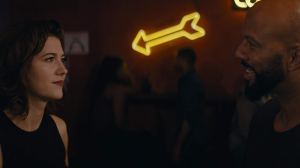
Nina (Mary Elizabeth Winstead) has some professional success there, but her personal life suffers – and we know it didn’t have far to fall from. For the first time in her life, she lets a good guy (Common) get close to her but she’s flailing. Her new roommates (Kate del Castillo, Clea DuVall) model a new and healthy way of living but Nina can’t reconcile it MV5BZTE4ZjUxODEtNmNmZS00ZWU5LWIzODgtNTU1MjNhNzM1MzNiXkEyXkFqcGdeQXVyMTY4NjI3Mzg@._V1_SX1777_CR0,0,1777,999_AL_with her own life, and I’m not sure she believes she deserves that level of happiness anyway. In fact, the closer she gets to good things, the more she sabotages them. Ultimately she’ll have a bit of a meltdown on stage that results in a viral video of some powerful truth-telling that her audience may not be ready for. Just about the only thing that video doesn’t threaten is her strength.

Director Eva Vives pulls together a terrific female-forward ensemble (Angelique Cabral, Camryn Manheim, Mindy Sterling),  to achieve this thoughtful look at what it means to live an authentic existence, especially for a woman in 2018. As her new boss Lorne Larry Michaels (Beau Bridges) tells her, the audience only thinks it wants truth – in reality they need it to be heavily curated.

[This reminds me of the very best stand-up comedy I’ve seen this year – Hannah Gadbsy, who has a special called Nanette. It’s on Netflix. It’s spectacularly funny but also very raw and angry and honest, which makes it a breath-taking, astonishing piece of art. Seriously. You should watch.]

Nina’s passion is motivated by pain. We are certain that her anger is covering for something, but she allows so few cracks that we don’t easily find a way in. Mary Elizabeth Winstead has a long cinematic history of being wonderful and this performance in particular is a brave kind of perfection. It’s like watching a pot boil, with its own internal tension despite knowing what’s coming. Vives sets up these emotionally intense scenes and allows Winstead to smash them out of the park. All About Nina will live to its name. It distills all the frustrations and rage we have as women, every struggle we have between delicacy and strength, independence and cooperation, self-interest and support. It’s a messy road, but beautifully walked.

Living Proof

When I was a little girl, my school had an annual “read-a-thon” to raise money for MS. Finally, a “thon” that little unathletic Jay could win! And boy did I: hundreds of books read, and hundreds of dollars raised.

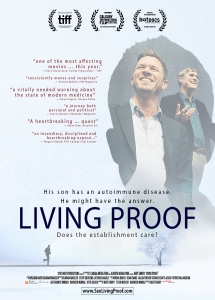
Film maker Matt Embry was diagnosed with multiple sclerosis when he was only 19 years old. A debilitating, incurable disease, both Matt and his family were devastated by it. His father, Ashton Embry, was frustrated at the paltry support offered by their doctors and with the lack of long-term results offered by any of the medication available. So he did his own research, and thanks in part to Judy Graham’s book about living with MS MV5BMjZhYmVmNTctNTlhZC00YmQ5LWJkZTUtM2ExN2RiMTc3ZWEyXkEyXkFqcGdeQXVyMzc4MTI1OTQ@._V1_naturally, he developed a diet for his son to follow. Matt eats unprocessed food – no gluten, no dairy – mostly fruit, veg, and lean meats. And since MS occurs more often in northern countries, like Canada, he takes a big ole dose of Vitamin D, like sunshine in a bottle. Yes, it’s a strict diet and requires constant preparation and vigilance. But if you’ve known someone cut down by MS, their bodies just literally abandoning them, you’d probably find such a possibility to be suitably motivating. And thanks to this lifestyle, Matt is still symptom-free, TWENTY YEARS after diagnosis. He has never taken any medication, but he has had a procedure called CCSVI – many people with MS have significant blockages in their jugular vein, which means not enough blood flows through to the brain.

Staving off MS without expensive drugs is reason enough for a documentary. Though it’s likely not the answer for everyone, it seems harmless enough to try, so Matt and his family have been devoted to disseminating the information, free of charge. But MS patients must happen upon it themselves, because none of the official avenues will so much as suggest it as an alternative. People my age are confined to wheel chairs and nursing homes because big pharma is only interested in medical alternatives that will make life-long paying customers out of patients. Diet and exercise are not profitable.

But you and I expect no less of the pharmaceutical industry. It’s unconscionable.  What really got my goat was the complicity of the MS Society of Canada, and its many chapters around the world. They raise millions of dollars, give a fraction to research, and literally suppress invaluable information from the people who suffer from MS and depend on them for resources. They accept donations from pharmaceutical companies, they endorse their drugs, and they funnel the money back toward research for medicine that will not cure MS. I am enraged to know that I ever gave\raised money for the MS Society. I was even more enraged to see them using the donations of well-meaning, hard-working people to sue the likes of Matt Embry. No wonder there have never been any significant advancements in MS research. It’s enough to make you sick.

TIFF18: A Star Is Born (2018)

When Angelina Jolie directed herself in By The Sea, they called it a vanity project. When Barbra Streisand starred in a remake of A Star Is Born, they called that a vanity project too. Bradley Cooper directs himself in yet another remake of A Star Is Born, and: crickets. Nobody says toot about no vanity project. And it’s not that I begrudge him this project at all; we all choose to do things that will show us in the best light. We just need to be more careful about the language we use when women do the same thing that men have always done.

Have you seen any or all of the previous remakes? This one is really well-done in a lot of ways. Bradley Cooper plays Jack, the established rockstar who can’t get through a show, or life, sober. But one night, in search of his next gin & tonic, he sees Ally (Lady Gaga) perform in a drag show and he’s a goner. Ally’s been unable to break into the music business because of her “looks” (ugh) so he gives her her first big break…and then regrets it? Her star shoots up while his pummels down. His hearing loss and his drinking problem and his anger get in the way of his career, but he still finds time to be condescending about Ally’s career trajectory, which he deems less authentic than his own (ugh again). And well, if you haven’t see the previous remakes, I won’t spoil it for you (yet), but: ugh.

Bradley Cooper turns out to be an excellent director who’s hooked up with an excellent cinematographer, Matthew Libatique. And he’s terrific in this. I was particularly astonished in the earlier scenes in which he’s a charming, functional alcoholic. It’s very subtle what he does, and very right – nothing big and sloppy, but there are tell-tale tics suggesting a man who has spent decades drunk. It’s brilliant. And Sam Elliott is fantastic, truly, tearfully terrific. And Dave Chappelle is great for what little he’s in it. And Anthony Ramos manages to stand out amongst all these stars – his face, beaming with pride for his friend, feels so honest. And okay, yes, Lady Gaga is good. Not great, but she doesn’t flub anything up, she’s not wooden, and she’s not even a big distraction. And of course when she’s singing she’s on fire. It’s disingenuous to cast her of course – the biggest thing to happen to pop music since Elvis. It’s insulting to brunettes everywhere (anywhere from 75%-97% of the world’s population) that they just made her hair a little mousy and suddenly the woman whose music cannot be separated from her style, her beauty, her glamourous image, is playing a woman discriminated against on the basis of looks? Let’s take a moment just to remember but a few of the low-key looks she sported to this very movie’s premiere, and ask ourselves again if she was really the best choice for the role.


0_2018-Toronto-International-Film-Festival-A-Star-Is-Born-Premiere-Red-Carpet


4592344-6215681-image-a-15_1538068359717


lady-gaga-1-gty-jt-180903_hpMain_16x9_608

And to have her particular hang-up be her nose in this remake, the remake following Barbra Streisand‘s…it’s just rich. Barbra has her own kind of beauty of course, but a much less conventional one. It meant something. Putting Lady Gaga in this role almost makes me feel like they’re laughing at us. And every time they do their “cute” reference to her being ugly, my stomach turns. In fact, this whole idea that a big, rich star could fall for an ugly duckling, could see past her looks and discover talent…it’s quite patronizing. Meanwhile, if my eyes do not deceive me, this imperfect woman has glowing skin and luscious locks and a tight, size-0 figure. And yes he still deigns to look down on her when her career necessitates a makeover. But what does he know of such things? He gets to show up in the same sweat-stained hat every day. The privilege! The privilege to not even recognize that gender divide, to not even have it occur to you. But that brand of career has never been viable for a woman, not in 1937 with the first A Star Is Born, and not in 2018.

[Spoilers ahead]

This movie is ostensibly about how fame is a trap, how Hollywood can eat you up and spit you out, but in the end, it’s still portrayed as the only dream worth having. Ally accuses her father of being a star-fucker but their relationship spontaneously brightens as she gets famous, and she brings him to the Grammys as her date. This is the story Hollywood loves to tell about itself (obviously, they can’t stop remaking it). But the truth is, these ideas are toxic as hell.

Like in all the remakes, when she gets her makeover, her beau is quick to wipe her face clean. We’re so trained to think of this as somehow empowering or worse, romantic, that Bradley Cooper has even admitted to doing the same thing to Lady Gaga in real life. But there’s nothing empowering about a man deciding what your face should look like, and it’s never his place to wipe your face like a child. I was so upset when I heard him repeat this story in the press it made me not want to watch this movie. Lady Gaga’s makeup has never obscured her art – it is her art, or part of it.

I’m not sure how long Cooper and company kicked this movie around  before it eventually made it into production, but it feels like it’s about 20 years late to the conversation. If anything, it’s a death sentence for grizzled old guys like Jack; those who cannot change with the times will be left behind. Of course, I realized right from the opening credits that this movie was never going to get anything right about the music industry. I called it when I spotted the studio behind it: Live Nation Productions. You know, the people who merged with Ticketmaster and forever ruined your actual concert-going experiences? Their service and “convenience” fees add half as much again to ticket prices even though you do all the work yourself, online, and then print out the ticket at home, with your own ink. Since the merger ticket prices have risen 142%, and that’s just for the tickets that scalpers buy up in rigged advanced offerings. In 2018, there isn’t a single venue that Jack could play and not be selling out himself. But the movie of course looks the other way.

Meanwhile, Ally is no cowering Vicki Lester. When the label pushes her, she pushes back. Yes, sometimes she compromises, but she’s paying her dues, she’s happy to be there, and her career is a collaboration in which she has final say.

[Serious spoilers ahead]

Except even in 2018, the man is determined to take that choice away from her.

Ally is ready to sacrifice her career in order to stay home with him, stabilize him. When he realizes this, he kills himself rather than hold her back. Now think about your own loved one deciding that for you – deciding to commit suicide in order to preserve your job. In most fairy tales, we believe in love above all else, but not Hollywood. In Hollywood, fame may be cannibalizing, but career is king. It’s everything. Jack would rather end his own life and break his beloved’s heart rather than risk her tour in Europe. He believes he is saving her from herself. It’s so many flavours of fucked up it made me sick.

I think this movie tried to say something real. It knows that music legends like Jackson Maine are already a thing of the past (is there a single modern-day equivalent?) but even as it pokes holes in the cloudy mythology, it can’t help but place value in his “integrity.” But even as he positions his own career path as the only legitimate one, his jealousy and fear are activated. He, and this film, and the 3 before it, are fueled by the Hollywood fear that for every new star, an old one is pushed out. He rails against it, but his subconscious has a firm grip – “Maybe it’s time to let the old ways die” – and Jackson dies along with them.

There are a lot of good elements to this movie and I get that many of you will enjoy it. I’m just finding that 2018 has left me angry, really angry, and I can’t watch movies without that filter of rage and indignation. Movies are the stories we tell of our time, and I don’t really like what this one is saying.


TIFF18: Ben Is Back

Ben is back. Believe the title. It’s Christmas Eve and Holly (Julia Roberts) has been out and about with her kids, running last-minute holiday preparations. But when she pulls in to her driveway, her eyes light up. Her Christmas wish has come true: eldest son Ben (Lucas Hedges) is back. He’s been away at rehab, and so has a piece of her heart. What a wonderful thing to have him back, to have her precious family all together for the holiday. But her happiness is tempered. It’s obvious without her saying so that she doesn’t quite trust him, that he’s given her lots of reasons not to.

MV5BMTgxMTk0MDgyMl5BMl5BanBnXkFtZTgwNTI1MzkxNjM@._V1_SX1500_CR0,0,1500,999_AL_Her teenage daughter is skeptical, but her husband Neal (Courtney B. Vance) is downright wary. Not only has he also put up with Ben’s ups and downs, he’s been the one putting his family back together afterward. But with Ben’s sponsor’s blessing, they come up with some boundaries and agree that Ben can stay for 24 hours of holiday magic and memories.


Well, there will be memories. Just not the cozy ones Holly was hoping for. This is what addictions are really about. About how they make a whole family sick. About the lies and the broken promises. But it’s also about a mother and her boundless love. About how she is afraid to enable him and afraid not to. Afraid of the danger and the toll and the consequences, but mostly afraid to lose him – lose him to drugs, lose him by pushing him away. So she jumps off the cliff alongside him. So now, instead of a sweet Christmas reunion, we’ve got a sketchy, seedy, underground drug movie. Holly’s concerned family at home remind us what the consequences are.

There were lots of movies about addiction at TIFF this year. Beautiful Boy was similar in theme – it too is told more from the parent’s perspective but its content is totally different. Steve Carell stays at home and frets for his son’s safety – the horror is in not knowing whether he’s alive or dead, in anticipating that phone call. For Julia Roberts, the horror is watching it all happen, finally understanding the extent of her son’s problems but still feeling just as helpless. Roberts is fucking fantastic in the role. Ben Is Back is heart breaking and intense. It is further proof that we still don’t know the best way to help an addict, and lord have mercy on any parent who has to learn that first hand.

Practical & Impractical Effects in Close Encounters of the Third Kind

According to a classification system that goes unexplained in the film, a close encounter of the first kind would be a UFO sighting. The second kind is finding proof of alien life. The third kind, as you likely know, is making actual contact with aliens themselves. A fourth kind has since been named and might have applied had Spielberg known of it; the fourth involves alien abduction.

Close Encounters very nearly featured what would have been early attempts at CGI. Director Steven Spielberg hired animator Colin Cantwell to create a CGI test of three UFOs floating over a stadium. The single-shot test took three whole weeks to complete, which immediately ruled it out in terms of the film, but it was one of the first computer generated images ever created for a film.

Spielberg’s next idea was even crazier. He wanted his aliens to have a gliding mobility (easily distinguished from human bi-pedal walking). So the obliging production team rigged up a grey spandex suit, slapped it on an orangutan, and put that orangutan on roller skates. What could go wrong? Well, turns out, it was a pretty smart monkey who knew a bad idea when it was strapped to his feet, so he sat down, removed the skates, and deliberately crawled to his handler.They never even got a screen test out of him.

After the monkeys came the mimes: they filmed the aliens mingling among human technicians played by mimes moving in slow motion so that when the film was sped up, the aliens appeared to be moving really fast while the technicians appeared to be moving at normal speed. They scrapped this too.

Finally the resorted to kids. It’s 6 year old elementary school girls (who move more gracefully than boys, Spielberg thought) in those costumes made especially for them and heavily backlit to achieve the proper silhouette. Cinematographer Vilmos Zsigmond overexposed the scenes so they would appear fuzzy and diffuse, and this helps them not look like little girls in rubber suits. Although, some of the shots in the climatic scenes are miniatures: the bright light coming out of the ship was created by a set of Christmas lights strung up on the back of a metal plate, behind little tiny alien figures. This was composited into a shot with real-life actors.

maxresdefault

A special 9-foot version of the mothership was built for that one spindly-legged alien which appears briefly, spreading its arms in a peaceful gesture. That was a marionette prototype made by puppeteer Bob Baker. The marionette idea was nixed but “Daddy Long Legs” made it into the film.

But what about that final farewell where the alien signs the musical notes back to the humans? For that, Spielberg recruited a special effects artist by the name of Carlo Rambaldi who created a fully articulated steel, aluminum, and fiberglass animatronic puppet that Spielberg nicknamed “Puck.” Puck’s expressions were based on photos of Cary Guffey, the child actor who plays little Barry. The puppet was operated by a crew of seven puppeteers, with Spielberg himself controlling the final articulation before the alien leaves to go to the mothership.

miniatures mark west special effects Greg Jein Close Encounters third kind 1977

Greg Jein

Incidentally, the aliens were meant to appear to be floating around in their ship, it being zero gravity or thereabouts. Even Roy was supposed to be seen to float into it as he approached. But the crew just couldn’t hide that many wires. They did, however, achieve weightlessness for Richard Dreyfuss in an early scene in his pick up truck. the truck was put on a turntable and flipped 360 degrees!

[During filming, Spielberg kept ruminating on Puck and wondered “What if this little guy didn’t get back on the mothership?” – that, of course, was the germination of E.T., whom Rambaldi would also go on to design.]

A note on those musical notes, which aren’t really a practical effect per se, but are such an iconic but humble sequence, we can’t not talk about composer John Williams’ brilliance for just a moment. Williams and Spielberg worked together a year before shooting even began to make sure they had the perfect sequence. Williams was originally working with 7 notes but since they wanted a simple greeting, they pared it down to 5 notes. Williams whipped up 100 permutations based on the Solfège system of musical education and together they whittled it down. Tuba player Jim Self is the “musical voice” of the mothership in the final edit.

A second note on how to get a great performance out of little Cary Guffey who’d never acted before. Spielberg has of course gone on to work with loads of child actors, but Guffey is among the youngest. Spielberg would unwrap presents just out of view of the camera so that Guffey would smile and point (you can also hear him excitedly shout “Toys! Toys!”). To get him to show fear, he had two crew members dress up in costumes. A false cardboard wall would drop, revealing a clown, and the poor kid would frown in surprise. Then a second wall drops, revealing a gorilla, and that was pretty scary. So the gorilla whips off his mask, revealing friendly makeup man Bob underneath and ta da – you got yourself a performance, or at least a series of emotions that look very real on tape.

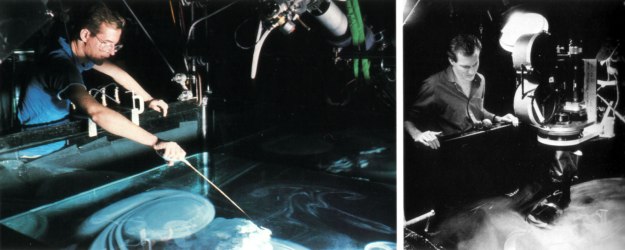
Douglas Trumbull was the visual effects supervisor on Close Encounters of the Third Kind who came up with techniques for this film that would lead to advances in motion control photography, which is how you combine pictures of miniatures with pictures of full-scale elements.

The mother ship was designed by Ralph McQuarrie and built by Greg Jein. Its aesthetic was inspired by an oil refinery Spielberg saw at night in India. Instead of the metallic hardware look used in Star Wars, which was coming out the same year, they emphasized a more light-heavy, luminescent look for the UFOs (Dennis Muren, who’d just finished up with Star Wars, put a tiny R2-D2 on the underside of the mothership). One UFO model was an oxygen mask with lights attached to it. They experimented with all kinds of ordinary objects that had interesting shapes. The miniatures were filmed in dark, smoke-filled rooms so their lights would cut through the fog and look super cool.

Douglas Trumbull created the cloud effects by injecting white paint into tanks half filled with salt water and half filled with fresh water.

cinefex26

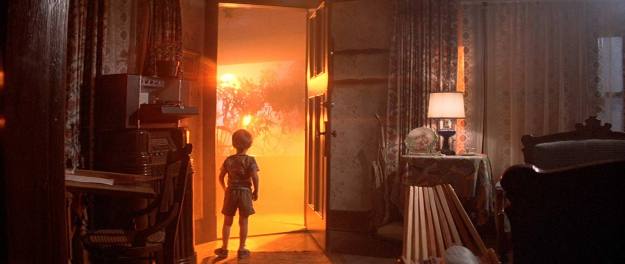
When asked in 1990 to select a single “master image” that summed up his film career, Spielberg chose the shot of Barry opening his living room door to see the blazing orange light from the UFO. “That was beautiful but awful light, just like fire coming through the doorway. [Barry’s] very small, and it’s a very large door, and there’s a lot of promise or danger outside that door.”

close-encounters-still-visitors

TIFF18: Giant Little Ones

Giant Little Ones is post-gay, mid-spectrum, pro-fluid. It’s a very specific adolescence, and except for a few details, it could be mine or yours.

Franky (Josh Wiggins) is on the swim team at school – the kind of swim team who showers together, shaves together, slings homophobic slurs together, apparently without irony. Franky’s best friend Nic is on the swim team too. They do almost everything together, but for Franky’s 17th birthday he’s planning something without him – the loss of his virginity, to his girlfriend, who is nice enough and pretty enough but just not that interesting. Is that a problem? Nic is emphatic: no. Nic and his girlfriend do it 6 times a day!

Franky’s mom (Maria Bello) leaves the house unattended for the party but things don’t go exactly as planned, and at the end of the night it’s just Franky and Nic, like the sleepovers of their childhood. Except this one ends in a blow job. In the morning, Franky is surprised by this turn of events, but Nic is many more things: ashamed, upset, angry. Nic destroys their friendship, and Franky’s reputation, and makes Franky’s life at school hell. The only person who doesn’t desert him is Nic’s sister, Natasha.

I really love Franky’s openness to this experience.  Josh Wiggins is a big part of this: he is giant-little-ones-e1536901112178charming and sweet, handsome and approachable. Franky doesn’t question his identity, he just absorbs it as part of it. It doesn’t need a label or a judgement. But there is a complication: Franky’s father (Kyle MacLachlan) has recently left the family because he’s gay. Franky’s resentment is mostly due to the abandonment and not the sexuality, but his feelings are complicated and confused and it makes dealing with this just a little harder than it has to be.
Every generation has its own set of unique problems and we’re still uncovering and discovering what it means to be young right now. High school is as hard as ever, but it’s fascinating to be able to peek in through the window to see today’s particulars. I saw Giant Little Ones on a whim and an inkling and it ended up being a really nice find, which is a happy festival occurrence. We go in with such high expectations for the Oscar hopefuls and at best all they can do is meet them. But a little Canadian indie like this can genuinely catch you off guard, and in reinvigorates you when you’re on movie #32 of the festival.


TIFF18: Colette

When Matt and I were perusing the TIFF titles this year and came across Colette, we thought it must be this year’s Big Eyes (in which a husband, Christoph Waltz, takes credit for his brilliant wife’s, Amy Adams, paintings). We weren’t wrong, but we were giving Colette insufficient credit.

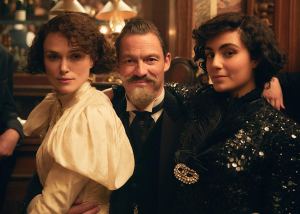
Colette (Keira Knightley) is a young country bumpkin who didn’t even know how to operate a snow-globe when she met her husband Willy (Dominic West), who dazzled her. He was a writer, worldly, enamoured with his own success and reputation. But the well is dry and they’re broke. To keep her husband happy and their household afloat, Colette sits down and writes a book about her own school girl experiences. Although Willy MV5BM2Y4MzdhMGUtNGE3My00NWZkLTkxMTEtMmU4ZThmNTZlZWQ3XkEyXkFqcGdeQXVyMjU3MTYyOTY@._V1_SY1000_CR0,0,1399,1000_AL_criticizes it for being too feminine and “full of adjectives” he signs his name to it and sends it off to be published. Of course it gets gobbled right up. Does Willy eat crow? He does not. He celebrates “his” success without a trace of irony and then gets mad at his wife for “implying” that she wrote it. Which, again, she did. This book does worlds better than any of his ever did so he’s eager to keep the gravy train going (imagine an actual gravy train! what a weird expression, especially since the carafe gravy is traditionally served in is called a boat). Anyway. He can’t help but lock her in a room until she produces another best-seller. It’s only logical! And she does. And when, oodles of success later, it begins to chafe and she suggests getting at least partial credit, her name alongside his, he bucks. Preposterous! Women writers don’t sell, he reminds her.

Living under those circumstances, it is perhaps not surprising that she explores her options, by which I mean, sleeps with women. She is emboldened, solely by the women in her life, to assert herself. And though the laws and the norms of the day prevent her from claiming all that she may, they also inspire her to finally break free from the leash that kept her bound to a husband who viewed her as a meal ticket, their marriage as a business transaction. Even a long leash chafes.

Keira Knightley has earned herself the crown for period films long hence, but finally she has found one that is worthy of her – or, better stated, a film that can maximize her limited gifts has found her. She sparkles here, breaking outside her box to march up a hill of empowerment. Colette is familiar but not generic. It relishes the vibrancy of the period, but it also embraces its grittiness. The messaging here is anything but subtle but it doesn’t take a gentle hand to sit back and hear her roar.