Tough Guy

After a year of getting beat up, the Detroit Red Wings “drafted big”, big guys across the board, which landed Canadian novice Bobby Probert was on the team. Bob Probert wasn’t just big, he was tough, and he had a reputation as a fighter. You know, to “protect his teammates.” As you do. This was the 80s, so hockey was rougher and refs were scarce. On-ice brawls were a lot more common than they are today, and Probert was only too happy to oblige. But Probert’s lack of restraint wasn’t just on the rink; off-hours, he drank heavily and did drugs. When stories of DUIs and police altercations hit the papers, the NHL forced him into treatment, and a lot of good that did – he hooked up with one of the counselors and brought her home. He must have been a charming schmuck because not only is that a huge breach of professionalism, it’s also pretty hard to overlook his chronically missing teeth.

The documentary shows the Red Wings management selfishly slapping bandaid solutions on the troubled kid. Their franchise was having a couple of difficult seasons, and if there weren’t any goals to get the hometown crowd excited, a fist fight would do it, and “The Bruise Brothers” (with Joey Kocur) became marketing gold. The coach kept indiscreetly mouthing off to the press, and Probert was now skating high, a cocaine-fueled rage machine waiting for a target.

Back and forth between Detroit (USA) and Windsor (Canada), it was only a matter of time before border patrol found drugs in Probert’s possession. Sure jail was a possibility, but so was deportation, and that was a threat to his career. The NHL failed him in more than one way: he was constantly told that he played better (meaner) when he was drinking than sober, but a contract with serious money was the best incentive for sobriety, and for a time, it worked.

Tough Guy interviews former teammates, former rivals (Tie Domi!), family members, even Don Cherry. It’s a Canadian wet dream, except it tells a dark tale with a mean downward spiral.

The Favourite

Yorgos Lanthimos tells stories about relationships. He clearly finds us human beings fascinating, but the way in which he carves his observations out of us us with such surgical precision makes me feel like Lanthimos isn’t quite one of us.

In The Lobster, he imagined that single people were so desperate to pair up, they’d agree to do so under duress, and under deadline, with failure to find love transforming you literally into an animal. In The Killing of A Sacred Deer, a man watches the innocent pay for his sins until he can not only admit them, but make a sacrifice to atone. These films strike a unique tone; Lanthimos’ voice is absurd but bold and unwavering.

In The Favourite, Abigail (Emma Stone) is a former lady fallen quite low. She’s at the MV5BYzUzNzg5ZmUtMzAwNC00NjA0LTkzOGYtMmViNzAzZmY1NjhhXkEyXkFqcGdeQXVyMjcwODY0NTE@._V1_palace to beg for a job from her cousin, Sarah, Queen Anne’s trusted lady in waiting. Queen Anne (Olivia Colman) is mentally and physically frail. Between painful attacks of gout and a nervous disposition, she leads a lonely life on her throne, often bedridden, frequently deranged with pain or paranoia. Her only friend and companion is Lady Sarah (Rachel Weisz), who basically rules the country in her place. Sarah is a strict go-between, acting as a buffer between Queen Anne and the demands of her royal position, and if she uses that position to exert her own will and influence, well…of course she does. Wouldn’t you?

But Abigail is way more wily than Sarah first gives her credit for. Abigail’s had to do some shitty things in order to survive, and she’s prepared to do what it takes to make sure she never has to suffer again. She throws her charm into overdrive, ,and soon Sarah realizes she’s competing with her cousin for Queen Anne’s attention.

In The Favourite, Yorgos Lanthimos’s gift to us is a power struggle between the three that is never dull, never less than captivating. Emma Stone is fresh-faced but  clever and calculating as Abigail, the servant with major ambition. Olivia Colman is desperately lonely and deeply insecure, but her queen has learned to wield her power to get what she needs. Rachel Weisz is brilliant, as ever. Insanely brilliant. Sarah has made a deal with the royal devil. She has goals and knows they don’t come cheap. Pretty soon there’s an insane transactional triad going on that you’ve got to see to believe – and to some extent, admire. Obviously, women in the 18th century weren’t exactly in the best position, not even if you were queen, but these 3 are making choices and bargains. They are driven by necessity, and desire.

This period piece is soaking in, nay, fermenting in, rich tapestries, both actual and metaphorical. You eyes will drip with colours and patterns and lush landscapes, but despite the beautiful 18th century dressings, this feels like Lanthimos’s most relevant, most contemporary work. Witty, naughty, and sometimes disturbingly dark, The Favourite is stunning, and an absurd amount of fun.

Aquaman

How do I even deal with the atrocity that is Aquaman? You probably know already that Aquaman is about a plot by the Atlanteans to attack the people who live on land, and so Aquaman has to become their king to save the world. But what you may not know is that this film is racist.

The only two black people in the movie are criminals (and also father and son). The black dad blows himself up when Aquaman (Jason Momoa) seemingly foils their attempt to steal a submarine from a bunch of white guys (Russians, as it happens).

Then that same submarine reappears to fool some of the Atlanteans into thinking that MV5BMzZjZTU2NjEtZTEzMC00YmRkLWIzZjUtMDczMWI4MDU4ODAxXkEyXkFqcGdeQXVyNTc5OTMwOTQ@._V1_the surface world is attacking them to obtain enough votes to attack the surface world. Turns out, one of the Atlantean human-shaped leaders had hired the black guys to steal the sub and fool another Atlantean human-shaped leader. Except then it also turns out that the leader who seemed to be fooled by the sub attack was actually aware it was fake news the whole time and went along with it anyway (and in case it is not clear, all the human shaped Atlanteans we see are white men, every last one, other than Aquaman’s love interest and Aquaman’s mom who are white women).

Then the surviving black guy is hired again by the Atlanteans to kill Aquaman and his love interest in Sicily, and the black guy is willing to go along with it because he blames Aquaman for his dad’s death. That plan fails, with the black guy apparently being killed by Aquaman, and also two non human CGI underwater leaders are either killed or maimed by the white underwater leaders who do not attempt any type of stolen submarine trickery on them at all.

So, to summarize the repeated, overt, MAGA-level racism (on the level of “Look at my African American over here!”):

1. The black son is called “Black Manta” so even when he wears a full suit of armor you can be sure that he’s not white.

2. No effort at all was put into fooling the two CGI leaders who weren’t on board with the plan to kill all humans. Again, those disposable leaders are the two that aren’t white men (and blond, blue eyed white men at that) – one is a merman voiced by a black guy and the other is a big brown CGI crab-man. So you might say the CGI leaders were less worthy of respect than the white ones or perhaps you’d say they came from “shithole” countries, if you were a racist.

3. The Atlanteans are really concerned with following certain rules, namely ones that prohibit going to war against us without four votes, while those same Atlanteans have no problem doing awful things to get those four votes, like killing the CGI underwater leaders who won’t vote the way you want in order to install a new leader who will. Which suggests a set of niceties for white guys that don’t apply to non-whites. Or that the nonwhites were asking for it by looking scary and not giving into what the white guys wanted. Po-tay-to, po-tah-to.

4. If the Atlanteans hadn’t bothered to steal the sub for fooling reasons, we wouldn’t have needed the black humans to steal anything. But then we’d have missed an opportunity to perpetuate the stereotype that black men are criminals.

Does it matter at all that the racist Atlanteans are the bad guys and they lose in the end? I don’t think it does. This movie is so dumb generally that it is not capable of coherent social commentary, and incoherent social commentary is worse than not saying anything. Further, if the film had wanted to make a point about the dangers of a racist political leader, it needed to make the racism a rallying point for Aquaman and those opposing that leader. In other words, for this movie to be on the right side of prejudice (i.e., against it), the racist Atlanteans needed to lose because of their racism. The non-racists needed to object to the racists’ offensive conduct and resist for that reason, but that never happens in Aquaman.  Instead, Jason Momoa’s character seems to buy into the same stereotypes as the Atlanteans when he leaves the black dad to die because the black guys killed some of the all-white sub crew.

Admittedly, Aquaman later says he learned a lesson from that experience but his application of that lesson is to provide mercy to the all-white Atlanteans. Which means Aquaman does not actually learn the RIGHT lesson, so neither does the audience.  As a result, the harmful stereotypes in Aquaman are perpetuated and normalized, and that’s very, very bad anytime but particularly bad in a film that is targeted at white males.

There’s so many other problems here but I won’t get into them because trafficking in stereotypes is the real issue here. Aquaman is intolerant and intolerable and you should avoid giving DC one more dime for this hugely problematic film.


Bird Box

Imagine threatening very small children with their lives. Imagine threatening your own children with their deaths, their painful deaths, by your own hands if necessary. Can you even imagine a situation so dire that you would tell your kids you would kill them IF?

If you’re a fan of Josh Malerman’s post-apocalyptic horror novel, Bird Box, the good news is,  you can always reread it. Netflix has adapted this “unfilmable” book (how many books have we said that about now?), and turned it into something bibliophiles will scarcely recognize. But that doesn’t meant it’s bad.

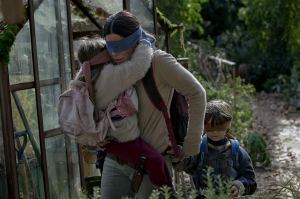
Malorie (Sandra Bullock) is in the impossible situation. She’s pregnant at the end of the world. This particular nightmare is the inverse of The Quiet Place – they had to stay silent in order to not die, and in Bird Box, they have to not see. The sight of something is causing people to almost immediately become homicidal and ultimately, suicidal. It’s a plague killing millions, killing billions, killing everyone around the world. The only way to survive is to not see, to never see. But food and water and resources inside are finite. MV5BMjE5Nzk1ODgwMV5BMl5BanBnXkFtZTgwMjU5MTE2NjM@._V1_SX1500_CR0,0,1500,999_AL_Malorie is living with a small group of people, strangers, really, who don’t always agree on the best way to exist together, or how to stay alive. Malorie’s not even the only pregnant one – Olympia (Danielle Macdonald) is expecting too, right around the same time. The house’s other inhabitants (Trevante Rhodes, John Malkovich, Jacki Weaver among them) will have to make all kinds of hard choices to ensure the group’s survival. As you probably guessed, ultimately, Malorie will need to leave the relative safety of their shared home – and worse than that, she may have to sacrifice one child to save another. Doesn’t that sound like a fun little jam to be in?
Yeah, this is a horror movie, in case you’re not picking up on the obvious. The unknown, horrible, unseeable things remain unseen by us, but they’re a constant threat. Director Susanne Bier understands it’s way creepier to only suggest the worst, and let our own imaginations prey on our fears. A newborn baby is of course the most vulnerable creature in the world. What else could heighten a dangerous situation like a helpless baby? But what else would pose a greater danger? A baby, unable to look away, unable to understand, a baby who will only need need need, and take take take, and attract attention while putting everyone at risk. A baby, two babies, normally a blessing, but in this scenario, the worst possible thing.

Bier creates a tense atmosphere and Bullock keeps us riveted. Rather than jump scares, Bier gives us a character study, and Malorie’s humanity and the children’s inherent weaknesses gives some real meat to the film’s anxiety. But the film strays quite far from the book, and to no real advantage. Since this film streams for “free” on Netflix, it’s a no-brainer if you can take the heat (or rather the chill, the frisson). Squeeze your eyes half shut.

Welcome to Marwen

Mark Hogancamp was beaten nearly to death by 5 men outside a bar where he’d casually mentioned enjoying wearing women’s shoes. When he awoke from his coma 9 days later, every memory of his life over the last 38 years was gone. Just gone. His life was changed forever. Formerly a talented artist and illustrator, Mark could no longer wield a pencil well enough to write his own name. Not that he remembered his art anyway; looking at his own stuff was no different than looking at a stranger’s. Imagine how sad, how profoundly sad it would make you to know that you had been capable of such beauty and now you don’t even have the memories.

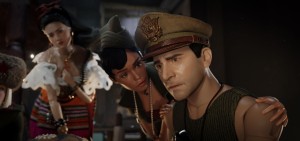
So that broken man is who Mark is when we first meet him in Welcome to Marwen. He is crippled with PTSD. He lives in fear. He’s over-medicating. Mark (Steve Carell) has an ingenious coping mechanism, though. Unable to do art the way he used to, his innate MV5BMTg5Y2M2YWEtNzU5OS00MzlkLWE5YWItZDliZGE1NzhjOWY4XkEyXkFqcGdeQXVyNTc5OTMwOTQ@._V1_abilities are leaking out however they can, and now Mark is a photographer, and his subjects are quite unusual. Hogancamp has constructed a village in his backyard, a village called Marwen, which is inhabited by dolls. He sets the dolls up in war-time scenarios, and each one represents someone special to him in real life, namely the women who care for him. Living among Marwen’s women is Captain Hogie, the stand-in for Hogancamp, a tough soldier who lives his life fearlessly. And so he should, because as invariably as he is captured and beaten by the Nazis hiding on the outskirts of town, his lovely ladies come to his rescue, time and time again.

Carell has made it his business to understand the outsider, and Mark is more wounded, more vulnerable than most. But he’s not defeated. He’s fighting back in small ways, in brave ways. He is a complex man and Carell embraces that. I’m just not sure his director does. Robert Zemeckis prefers to stay away from the tricky stuff. He’s made a feel-good movie where perseverance triumphs over adversity. I suppose that’s nice, but I’m not sure it’s a good fit for the story, or true to Hogancamp’s experience. Likewise, Zemeckis seems puzzled about how to treat the women of Marwen. The movie incorporates some truly incredible animated sequences as we see the dolls come to life and act out the scenarios that Hogancamp devises for them. The animation is informed by motion-capture and it looks really, really cool. Voiced by some very talented actresses (Janelle Monae, Leslie Mann, Merritt Wever, Eiza González, Gwendoline Christie), the dolls are absolute bad-asses. In real life, Hogancamp’s photography of them has resulted in gallery shows around the world. But they’re also comfort items. The dolls are how he deals with his fear, they’re talismans, protectors, therapeutic symbols of safety and security. Zemeckis seems more interested in treating them like sex dolls, which is a creepy impulse, and one that is not reflected in the dialogue, so it’s like the story disagrees between what it shows us and what it tells us, and that discord can be quite distracting.

I think the actors involved in this project strove for an authenticy that perhaps Zemeckis overlooked, or failed to value. Which is too bad, because this movie had real oddball possibilities. It’s still a pretty incredible story, and I don’t mean to discourage anyone from seeing it, because Hogancamp’s story is worth being told (although there is a book and a documentary that may do it better). The way Hogancamp’s experience informs and describes trauma is unique and real and complicated, but I don’t think Zemeckis trusts us to get it, or else he doesn’t get it himself. He gets such a stiffie from all his special effects that he robs the movie of what actually may have made it special. We shouldn’t be dissecting a man’s trauma just to give it the syrupy Hollywood treatment. There was an opportunity to be real, to be honest, to show life’s ugliness and be brave and bold about it, but Zemeckis took the road too frequently traveled. He played it safe, and disappointing, and the movie just can’t live up to the truth.

Mary Poppins Returns

Mary Poppins Returns is practically perfect in every way. It looks wonderful, whimsical, fanciful, a dreamscape. The animated sequences are next-level. The choreography is lively and polished. The costuming, by genius Sandy Powell, makes me tremble, its candy colours and hand-painted detailing an absolute riot. It’s wearable happiness.

And the cast. The cast! Ben Whishaw and Emily Mortimer play Michael and Jane Banks, the original kids from the first Mary Poppins, all grown up. Julie Walters tinkers in the kitchen as the hard-working maid, Ellen. Lin-Manuel Miranda plays Jack, the effervescent but largely ineffective lamp lighter (he might light 3 lamps total during the course of a 2 hour movie because his song and dance breaks are so frequent; the lamp lighter’s union must be fabulous). Together, they’re already a dream cast, but then MV5BY2I4NTRiM2UtYzIxYS00MTkyLTk4Y2ItYmNjNWNlMzZiYzdjXkEyXkFqcGdeQXVyNTc5OTMwOTQ@._V1_director Rob Marshall plunks down Emily Blunt as the iconic nanny, Mary Poppins. Ho-lee shit. I mean, every ounce of credit to Julie Andrews, but since she’s vacated the seat, Emily Blunt is absolutely the perfect choice to carry the carpet bag. Anyone else in the role is simply unimaginable. And Colin Firth and Meryl Streep are BONUSES? Ex-squeeze me? Pure casting heaven.

But here’s the deal: despite there not being a single smudge dirtying up the glass, the magic just wasn’t there for me. I wanted to love this movie. Maybe I wanted it too much. It has all the right ingredients, but the pinch of disappointment is all I can taste.

Michael Banks is in a spot of trouble. His wife died a year ago, leaving him in charge of the house and the kids. All are neglected. His adorable children aren’t just raising themselves, they’re taking care of him too. Just about the only thing they can’t do is save the house from foreclosure. Michael and Jane can’t do it either – neither has any money. Where or where are those stock certificates their father left them? They’ve only got a few days to save their family home from the evil banker, Colin Firth. Cue Mary Poppins. Nominally, she’s taking care of the children, but I think her main ambition is just to allow them to be children again. And ideally, force Michael to act like the father again. So that’s the plot, and then we continually interrupt the plot to do some wild Mary Poppins shenanigans. The dancy, singy, cartoony musical numbers are incredible, or they would be if the songs weren’t so negligible, but they grind the plot to a halt and don’t relate to the rest of the movie at all. It’s not cohesive; I feel like I was watching two different movies, part depression-era family tragedy, part nostalgic stuff and nonsense. There are some wonderful call-backs to the original film, but I feel like Mary Poppins returns relies too heavily on its predecessor and our forgiveness. I wanted so badly to be carried away by this, but I remained firmly in my seat, butt against leather, popcorn in the cracks (of the recliner, not my ass). Translation: perfectly ordinary in every way.

A Simple Favor

Emily (Blake Lively) is effortlessly cool and glamourous. She works a high-profile job in the city and has a handsome husband and an air of mystery. No one is more surprised than Stephanie (Anna Kendrick), a single mom and mommy blogger, when Emily befriends her. Their boys are friendly in school and now the mums are friendly over martinis.

But just weeks after an unlikely friendship blossoms between Emily and Stephanie, Emily calls her with a request for a simple favor: a work emergency has popped up, could Stephanie pick up her son from school? Two days later, the son is still in Stephanie’s care, and no one had heard from Emily.

As the investigation into Emily’s disappearance deepens, Emily’s secrets unravel. Her MV5BMTUzNDc3NTM4M15BMl5BanBnXkFtZTgwMzYxNTM0NTM@._V1_SX1777_CR0,0,1777,999_AL_husband Sean (Henry Golding) is very revealing. Turns out, Emily was a pathological liar and her past was very closely guarded. Stephanie doesn’t know what to think about her friend, but her doubts don’t exactly stop her from getting cozy with Sean…and eventually moving right in. Which seems like a bitch move from a grieving best friend, but then, the recent widower isn’t exactly objecting. Why is Sean not objecting?

Anna Kendrick is very good at being a pathetic loser, and Blake Lively is extraordinary at being a clotheshorse. This movie is exceedingly stylish. Blake Lively’s menswear-inspired wardrobe is to die for, but I swear I’m not the one who killed her. But no matter how you dress this thing up, it’s no Gone Girl, but that’s exactly what it wants you to mistake it for. Unfortunately, it can’t quite embrace any one genre. It often looks noir but goes for the easy laugh. Which one is it, truly? I admire that Kevin Feig went for a blend of both, but I don’t think he quite pulled it off. However, if you’re a fan of the Kendrick-Lively duo, they’ve never been Livelier or more Kendricky. They each know their strengths, and Feig gives them a beautiful stage on which to drip their special sauces.

Adrift

Tami (Shailene Woodley) is a grass-smoking, pukka-shell-wearing rootless wanderer, working odd jobs from one port to the next just to avoid going home. In some marina she meets Richard (Sam Claflin), and he cooks her a vegetarian “version” of fish, which turns out to be salad, fyi.

I don’t care for Sam Claflin, and he’s not gaining any ground with his lackluster performance here. I felt rather neutrally about Shailene Woodley before today, and I can MV5BYWI2NzA3YTgtZjZjMS00MmM3LThkY2QtYmQ3Nzg2YmIwZmY0XkEyXkFqcGdeQXVyNDE5MTU2MDE@._V1_tell you with certainty she’s dipped into the negatives with this film, in which she over-relies on a screechy giggle she mistakes for endearing, even while narrating a letter she’s handwriting to her mother, which apparently was peppered with LOLs even though the movie takes place in 1983, and I doubt LOLs existed then. They just had to let mothers find something funny, or not, on their own back then. It was the dark ages.
I’m biased. I hate making heroes out of stupid white people who take needless risks and do dumb shit and then expect us to drop everything to rescue them when they inevitably get into trouble. We cannot manage to feed and house all the children in our society, but we’ll spend a million dollars to rescue a couple of people nature was trying to survival-of-the-fittest on the top of a mountain, or in this case, out to sea. I don’t have a lot of sympathy for these two, and was frequently and quickly so bored-slash-agitated with this movie, I wished them dead.

I don’t know if this movie is based on a true story, and if it is, I suppose I don’t actually wish them dead. Probably. I mean, on the one hand, it must be a true story, because how else did they name her Tami? I mean, Tammy is bad enough, but Tami? But on the other hand, who would pay for such a generic story? I mean, it doesn’t take a genius to be like, lost at sea bad, not enough food, etc. It does, however, take a special brand of moron to be starving but still refuse to hurt innocent fish by killing them for food.  I mean, after a few hungry days, some people will eat their own mothers, but she clings to her vegetarianism like she hopes to die a self-righteous twat. Meanwhile, Richard loafs about with a gruesome injury, doing an annoying self-pitying routine that gets so annoying you’ll want to throw him overboard yourself.


Spider-Man: Into the Spider-Verse

What’s better than Spider-Man? TWO Spider-Mans (or is it Spider-Men?)!  Either way, take that thinking to its conclusion, like Lego Movie co-writer Phil Lord did, and you end up with Spider-Man: Into the Spider-Verse, a cinematic universe to end all cinematic universes.

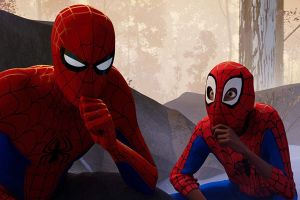
MV5BMjA0MTgwNTM5MV5BMl5BanBnXkFtZTgwOTgyODI4NjM_._V1_SX1777_CR0_0_1777_744_AL_.0Spider-Man (Jake Johnson) has hit a bit of a rough patch in middle age, as has teenager Miles Morales, who just got bitten by a radioactive spider and is going through some changes as a result on top of struggling with fitting in a his new school. Right after being bitten by that pesky spider, Miles stumbles into a science lab where another Spider-Man (Chris Pine) is trying to stop the Kingpin (Liev Schreiber) from opening a dimensional portal.  During the battle, Kingpin kills that Spidey but not before the first Spider-Man, the middle-aged one, is sucked through the portal that the Kingpin’s machine created.

Confused? You should be, but the most amazing thing about Spider-Man: Into the Spider-Verse is that this jumble of Spider-Mans (Men?) makes perfect sense on-screen. And that’s a compliment in two ways. First, because there is so much happening in this movie that it has no right to make sense, and second, because there are a whole lot of other amazing things about this movie.

Spider-Verse’s animation, particularly the art style, is stunning. A number of other superhero films have taken inspiration from the comics, whether in using captions,  multiple panels, or bright colours.  Spider-Verse takes that to a whole other glorious level, owning its comic book roots and jumping off the screen even in classic 2D.

Spider-Verse is also remarkably accessible. This is not a solo superhero film with only two or three familiar  characters to track. Spider-Verse is chock full of obscure one-offs, alternate takes that faded away, including an entire “Ultimate” comic book line that was canned by Marvel in 2015 due to lack of interest. All of that can sit comfortably in the background but no prior knowledge of anything is necessary, even of Spider-Man, to understand and enjoy this film.


Green Book

Tony Lip was a tough guy bouncer at the Copa, Copacabannnna, the hottest spot north of Havana. But in the fall of 1962, the Copacabana closed for renovations, and Tony Lip was temporarily out of work with a wife and two kids to feed at home. Some wise guys seem to imply they might have some “work” for him, but he avoids that by taking work with Dr. Don Shirley, a world-class piano player embarking on a tour of the Southern United States. Tony isn’t thrilled that Dr. Shirley is a black man – he’s not too fond of them generally, but the money is too good to turn down, even if it takes him away from his family in the two months before Christmas.

Tony (Viggo Mortensen) and Dr. Shirley (Mahershala Ali) are an odd couple on a road trip. Tony’s crude and crass and unrefined; he’s rarely left the neighbourhood where he grew up. Dr. Shirley is a gentleman in every respect. He’s cultured and educated. His MV5BZDE1N2U2MGUtM2JiNi00OTMzLTk2MjAtMmM0ZmQyNGZhNjg0XkEyXkFqcGdeQXVyNjUwNzk3NDc@._V1_SX1777_CR0,0,1777,882_AL_manners are as impeccable as his dress. But when Tony boasts that he’s “blacker” than Shirley, who doesn’t know Aretha Franklin or fried chicken, he’s only showing what a narrow understanding of race he has, because when Shirley is repeatedly subjected to racist indignities and abuses, Tony is shocked while Shirley is not. The “Green Book” to which the title refers is an actual motorist’s handbook, which, for $1.25 teaches people how to navigate segregation and not get lynched while traveling down south. I feel that I might have sold a Red Book for $1.50 that simply said: don’t go. But Dr. Shirley’s going on purpose, knowing it will be hard, but feeling a responsibility to do his part in challenging the system. And white people play their part, paying to enjoy\appropriate his culture while refusing to dine with him in the same room.

It’s a tough subject matter that director Peter Farrelly makes palatable with humour and a gentle approach. Mostly, though, he relies on the magnificent chemistry between Mortensen and Ali, who are both wonderful. Ali has the bearing to makes Shirley’s multiple doctorates feel plausible, and the physicality to make his piano-playing feel real (it’s not, but it’s the best we’ve seen on screen thanks to Kris Bowers, his incredibly talented double). Together, Ali and Mortensen are magic, their scenes positively crackling. And when Dr. Shirley plays, there’s so much energy, the music wells up inside you.

It’s inspiring to see a time of social change reflected in one relationship, how we really can make a difference on an individual level. It’s unsettling to watch the worst racism unfold and understand that 2018 is not exactly beyond this stuff – in fact, we may need this reminder now more than ever. However, there are some problems that I have with the movie. Namely, that the story is Tony’s to tell. That he’s a hero because he consented to drive a black man, while the black man who has a litany of actual accomplishments is quite literally relegated to the back seat, a supporting character in what should have been his film.  Why are we still telling black stories through white eyes? Why is racism only safe to talk about when it’s a white experience? Why do I know how Tony launders his underwear but know so little about Dr. Shirley, a highly educated genius musician who has traveled the world but whose only meaningful relationships come from hired help? Dr. Shirley learned to play piano from his mother, whom we know nothing about. His only living relative is an estranged brother, whom we know nothing about. Dr. Shirley had to be above reproach at all times, constantly turning the other cheek even after he’d run out of cheeks; he had to be perfect just to exist in white spaces, just to be invited into them, briefly, under strict, inhumane conditions, on white people’s terms, and then to leave again as soon as they stopped having use for him, and to smile and pretend to be grateful about the whole thing. This is a white person’s black movie, the kind of movie white people can feel superior watching because they manage to be less racist than Alabamans in 1962. Pat ourselves on the back! Meanwhile, this is the white guy’s story, written by a white guy, directed by another white guy, with Oscar buzz somehow reserved for the white actor who dropped the n-word at a screening for the film. This is the kind of Best Picture nod meant to appease diversity problems, but it’s more about white comfort than black experience. Movies like Sorry To Bother You, Blindspotting, Blackkklansman, and even Black Panther, are better movies with more to say, and they’re told with black voices, which is why they’re more easily overlooked. But fuck white comfort. This shit should make us uncomfortable. If you’re talking about racism and worried about hurting white people’s feelings, you’re doing it wrong, and it’s time to stop.