Monthly Archives: January 2017

Oscar Nominations 2017

For some reason, the Oscar nominations were not presented in front of a live audience this morning. Pre-taped bits with past Oscar winners like Jennifer Hudson (best supporting actress, 2010 for Dreamgirls) and Brie Larson (best actress 2016, for Room) preceded an automated list announcing the Oscar nominations for 2016’s best movies, interrupted with a commercial for itself. The Academy Awards will take place February 26th, hosted by Jimmy Kimmel. I just realized that I won’t be in the room to win my Oscar pool this year – Sean and I will be in Philadelphia, perhaps not even watching the ceremony!

An accounting firm called PricewaterhouseCoopers has taken care of the Academy balloting process for over 80 years. They send out the nomination forms in December and tabulating them in January takes about 1700 hours. There are over 6000 voting members of the Academy, and they’re all industry professionals. Each branch has different rules as to who can become a member – visual effects supervisors have to be active for a certain number of years, while an
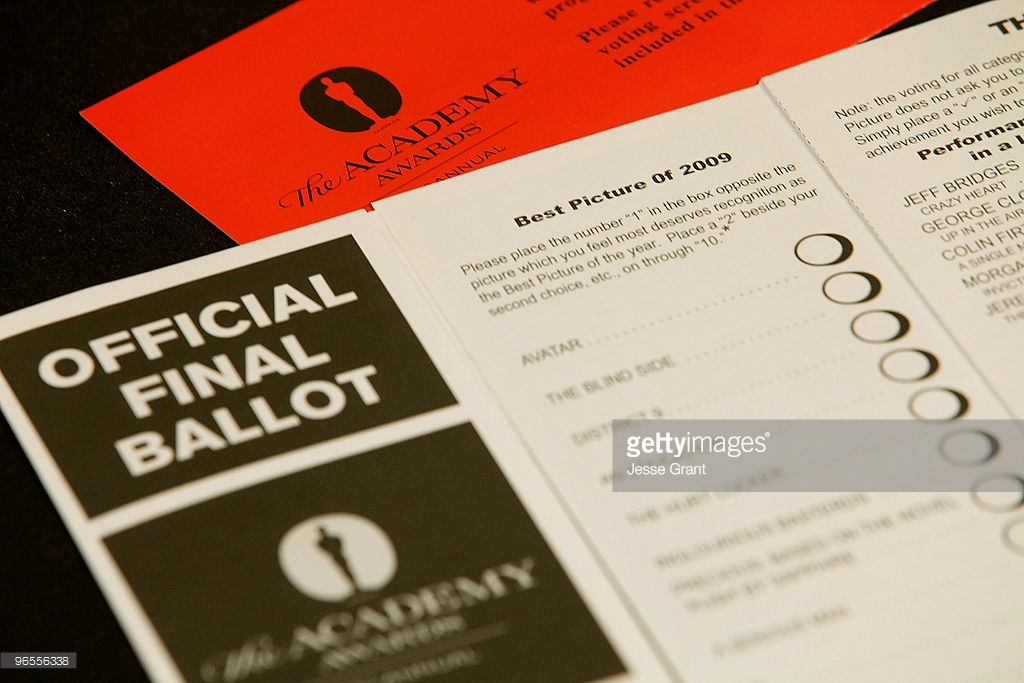
actor must have a credited role in at least 3 films, and a writer should have at least 2 credits, and all must have “achieved distinction” in the motion picture arts and sciences. The tricky part is that you can only be a member of one branch, so someone like Ben Affleck has to decide whether he wants to be there as an actor, a director, or a writer. Each category votes only for itself – on editors can decide who will be nominated for best editing, and only actors vote for best actors nominees. Everyone can vote for best picture, however.

For a film to be considered, it has to meet some basic requirements: it must be over 40 minutes, it must have had at least a 7-straight-day run at a paid-admission L.A. theatre, and it can’t have debuted on television or the internet.

When an Academy member receives a ballot, they get to list their 5 nominee choices in order of preference, and are encouraged to “follow their heart”. The ballots are counted by hand, and the accounting firm looks for the “magic number” – the number of mentions it takes to turn a name into a nomination. The formula they use is: total # of ballots, divided by total possible nominees plus 1. So for Best Director, say you have 600 ballots, and you get to have 5 nominees (plus 1 = 6), that’s 600 divided by 6, or 100 ballots to become a nominee.

The counting starts based on a voter’s first choice  until someone reaches the magic number. Once Damian Chazelle (for example), reaches the magic number, all the ballots that had him as first choice will be set aside. The director with the fewest first-place votes is automatically knocked out, and those ballots are redistributed based on the voters’ second choice (the directors still in the running keep their calculated votes from the first round).  Once the nominees are announced today, the accounting firm will now send out new ballots and everyone can vote in all categories for the actual awards, although people are discouraged from voting for categories that they don’t understand.

Now on to the nominations!

Best Picture

Arrival

Fences

Hacksaw Ridge

Hell Or High Water

Hidden Figures

La La Land

Lion

Manchester By The Sea

Moonlight

Best Director

Denis Villeneuve – Arrival
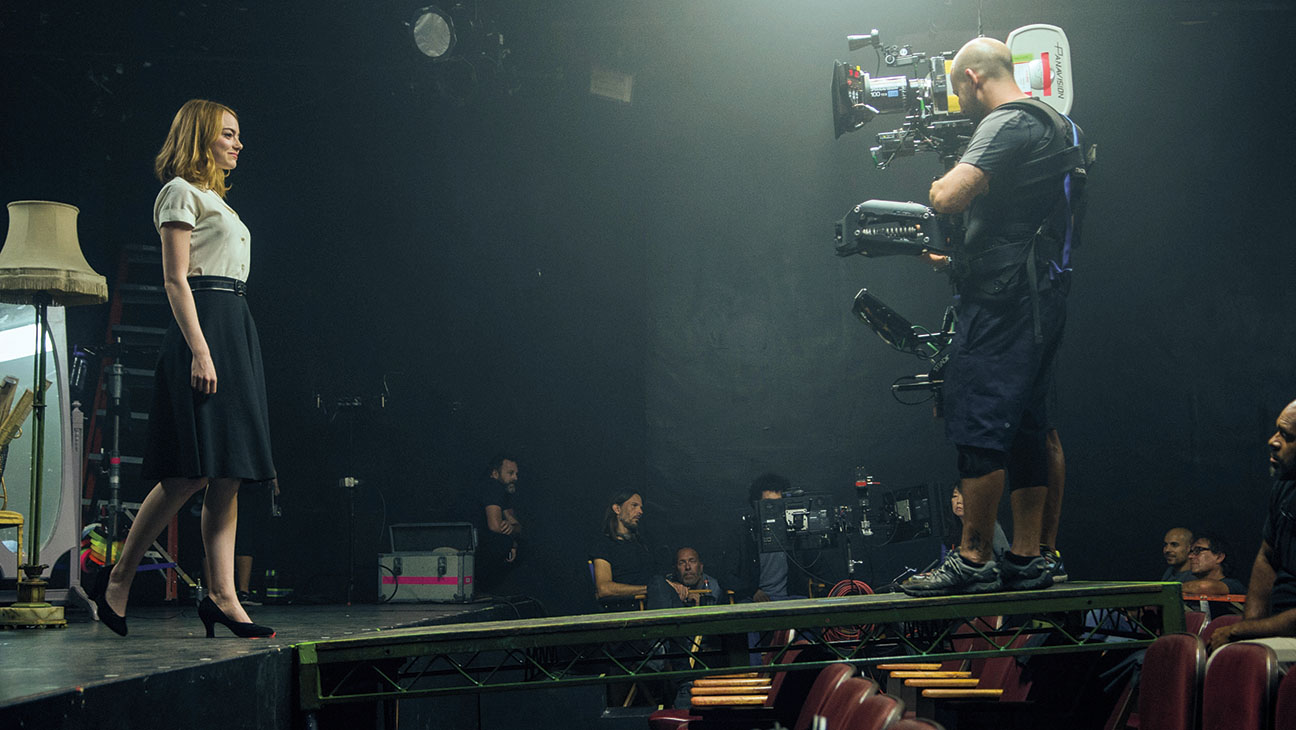
Mel Gibson – Hacksaw Ridge

Damien Chazelle – La La Land

Kenneth Lonergan – Manchester By The Sea

Barry Jenkins – Moonlight

Best Actor

Casey Affleck, Manchester By the Sea

Andrew Garfield, Hacksaw Ridge

Ryan Gosling, La La Land

Viggo Mortensen, Captain Fantastic

Denzel Washington, Fences

Best Actress

Ruth Negga, Loving

Isabelle Huppert, Elle

Natalie Portman, Jackie

Emma Stone, La La Land

Meryl Streep, Florence Foster Jenkins

Supporting Actor

Lucas Hedges, Manchester By The Sea

Jeff Bridges, Hell or High Water

Michael Shannon, Nocturnal Animals

Dev Patel, Lion

Mahershala Ali, Moonlight

Cinematography

Arrival (Bradford Young)

La La Land (Linus Sandgren)

Lion (Greig Fraser)

Moonlight (James Laxton)

Silence (Rodrigo Prieto)

Documentary

Fire At Sea

I Am Not Your Negro

Life, Animated

OJ: Made In America

13th

Documentary Short

Extremis

4.1 Miles

The White Helmets

Watani: My Homeland

Joe’s Violin

Foreign Language Film

Land of Mine

A Man Called Ove

The Salesman

Tanna

Toni Erdmann

Live Action Short

Ennemis Entreniers

La Femme et le TGV

Silent Nights

Sing

Timecode

Sound Editing

Arrival

Deepwater Horizon

Hacksaw Ridge

La La Land

Sully

Sound Mixing

Arrival

Hacksaw Ridge

La La Land

Rogue One

13 Hours: The Secret Soldiers of Benghazi

Production Design

Arrival

Fantastic Beasts and Where to Find Them

Hail, Caesar

La La Land

Passengers

Visual Effects

Deepwater Horizon

Doctor Strange

The Jungle Book

Kubo And the Two Strings

Rogue One: A Star Wars Story

Costumes

Allied (Joanna Johnston)

Fantastic Beasts (Colleen Atwood)

Florence Foster Jenkins (Consolata Boyle)

Jackie (Madeline Fontaine)

La La Land (Mary Zophres)

Original Screenplay

Hell or High Water (Taylor Sheridan)

La La Land (Damien Chazelle)

The Lobster (Yorgos Lanthimos, Efthimis Filippou)

Manchester By the Sea (Kenneth Lonergan)

20th Century Women (Mike Mills)

Adapted Screenplay

Arrival (Eric Heisserer)

Fences (August Wilson)

Hidden Figures (Allison Schroeder and Theodore Melfi)

Lion (Luke Davies)

Moonlight (Screenplay by Barry Jenkins; Story by Tarell Alvin McCraney)

Makeup & Hairstyling

A Man Called Ove (Eva von Bahr and Love Larson)

Star Trek Beyond (Joel Harlow and Richard Alonzo)

Suicide Squad (Alessandro Bertolazzi, Giorgio Gregorini and Christopher Nelson)

Original Score

Jackie (Mica Levi)

La La Land (Justin Hurwitz)

Lion (Dustin O’Halloran and Hauschka)

Moonlight (Nicholas Britell)

Passengers (Thomas Newman)

Original song

Audition – La La Land

Can’t Stop the Feeling – Trolls

City of Stars – La La Land

The Empty Chair – Jim: The James Foley Story

How Far I’ll Go – Moana

Animated

Kubo And the Two Strings

Moana

My Life As A Zucchini

The Red Turtle

Zootopia

Animated Short

Blind Vaysha

Borrowed Time

Pear Cider and Cigarettes

Pearl

Piper

Editing

Hacksaw Ridge (John Gilbert)

Arrival (Joe Walker)

Hell or High Water (Jake Roberts)

La La Land (Tom Cross)

Moonlight (Nat Sanders and Joi McMillon)

Supporting Actress

Viola Davis, Fences

Naomie Harris, Moonlight

Nicole Kidman, Lion

Octavia Spencer, Hidden Figures

Michelle Williams, Manchester By the Sea

Wow, we’ve seen a lot of these! What have you seen, loved, hated, felt was overhyped? Surprises?

Split

Ironically, I think it’s the film itself that suffers from DID (dissociative identity disorder, or “multiple personalities”). M. Night Shyamalan can’t decide if this is a strict horror film or if it’s more thriller, or character-driven. He jumps right into the plot with minimal fuss: three teenaged girls are abducted by a very methodical man who turned out to be only one personality among many. Captive, the girls try to figure out which of the personalities might be induced to help them, and which ones mean them harm.

The film works as well as it does because James McAvoy was the perfect casting choice (although he was 2nd choice, and only took the role when Joaquin Phoenix had some conflicts). In the hands of anyone else, the disorder might have seemed funny or splitshadow.jpgcartoonish, but McAvoy gives each personality a distinctive flavour without ever resorting to stereotypes. And that’s hard work period, never mind the fact that he’s fighting Shyamalan’s confused script, that seems to want to have something meaningful to say about this controversial disorder, but also really just wants to be an exploitative horror film. You can’t have it both ways.

Split is further testament that M. Night Shymalan has lost his way. He doesn’t know who he is as a film maker anymore, and his lack of confidence is evident in the script and on the screen. Having jumped head first into action, he then seems to regret his choice of not split-anya-taylor-joy-betty-buckley-jessica-sula.jpghaving introduced any of his characters. He bestows back stories on two of them through flashbacks, hoping it’s not too late. The rest remain paper thin. The girls (Anya Taylor-Joy, Haley Lu Richardson, Jessica Sula) are mostly there to scream on cue, and to wear progressively less clothing.
Is it a bad movie? No. No-ish. It’s not without merit. I was drawn in, and stressed out. I had all the right reactions. I just didn’t buy it 100%. You might be tempted, particularly by the film’s end, to say that it’s Shyamalan’s best work since Unbreakable. He’s certainly hoping you’ll say that, banking on it in fact. It’s not the highest compliment, of course, but I’m guessing he’ll take it.

20th Century Women

1979: three women. Dorothea (Annette Bening) is an older single mother of a teenaged son who she fears is missing out on some seminal influences, so she enlists his precocious friend Julie (Elle Fanning) and her free spirit\punk photographer tenant Abbie (Greta Gerwig) to “it takes a village” him.

If 20th Century Women isn’t as concerned with being an accurate reflection of the times, it’s a fucking brilliant portraiture. The characters, expertly drawn by writer-director Mike 20th-century-women-annette-benningMills, feel very much like real people because their problems are so distinct. The women don’t bleed into each other; they are each accorded with specific neuroses, anxieties, passions, and influences. We know a little about how they were born, and how they will die, but mostly we know how they are living. 20th Century Women is not plot-driven; nothing “happens” except truth is revealed through meticulous character study.

It helps, of course, to have Annette Bening on board. She’s the reason we’re watching. Her performance was nominated for a Golden Globe. I have been rooting all awards-season long for Natalie Portman in Jackie but having seen this, it will be difficult to go back. Bening treats this movie like a masterclass in acting. Nothing is showy or extraneous. In fact, some of her most brilliant times on screen are in perfect silence, with just the wrinkle of her brow or the droop of her shoulder or some awkward middle-aged dancing communicating all we need to know. Fanning and Gerwig are really quite good as well, but I only know that from the scenes which Bening sits out. If she’s onscreen, my eyes are glued to her. She’s always been this watchable, it’s just been a while since she’s had a role that was equal to her.

Mills’ affection for his characters is evident in their quirkiness. 20th Century Women is funnier than it has to be. Since I’m a strict non-talker at the movies, I tend to communicate approval through hand squeezes. I felt like I’d done a lot of squeezing by the end of the movie, even a little eye-catching and eyebrow lifting, which is probably moot in a dark theatre, but I was feeling magnanimous!  Sean concurred, which I think is an even thumbnail_25085better endorsement for a film that couldn’t be further from his own experience. And that’s what’s so remarkable. Though its genius is in the details, the specificity of the characters, it’s all somehow very relatable. And any movie that’s also a mirror is definitely worth its salt.

The Founder

the-founder-movie-2016-trailer-michael-keatonI suppose it was to be expected that Ray Kroc, the “founder” of McDonald’s, was an asshole. But, wow, was he ever an asshole. He died well before this movie was made but it seems he would have agreed with that assessment and been fine with it since it got him where he wanted to be – it made him rich, eventually.

But not without some struggles. You see, he didn’t “create” McDonald’s until he was 52 years old, and the reason for the quotation marks is because he didn’t actually create it. But as we know, history is written by the victors, and that’s Ray Kroc.

Michael Keaton is extremely good as Kroc. Good to the point that he makes Kroc seem like almost a decent guy even though he’d take your last McNugget whether or not he was hungry. The great Nick Offerman and the familiar John Carroll Lynch are excellent as well as Kroc’s former partners, the McDonald brothers. Other familiar faces will pop up for a scene or two, but this movie is mainly about Kroc and the McDonalds.

The Founder’s story is an interesting and engaging one from start to finish. It skips around noticably at parts and I felt a bit disconnected from the movie as a result, but the core tale remained crisp, clear, and entertaining throughout, to the point that the lawyer side of me wanted to yell at the screen as one particularly bad decision was made.

So bring your notepad and find out how an empire can be built from practically nothing on someone else’s idea, as long as you don’t mind being an asshole about it. The Founder gets a score of seven “fries with that” out of ten.

Social Anxiety & Celebrity

Sean and I watched Neal Brennan’s stand-up special 3 Mics on Netflix earlier this week. Neal Brennan was the co-creator and co-writer and co-everything else on Chappelle’s Show, which meant a whole lot of success all at once, and then even more abruptly, nothing at all. He has since reinvented himself as a stand-up comedian, but what you get from watching 3 Mics isn’t your typical routine. It’s got plenty of laughs, particularly from the “one-liners” mic, but he’s most riveting when he’s at another mic, a less funny mic, the one where he talks about  “emotional stuff.”

He talks candidly about his depression, his childhood, his career, his father’s alcoholism and emotional abuse. He talks about the void where self esteem usually goes, and how he spent many years all too happy to hide behind his more gregarious partner, Dave Chappelle. Still fighting his demons, he is nonetheless up on the stage, and he’s getting very honest about how hard it is for him to be there, and why it’s so important that he stay.

Which set me to thinking a couple of days ago when I was at a USS concert. Ubiquitous Synergy Seeker is the best band you’ve never heard of, an electronic-based alt-rock duo (comprising a singer-guitar player named Ash and a hype man called Jason) who describe themselves as “camp fire after-party” and sound kind of like if kurt cobain and kanye had ever met and made an album – only not, it’s way more unique than that, and so, so listenable. Singable. Danceable. Turn-uppable. Bliss outable. And it just so happens that the singer-guitar player dude, Ashley Buchholtz is a notoriously shy “hyper-introvert” who’s battled his own demons, struggled with self worth, and even now, to a crowd of adoring fans, admits that singing the songs we paid to hear is hard for him – his greatest fear, actually.

So that made me think about how we view performers as people who are outgoing, and who seek the spotlight, even though that’s not always the case. And as I read up on actors I’d heard were particularly shy, I heard over and over that performing was a way to overcome shyness, but for a lot of people, it’s never completely overcome. Carol Burnett felt she could only perform “in character” and would clam up if she was just being herself. Barbara Streisand rarely performs live because even after decades of super-stardom, she’s still a pack of nerves before every show (so, reportedly, is Adele).

Adam Sandler is so shy he rarely does press and when he does, it’s almost always in character. You’ll notice that when he sings, it’s almost always in another voice; funny accents help him overcome his nervousness.

Kim Basinger struggles so much that when she won her Oscar in 1997 (best supporting actress – L.A. Confidential), she was hardly able to speak. She has agoraphobia, panic attacks, and social anxiety: some days, leaving the house is more than she can bear.

Kristen Stewart has a reputation for being cold and distant, but the true source of her reserve is crippling shyness. She worries so much about what others think of her, she can barely stand to talk about herself, and comes off guarded and sullen in interviews.

Nicole Kidman has overcome the stutter that made her so shy as a child, but even now there are days she can’t stand to walk into a restaurant or a party alone. Richard Gere was so shy as a child that his parents wondered if he could even speak. Evan Rachel Wood was too shy to even order a pizza.

Courtney Cox has said that her shyness has limited her career. Being too nervous to audition, to risk rejection, she hasn’t pursued a movie career like other Friends.

Mark Ruffalo describes himself as an introvert and a bit of a “depressed person” who negotiates happiness for himself on a day to day basis. Director Tom Ford thinks of himself as a loner, and  “Very introverted. I’m very shy. I’m very emotional.”

Of her anxiety, Jennifer Lawrence says “I have a prescription.” She doesn’t think it’s likely to get any easier, either: “No, I’m always just very nervous. I never feel like, ‘I’ve got this.’ I’m always very nervous and aware of how quickly people can hate you and that scares me.”

Sarah Silverman adds “People use “panic attack” very casually out here in Los Angeles, but I don’t think most of them really know what it is. Every breath is labored. You are dying. You are going to die. It’s terrifying. And then when the attack is over, the depression is still there.”

Emma Stone’s panic attacks were so intense when she was little, it led to agoraphobia. She manages them better today, but that doesn’t mean she doesn’t get them, it just means she’s learned some ways to cope. The red carpet life must be extra-stressful for anyone who suffers with social anxiety. I think it’s really cool to pursue your passion even when it butts heads with your fears. I applaud anyone who has to work hard just be among people, and I’m even more impressed with those who find a voice with which to speak out, and to remind us that we’re never alone. Someone else is feeling it too.

Words of wisdom from USS: Chill out. Be easy on yourself.

Blade Runner

Jay provides an excellent litmus test anytime I’m unable to separate nostalgia from quality.  It happened with Star Wars, it happened with Indiana Jones, and it has now happened with Blade Runner.  As I write this, it occurs to me that Jay may just hate Harrison Ford, but let’s leave that aside for now.

Yes, because Blade Runner 2049 is on the horizon, I was able to convince Jay to watch Blade Runner with me earlier this week.  Anytime I can get Jay to watch what I will call nerd-fi, a category that includes most movies I saw in the 80s and 90s, it feels like a major brunner4victory.  But only until the movie starts, because so far, about 5 minutes into each movie I proudly show to Jay, she wonders why I bothered to beg her to watch this one, asking things like, “Do you remember it being this bad?” when the flying cars first come into view.

Maddeningly, I can’t even argue against her assessments.  In 2017, Blade Runner is not a great movie.  It’s not really even a good movie.  It’s a movie with vision, it’s beautiful to look at (though the flying cars do look as horrible as Jay pointed out), it brought dystopian futures and particularly Philip K. Dick to mainstream cinema, and it has an ambiguous ending that becomes even more so with every new cut issued by Ridley Scott.  But it’s also a movie with cornball acting, disposable characters that we are barely introduced to, and a ton of sequences that are beautiful but: (a) extremely repetitive (how many times do we need to see a car fly by a Coke billboard or the offworld blimp ad);  (b) essentially silent (like Ford’s visit to a food cart/open air diner); and (c) do nothing to advance the plot (which, let’s be honest, is probably about 35 minutes worth of movie without being padded by all the beautiful shots of futuristic Los Angeles).

brunnerStill, there is something to be said about Blade Runner and something reassuring about its continued relevance.  A big reason that the movie feels thin today is because it has been so influential.  We’ve seen so many films build on what Blade Runner started, and in comparison, Blade Runner is like a wheel made out of stone.  In that way, it’s important but if choosing between the original or the best that the genre has to offer today, the modern film is going to be the better one.  But there is still room in my heart for the rickety original, the one that was ahead of its time (and ahead of ours, as Blade Runner is set in the “distant” future of 2019).

And in some distant future of our own, maybe I will find a movie that I feel nostalgic for that also stands up to Jay’s critical eye.  Your suggestions are welcome!

Divines

Shit. This is not some easy-breezy coming of age story, I’ll tell you that much for free. You’d be forgiven for assuming as much when the camera originally picks up with two teenaged girls who goof off in class and daydream about making big money, but that’s just the first sign that you should buckle the fuck up.

Dounia (Oulaya Amamra) and Maiimouna (Deborah Lukumuena) are from the shanty side of Paris, where they’re expected to train as receptionists at school. The teacher is as clueless as divines-movie-download-english-subtitlesthe class is hopeless, and you can’t quite bring yourself to blame these girls for dropping out. But then Dounia meets two people who might potentially change her life:  Djigui, an untrained but talented dancer, who makes her think a different kind of life is possible, and Rebecca, a glamorous young drug dealer\sex worker who makes that different kind of life accessible.

Dounia is nothing if not an upstarter. With boundless energy and roiling teenaged cynicism, she and her friend put themselves in situations they’re too stupid to realize are crazy dangerous. They’re both too mature and too naive, eager to make their mark but easily manipulated. The camera’s gaze is unflinching, even if ours is not. No matter how big and bad the girls pretend to be, their youth and inexperience betray them.

Writer-director Houda Benyamina gives a  gritty but sympathetic look at the less polished side of Paris, where money, race, and power are unapologetically at the forefront of everyday existence. The film is raw and filled with rage, which means it’s got this really buzzy undercurrent that makes you feel like anything is possible and you have no idea where it’s all going. The energy is astounding, especially from a largely unknown cast (Amamra is Benyamina’s little sister), and even though this isn’t a typically “enjoyable” film, I felt pulled inside of it, headlong, and we all just prayed that we’d make it out alive.

Patriots Day

patriotsday-markwahlberg-marathonbannerTerrorists are despicable. They take lives or limbs and create chaos and fear, sometimes in support of twisted ideology, sometimes just for kicks, and always demonstrate a complete lack of humanity. Sensational as their actions are, what deserves recognition are not the acts themselves, but the responses by the terrorists’ targets.
Patriots Day revisits Boston’s response to the 2013 Boston Marathon bombings. It is a difficult watch but it has to be. We have to feel the weight of the loss in order to appreciate Bostonians’ courage in the face of a homegrown terrorist attack by two brothers who, from outward appearances, were just a couple of millenials trying to find their way (bizarrely, at least one apparently was a 9/11 truther).

Patriots Day provides a behind-the-scenes look at the events leading up to the bombings and then the hunt for these monsters who intended to strike Times Square next. They killed three people with their bombs and killed two more cops in the aftermath. Amidst the carnage, the police remain focused on bringing these suspects in alive, and it seems they might have succeeded in that endeavour but for the brothers’ lunacy.

Peter Berg and Mark Walhberg have turned these real life disaster movies (tragopics?) into big business for themselves, and Patriots Day improves on their formula from Deepwater Horizon.  Both movies take an arms’ length approach and do a good job of sticking to the facts. These characters are not perfect because they don’t need to be. Some, like Mark Wahlberg’s character, are composites. That is a bit weird when we are introduced to the real people at the end of the movie and the main character is missing, but in the middle of the crisis the character feels real and that’s what matters most. This movie feels real as well and is definitely worth watching.

I suspect even if Wahlberg’s character were real, he would not have given such a perfect off-the-cuff speech at the climax, but again, it works. It works because it captures how the people of Boston responded to this terrible event: not with hate or fear, but with determination, resolve, and strength. In the immortal words of David Ortiz (who appears in the film):


Silence

Martin Scorsese and I had very different reactions whilst reading Shusaku Endo’s acclaimed novel, Silence. He thought: this will make a great movie, even if it takes me 28 years to bring it to theatres (and it did). I, however, got through the book like one gets through a prison sentence: head down, one day at a time, putting in my time, hoping it rs-silence-8ec449bd-cf0f-4008-942e-3d25d5a334f7doesn’t kill me. Having read the book, I knew exactly what we were in for with the movie, and I warned anyone who would listen, but that doesn’t mean I didn’t want to see it. It’s Scorsese. I mean, that alone is enough. But I also know that Martin Scorsese has something to say about spirituality, and if he’s gotten away from it with his last few movies, this one is a major reinvigoration of his theme.
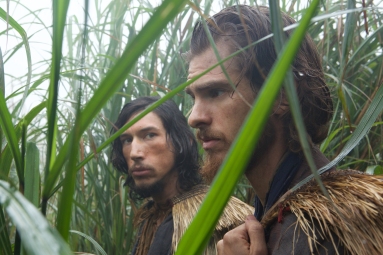
Little Marty was friends with a loving and influential priest growing up, and this encouraged him to join a seminary to become a priest himself. Lacking a true calling to the vocation, Scorsese flunked out, but he never stopped asking himself how a priest got past his own ego, his own pride, to put the needs of his parishioners first.

In many ways, that’s exactly what the film Silence asks of its main protagonist Father Rodrigues (Andrew Garfield), a Christian missionary sent to Japan in the 1600s, when Christianity was outlawed, and his presence forbidden. He and Father Garrpe (Adam Driver), in search of their mentor Father Ferreira (Liam Neeson), make the voyage to a land unknown. They haven’t heard from him directly in years, but there are rumours that he has renounced his faith. Certain that this cannot be true, the two young missionaries vow to find and rescue him, while restoring the faith of their underground followers.

Praise be to Scorsese’s cinematographer, Rodrigo Prieto, who helps create this world with so many natural touches: fog allowed to hide and obscure, fire reminding us of the hell silence-01083r.jpgthat Rodrigues faces, or the hell that he’s in now. Even though the movie is relentlessly brutal, you’ll still be wowed by the images, the beauty lurking within the swamp.
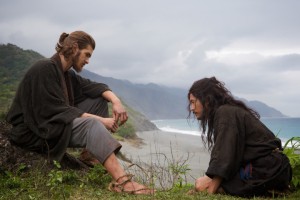
Silence is uncomfortable – truly, truly uncomfortable. The tortures are otherworldly. What’s the takeaway from these 161 minutes of quiet pierced with merciless violence? Silence leaves you with more questions than answers, and how you feel about it will depend on how filled with god’s love your heart is going in. Yes it’s a meditation on religion and spirituality, but it isn’t afraid to point-blank ask us whether we’ve heard or felt god in the silence. Is he there, quietly observing his people be tortured and killed? Is he there, silently allowing persecution and murder? Does silence sow seeds of doubt?

For the most part, Scorsese seems to be fairly neutral in the plight of Christians vs. Japan. I definitely felt the strong whiff of colonization, the belief that the stories white people tell each other about their god and heaven are somehow more true than the stories the Japanese have been telling for centuries. Not just more true but The Truth. These might be 17th century problems, but they sound very familiar – almost like those same problems are here in the 21st century as well.

SILENCEThis Asshole Atheist really noticed the distinction between religion and faith – religion being something a government can choose to eradicate; faith, however, is much more difficult. Silence is really a question of belief, not just what you believe, but how strongly you believe it, how strongly you think others should believe it, how far you’re willing to go to impose those beliefs, how much pain you can endure before you abandon those beliefs. And if god himself can hide in silence, can belief dwell there also?
With Martin Scorsese at the helm, you already know this is a disciplined and wondrous exercise in film making, perhaps a masterpiece among masterpieces from this celebrated auteur. But Silence is best discussed by the feelings it evokes in the viewer. It’s meant to be thought-provoking. If god is love, is it better to love god even in the face of threat, or is it better to love our fellow man even when it means denying god? One gruesome scene marches into another, never quite glorifying the martyr, never quite condemning the oppressor. Maybe the point is that there is no point. Silence is a theological debate that grants permission to test the limits of faith, to ask the unanswerables. It is difficult to watch and difficult to process but I believe that Silence is meaningful even to the non-believer: it’s just that good a film.

Live By Night

It’s possible that Live By Night will give hope to mopey gangsters everywhere by raising awareness of their difficult, stressful lives. It can’t be easy making money hand over fist by preying on the working class, especially when other bad guys are constantly trying to pick fights with you. In that small way, Ben Affleck (a.k.a. the director of Argo and the Town) has done those poor souls a great service by finally addressing this important topic and bringing their suffering to light.  screen_shot_2016-09-08_at_4-54-03_pm

[/sarcasm]

It’s clearly long past time for Matt Damon to stage an intervention. Affleck has lost his way and next on his list of mopey outlaws is the Batman. There can now be no doubt that Affleck will use that movie like he used this one, to share his people’s plight by bringing more one-percenter depression to the silver screen.  I can neither tolerate another bad Batman movie nor refrain from seeing whatever schlock is put onscreen starring a comic book character (I am so far gone I thought the Logan trailer looked good). Help me, Matt Damon, you’re my only hope!

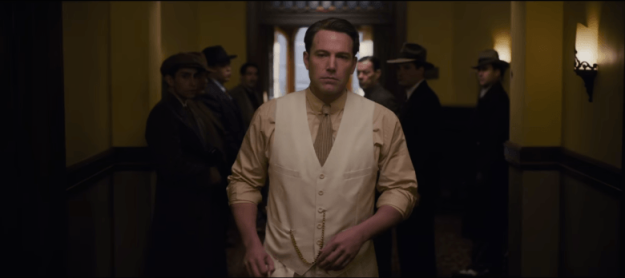
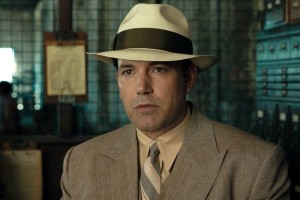
Putting aside my Batman-related angst and focusing on Live By Night, Affleck is the core of what is wrong with the movie, which I suppose is inevitable since he directs, stars and wrote the screenplay. I suspect he’s even disappointed in himself. He should be, becauslead_960e if nothing else the role he has created for himself is a terrible one. The lead character is remarkably unsympathetic and no amount of teary-eyed inner conflict or monotone monologuing in voiceover form (because this character doesn’t like to express feelings aloud) can change that. On top of that, his hats make him look ridiculous, and there are so many hats.
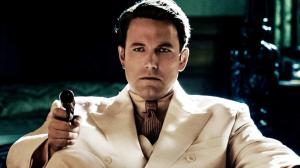
Affleck the writer/director also does himself no favours by all but omitting action scenes from this gangster tale. Worse, the film’s few action scenes are as a jumble of tommy-gun-wielding m_8e517450-d96c-11e6-a260-7aa04c68bc63aniacs shooting at each other that leave the viewer unclear as to who’s on whose side (spoiler alert: the guys doing the killing are the ones on Affleck’s character’s side). Affleck also completely wastes Brendan Gleeson, Zoe Saldana, Chris Cooper, Elle Fanning, and most egregiously Agent Coulson (though Jay took Chris Messina’s bad teeth and pot belly hardest but at least Messina got a decent amount of screen time).

In case you can’t tell by now, Live By Night is not a good movie, not by a long shot.  I should have seen Patriots Day instead. Did you hear that, Affleck? I should have seen a Mark Wahlberg-Peter Berg joint rather than this mess. You’re an Oscar winning writer, dammit! Go think about what you’ve done and get your shit together before you ruin Batman too.