Tag Archives: Oscar contender

Ferdinand

Ferdinand is a big, beefy bull who accidentally destroys a village and gets branded a beast. The biggest, most monstrous bulls get chosen by the matador for bullfights, MV5BZWQ5ODZiMWMtYjM1Yy00ZDlhLTkwYzctNTQxNzE5MDRhNmIxXkEyXkFqcGdeQXVyNjA0MTc4OQ@@._V1_SX1777_CR0,0,1777,738_AL_but Ferdinand has never aspired to such fame. He’s a gentle soul, really, a pacifist. The other bulls are quite judgmental about his lack of fight but Ferdinand stays true to himself.

And that’s all I really have to say about it. This is not Pixar; it’s not intended for adults, or particularly bright children. Ferdinand is forgettable. It doesn’t even try to surprise you. But John Cena as Ferdinand is pretty okay and Kate McKinnon as a “calming goat” is sometimes nearly funny, so I guess there’s that. It just feels lackluster, and lazy.

Oscar Nominations 2018

Since we got 18 hours’ worth of snow and freezing rain between Monday afternoon and Tuesday morning, Jay and I both got to stay home and watch Andy Serkis and Tiffany Haddish announce the 2018 Oscar Nominees.

Our instant reaction after the presentation finished?  Quite positive, I’d say.  The Academy seems to have included everyone who ought to be a contender for these awards, save for James Franco but there’s an understandable reason for that (#metoo).  The only real disappointment was that Wonder Woman didn’t get any nominations at all, which seems like a significant omission for a movie that is fifth on Rotten Tomatoes’ best of 2017 list, particularly when the terrible Suicide Squad got nominated for (and won!) an Oscar in 2017.

Even though Wonder Woman didn’t get any nominations, it was both satisfying and encouraging to see Jordan Peele’s Get Out and Greta Gerwig’s Lady Bird get the recognition they both deserve.  Hopefully, their success will lead to other quality passion projects like those getting a green light and finding their audiences too.

Here’s the full list of nominations along with links to the ones we’ve reviewed (we got most of them and will be working on the rest between now and March 4th).

Did you spot any glaring omissions by the Academy?  If so, let us know in the comments!

BEST PICTURE:

Call Me By Your Name

Darkest Hour

Dunkirk

Get Out

Lady Bird

Phantom Thread

The Post

The Shape of Water

Three Billboards Outside Ebbing, Missouri


DIRECTING:

Christopher Nolan — Dunkirk

Jordan Peele — Get Out

Greta Gerwig — Lady Bird

Paul Thomas Anderson — Phantom Thread

Guillermo del Toro — The Shape of Water


ORIGINAL SCREENPLAY:

The Big Sick — Emily V. Gordon, Kumail Nanjiani

Get Out — Jordan Peele

Lady Bird — Greta Gerwig

The Shape of Water — Guillermo del Toro, Vanessa Taylor

Three Billboards Outside Ebbing, Missouri — Martin McDonagh


ADAPTED SCREENPLAY:

Call Me By Your Name — James Ivory

The Disaster Artist — Scott Neustadter, Michael H. Weber

Logan — Scott Frank, James Mangold, Michael Green

Molly’s Game — Aaron Sorkin

Mudbound — Virgil Williams, Dee Rees


ACTOR IN A LEADING ROLE:

Timothée Chalamet — Call Me By Your Name

Daniel Day Lewis — Phantom Thread

Daniel Kaluuya — Get Out

Gary Oldman — Darkest Hour

Denzel Washington — Roman J. Israel, Esq.


ACTRESS IN A LEADING ROLE:

Sally Hawkins — The Shape of Water

Frances McDormand — Three Billboards Outside Ebbing, Missouri

Margot Robbie — I, Tonya

Saoirse Ronan — Lady Bird

Meryl Streep — The Post


ACTOR IN A SUPPORTING ROLE:

Willem Dafoe — The Florida Project

Woody Harrelson — Three Billboards Outside Ebbing, Missouri

Richard Jenkins — The Shape of Water

Christopher Plummer — All the Money in the World

Sam Rockwell — Three Billboards Outside Ebbing, Missouri


ACTRESS IN A SUPPORTING ROLE:

Mary J. Blige — Mudbound

Allison Janney — I, Tonya

Lesley Manville — Phantom Thread

Laurie Metcalf — Lady Bird

Octavia Spencer — The Shape of Water


DOCUMENTARY (FEATURE):

Abacus: Small Enough to Jail — Steve James, Mark Mitten, Julie Goldman

Faces Places — Agnès Varda, JR and Rosalie Varda

Icarus — Bryan Fogel, Dan Cogan

Last Men in Aleppo — Feras Fayyad, Kareem Abeed, Søren Steen Jespersen

Strong Island — Yance Ford, Joslyn Barnes


DOCUMENTARY (SHORT SUBJECT):

Edith + Eddie — Laura Checkoway, Thomas Lee Wright

Heaven is a Traffic Jam on the 405 — Frank Stiefel

Heroin(e) — Elaine McMilion Sheldon, Kerrin Sheldon

Knife Skills — Thomas Lennon

Traffic Stop — Kate Davis, David Heilbroner


LIVE ACTION SHORT FILM:

DeKalb Elementary — Reed Van Dyk

The Eleven O’Clock — Derin Seale, Josh Lawson

My Nephew Emmett — Kevin Wilson Jr.

The Silent Child — Chris Overton, Rachel Shenton

Watu Wote / All of Us — Katja Benrath, Tobias Rosen


ANIMATED FEATURE FILM:

The Boss Baby — Tom McGrath, Ramsey Naito

The Breadwinner — Nora Twomey, Anthony Leo

Coco — Lee Unkrich, Darla K. Anderson

Ferdinand — Carlos Saldanha

Loving Vincent — Dorota Kobiela, Hugh Welchman, Ivan Mactaggart


ANIMATED SHORT FILM:

Dear Basketball — Glen Keane, Kobe Bryant

Garden Party — Victor Claire, Gabriel Grapperon

Lou — Dave Mullins, Dana Murray

Negative Space — Max Porter, Ru Kuwahata

Revolting Rhymes — Jakob Schuh, Jan Lachauer


FOREIGN LANGUAGE FILM:

A Fantastic Woman — Sebastián Lelio, Chile

The Insult — Ziad Doueiri, Lebanon

Loveless — Andrey Zvyagintsev, Russia

On Body and Soul — Ildikó Enyedi, Hungary

The Square — Ruben Östlund, Sweden


CINEMATOGRAPHY:

Blade Runner 2049 — Roger A. Deakins

Darkest Hour — Bruno Delbonnel

Dunkirk — Hoyte van Hoytema

Mudbound — Rachel Morrison

The Shape of Water — Dan Laustsen


PRODUCTION DESIGN:

Beauty and the Beast — Sarah Greenwood, Katie Spencer

Blade Runner 2049 — Dennis Gassner, Alessandra Querzola

Darkest Hour – Sarah Greenwood, Katie Spencer

Dunkirk — Nathan Crowley, Gary Fettis

The Shape of Water — Paul Denham Austerberry, Shane Vieau, Jeff Melvin


VISUAL EFFECTS:

Blade Runner 2049

Guardians of the Galaxy Vol. 2

Kong: Skull Island

Star Wars: The Last Jedi

War for the Planet of the Apes


FILM EDITING:

Baby Driver — Paul Machliss, Jonathan Amos

Dunkirk — Lee Smith

I, Tonya — Tatiana S. Riegel

The Shape of Water — Sidney Wolinsky

Three Billboards Outside Ebbing, Missouri — Jon Gregory


COSTUME DESIGN:

Beauty and the Beast — Jacqueline Durran

Darkest Hour — Jacqueline Durran

Phantom Thread — Mark Bridges

The Shape of Water — Luis Sequeira

Victoria & Abdul — Consolata Boyle


MAKEUP AND HAIRSTYLING:

Darkest Hour — Kazuhiro Tsuji, David Malinowski, Lucy Sibbick

Victoria & Abdul — Daniel Phillips, Lou Sheppard

Wonder — Arden Tuiten


ORIGINAL SCORE:

Dunkirk — Hans Zimmer

Phantom Thread — Jonny Greenwood

The Shape of Water — Alexandre Desplat

Star Wars: The Last Jedi — John Williams

Three Billboards Outside Ebbing, Missouri — Carter Burwell


ORIGINAL SONG:

“Mighty River” — Mudbound, Mary J. Blige, Raphael Saadiq, Taura Stinson

“Mystery of Love” — Call Me By Your Name, Sufjan Stevens

“Remember Me” — Coco, Kristen Anderson-Lopez, Robert Lopez

“Stand Up for Something” — Marshall, Diane Warren, Lonnie R. Lynn

“This is Me” — The Greatest Showman, Benj Pasek, Justin Paul


SOUND EDITING:

Baby Driver — Julian Slater

Blade Runner 2049 — Mark Mangini, Theo Green

Dunkirk — Richard King, Alex Gibson

The Shape of Water — Nathan Robitaille, Nelson Ferreira

Star Wars: The Last Jedi — Matthew Wood, Ren Klyce


SOUND MIXING:

Baby Driver — Julian Slater, Tim Cavagin, Mary H. Ellis

Blade Runner 2049— Ron Bartlett, Doug Hemphill, Mac Ruth

Dunkirk — Mark Weingarten, Gregg Landaker, Gary A. Rizzo

The Shape of Water — Christian Cooke, Bran Zoern, Glen Gauthier

Star Wars: The Last Jedi — David Parker, Michael Semanick, Ren Klyce, Stuart Wilson

The Post

In 1971, Kay Graham was the first of her kind, a female newspaper publisher, but she was never supposed to have the job. The Washington Post was part of the family business but her father passed it down not to her, but to her husband. But when her husband committed suicide, she stepped into shoes that had always been loafers, not heels.

Then, something amazing happens: someone leaks top secret documents that detail the Vietnam cover-up that spanned 4 U.S. presidents including the current one, Richard Nixon, who’s kind of a dick. The NY Times gets ahold of them but gets shut down by Tricky Dick and his cronies. The papers then filter down to The Washington Post, and Kay Graham has to decide whether she’s going to risk her little empire AND a serious prison sentence.

Interesting facts about Mrs. Graham: she was not a powerful business person, or used to MV5BMTg5Nzg3NjUzNV5BMl5BanBnXkFtZTgwNTY5NzA1NDM@._V1_SX1500_CR0,0,1500,999_AL_being in charge. She’d never had another job. She was naturally meek, and kind of nervous. She was surrounded by assertive men, some of whom weren’t crazy to have her among their midst and certainly didn’t see her as an equal never mind a boss, and none of whom were shy about voicing their opinions. She was, however, an accomplished socialite, which in the city of Washington, means she counted many prominent politicians among her friends – and the particular politician at the epicenter of this scandal was among her closest. These facts are not to diminish her but to illustrate just how courageous she truly was to take the stance she did.

Newsflash: Steven Spielberg is a good director. Yeah, we already knew this, but this film had me noticing all kinds of little details that I admired greatly. This movie has the feel of a smart and sharp little indie; it’s taut and thrilling and lots of fun. It gets a little heavy-handed at times but its best moments are when it’s showing, not telling.

Maybe Spielberg’s greatest asset is his incredible ensemble cast. Tom Hanks is the fevered editor, and he’s flawless. Bob Odenkirk is stupendous as a hard-working investigative journalist. But of course it’s Meryl Streep who steals the show as Kay Graham. It’s not a showy role. Mrs. Graham is never the biggest personality in the room. She’s not commanding, but we are nevertheless riveted by Ms. Streep. Her shaking hands, her tremulous lip – we see how hard this for her, and so we admire her all the more for doing it.

You are not contractually allowed to write a review of this film without using the word “timely”. About a year ago, Nixon was down-graded to only the second most douche-baggiest president in history. Truth matters. The press belongs to the governed, not the governors. Support journalism. Subscribe to a newspaper, even if you read it online. One day they’ll be making movies about this time. But this is not just a news story, it’s also, of course, a nod to feminism. Mrs. Graham walks through a sea of secretaries before she’s admitted to the all-male floor of the New York Stock Exchange. She faces a Supreme Court that has never had a female Justice and wouldn’t for another decade. When someone says that Mrs. Graham’s father willing the family business to Kay’s husband says a lot about the man, Tom Hanks replies that actually, it says more about the time. So yeah, this is the movie we all need right now. It’s essential viewing. But even if wasn’t so “timely”, it’s so thoroughly peppered by exceptionally talented people that The Post is an easy recommendation and a damn fine film.

The Florida Project

Thank you New Hampshire Film Festival for bringing this beautiful film to us. We missed seeing it at TIFF and it got huge buzz. HUGE. Director Sean Baker is following up his crazy-good Tangerine and we’ve been collectively, societally waiting with baited breath for his next effort. It feels like Sean Baker is doing important work without all the trumpets and majorettes and fanfare. But I sort of hope that maybe I can blow the horn a bit here, wave a flag or two: The Florida Project is fucking awesome.

6 year old Moonee has the run of the crummy Orlando motel where she and her mother live in “extended stays.” Halley, her mom, can’t get work at Disney and has no other MV5BYjZhMDZmZjItNjcyZC00ZWY2LTkzMzUtZWM0ZDgyYzM2Nzg2XkEyXkFqcGdeQXVyNDg2MjUxNjM@._V1_SY1000_CR0,0,1333,1000_AL_options, so you can imagine some of the crazy things they do for money. It’s a destitute, desperate kind of life but you’d never know it to see Mooney adventuring around free-range with her comrades.
Sean Baker is a master of society’s fringes, and the near-homelessness of the people constantly scrounging for rent between scrapes with the law or family services is about as marginal as you get. Situate that beside the self-proclaimed “happiest place on earth” where the wealthy tourists stay in much nicer digs and it’s an uncomfortable reminder that the rich get richer and the poor get poorer.

Moonee, meanwhile, is seemingly untouched by her circumstances. Intellectually, you know it’s not true: that of course she’s affected by what she sees and hears and eats and meets and experiences, and that she’ll find it hard to climb above her mother’s station. But for now she’s a happy-go-lucky kid who rarely faces consequences, although that’s largely thanks to the motel’s manager and de-facto babysitter, Bobby, who is the eyes, ears, caregiver and mediator when parents just aren’t up to snuff. And believe me, this is a building where neglect rules the day. I felt real tension watching these kids be unwatched.

Halley, barely more than a kid herself, and scarcely more responsible, is tattooed with bad decisions but not without sympathy. Bria Vinaite, who plays her, really understands Halley’s sharp corners and soft underbelly. Willem Dafoe gives Bobby a complexity and edge that make his character fascinating. He’s like the beating heart of the building he supervises. But it’s little Brooklynn Prince as Moonee who just about steals the whole gosh darn movie. She is so real and raw it often feels like you’re watching a documentary, and that the stakes are indeed life-altering. Child actors can make or break a movie but Sean Baker has found not one but a trio of incredibly spirited, natural, and talented kids that make this movie what it is.

The Florida Project is audacious, authentic, absorbing. And it’s begging to be watched.

The Breadwinner

Not all men are bad, not even all Afghan men. That’s important to remember. Not all of them want to treat women like garbage, but the taliban sure does. It’s not enough to cover women head to toe in burqas, but new rules in Afghanistan prohibit them from leaving the house at all, except in rare cases when accompanied by a father, husband, or brother.

Parvana’s older sister hasn’t left the house in so long she’s forgetting what it was like. Parvana is “lucky” because her father lost his leg in the war and his livelihood more recently, so she assists him down to the market where they try to sell their possessions in order to eat. Her father respects his daughters, educated them, and wants better things for them, things he can no longer give them with the oppressive taliban regime patrolling with guns and indignation. When the taliban inevitably hauls him off to prison for no reason, suddenly the family is left without an escape clause. Parvana’s mother andMV5BMDg0ODM5NTYtMjNkMS00NDQ3LWI5MGYtMDg3ZTQ5MDE0OTRlL2ltYWdlXkEyXkFqcGdeQXVyMjQ1NjA0ODM@._V1_ sister and baby brother could literally starve to death waiting for a man to come release them from their own home so Parvana does the only thing she can think of to save them: she cuts off her hair, wears the clothes of her dead brother, and to taliban eyes, becomes a boy.
You may recognize The Breadwinner as a recent high-profile screening at TIFF; Angelina Jolie is a producer and her red carpet appearance really shined the spotlight on this important film. People were equally excited to celebrate it at the Ottawa International Animation Festival. It played to a packed house and I imagine it will again on Saturday so if you haven’t got your tickets, get on it!

The Breadwinner’s animation is stunning.  Stunning. Like, I want to get tattoos of it on my body. That’s really the highest praise you can give, or that I can give, an animated movie, a compliment I haven’t given before or even thought to. The story is kind of perfection. It’s by no means an exact replica of the book. It diverges significantly from it but still feels like an authentic and spiritual distillation of it.

If The Breadwinner isn’t talked about come Oscar time, I’ll be shocked and outraged. Not taliban guy seeing a woman “calling attention to herself” by merely being outdoors outraged, but outraged. It’s a great story coupled with the most amazing animation but it also could not be more essential viewing at this moment in time.

Three Billboards Outside Ebbing, Missouri

Holy hell.

Writer-director Martin McDonagh has almost certainly reached the peak of his film making career with this film. It doesn’t get much better than this.

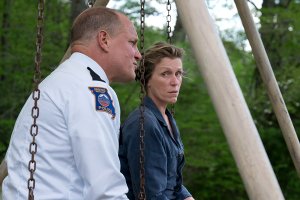
The three billboards in question have been rented by grieving mother Mildred Hayes (Frances McDormand) to accuse the town sheriff, Chief Willoughby (Woody Harrelson) of not having made any progress on the case since her daughter was brutally raped and murdered. Willoughby isn’t terribly pleased, but he’s got more important things to worry about – namely, terminal cancer. So it’s his racist, hotheaded, cruel officer Dixon (Sam Rockwell) who takes up his cause, torturing anyone he suspects of having helped.

MV5BZmMyMTg1NzEtNWZiZi00OTczLTg0NzUtNzFlNjI5YjJkMzkxXkEyXkFqcGdeQXVyNDg2MjUxNjM@._V1_SY1000_SX1500_AL_McDonagh uses lyrical language peppered with inspired cursewords; his heavy-weight cast punches it up with a surprising mixture of gravitas and black comedy.

Frances McDormand, national treasure, is of course fantastico. Wearing her ubiquitous coverall, she’s a no-nonsense woman who’s been through hell even before her daughter’s gruesome death. She is not without a softer side, though rarely seen. McDonagh gave her a couple of speeches that practically earned standing ovations at our screening. She walks a thin line between vengeance and justice but discovers she is not exempt herself. She’s got a terrific scene pitted against Willoughby that suggests these two have more history than we’re privy to. It’s a small town; there’s almost no vitriol without at least a measure of respect. As Willoughby, Harrelson once again reminds us he’s capable of almost anything. But, arguably, the man to watch is Sam Rockwell. He’s hateful, detestable, and yet we don’t quite hate him or detest him as we should. That’s sort of the miracle of McDonagh’s script – all of his characters are deeply flawed. Mildred is our protagonist but she’s no one’s hero. She makes too many mistakes. Dixon is all mistakes but for a small sliver of charm, and Rockwell exploits the hell out of it. He’s almost maniacal at times, and loads of fun to watch. Any time any of these power houses square off verbally, they’re shooting spitfire, and it’s even more entertaining to watch than a good old fashioned shoot out. And that’s not even mentioning a very capable stable of secondary characters that add dimensionality to the population of this small, insular town.

McDonagh’s world is not one of easy outs. It feels like he has asked himself – what would be most surprising here – and yet, despite a plot that constantly feels like it’s developing from the left field, it feels right.

I fully expect to see McDormand’s name on the Oscar ballot this year, in a race for Best Actress that’s already crowded (she’s the third name I’ve tossed out this festival alone). But Rockwell’s belongs there too – this is what Best Supporting aspires to be. Although conventionally shot, this is an extraordinary film, one I hope you’ll see and love when it comes out this November.

A Man Called Ove

There is indeed a man called Ove. He is a crotchety old man who rules his condo tenement with fierce rigidity. He’s aged out of his job and his wife has left him (well, died, but he’s such a grump I can only assume it was purposely, to escape him). I shouldn’t joke; his wife’s grave is the only time and place where he’s a little tender. Does he list her a litany of complaints? Of course he does. But only because the world’s gone to MV5BNTgzNDcxYzEtZDljOC00NDZmLTk2ZTAtOTVhM2Y1MWI1YzUyXkEyXkFqcGdeQXVyMDc2NTEzMw@@._V1_SY1000_CR0,0,1581,1000_AL_shit without her. The only reason he hasn’t committed suicide yet is the damn neighbours, who need constant monitoring and discipline, and who else would take it upon themselves to mete it out?
It turns out that Ove has had a pretty interesting life. It’s just that no one knows it because he isolates himself, sequestered in a condo that’s still a shrine to his dead wife. It’s only because some boisterous, needy new neighbors draw him out against his will that we learn the ups and downs that have contributed to his current thorny state. If you’re feeling like this sounds a little sentimental, well, it is. But it stays just shy of saccharine thanks to a nuanced performance by Rolf Lassgård in the title role. He never lets Ove go full-martyr, he keeps the role alive and flawed and beautiful. Ove’s may not exactly be a unique character arc, but it’s charmingly irresistible in Lassgård’s hands.

The film is a little predictable but so sweetly executed that I’m finding it hard to fault it. It’s surprisingly funny at times, mixing genres fairly deftly, making for a lovely, bittersweet, and humane character study that’s a pleasure to watch.

Oscar Spotlight: Live-Action Shorts

My favourite thing about sitting down to watch a short film is having no idea what to expect. I rarely watch a feature film without having seen a trailer or at least having read something about it. When I watch a collection of shorts, I am pretty much ready for anything.


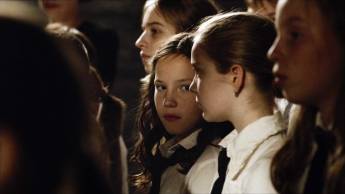
mindenki_behindthecurtainMindenki (Sing). Everyone who wants to is welcome to sing in choir, promises the principal at Zsófi’s new school. The truth, she will soon discover, is more complicated. Zsófi is an enthusiastic student until her spirit is crushed when Miss Erika, who thinks they may have a real shot at the championship this year, takes her aside and asks her to stop singing out loud.

Mindenki has a lot going on in just 25 minutes. Watching a 10 or 11 year-old being told by her favourite teacher that she simply isn’t good enough and that she should just “mouth the words” while the others sing is pretty much as heartbreaking as it sounds. It says a lot about the ways some students can get left behind and the ways that a careless teacher can demoralize a child and stifle creativity.

silent-nightsLikeable actors, terrific editing, and a timely story go a long way in elevating the imperfect but nonetheless effective Silent Nights. Mostly a love story set against the backdrop of the immigration and refugee controversy in Western Europe, Silent Nights follows a brief affair between a Danish girl volunteering in a shelter and a homeless man from Ghana.
Silent Nights packs a lot of story into 30 minutes and it features a much clearer beginning, middle, and end than I’m used to seeing in short films. It’s actually structured like a min feature film complete with subplots that lead nowhere. The script is ocassionally a little too sentimental but it earns big points for introducing us to two complex characters that we can care about.


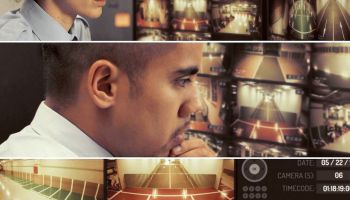
With just 15 minutes, Timecode is the shortest of the five nominated shorts. It’s also potentially the most confusing. Luna is a parking lot attendant who discovers that her colleague Diego has left a surpritimecodese for her. He has danced his heart out in front of the security cameras for her amusement. I have to admit though that it took me awhile to recognize it as dancing. I thought at first that he was fighting off an invisible assailant. So begins their unusual shift exchange ritual.

Timecode has already picked up several awards including the Palmes d’Or at Cannes and more importantly Best International Shortfilm at the Whistler Film Festival so its got a serious shot at the Oscar. It’s cute, well-made (even if not always well-danced but hey we forgave La La Land), and is probably the least pretentious of the five nominees. I just simply didn’t enjoy it as much as I enjoyed the others.


Ennemis Interieurs (Enemies Within)
is the more disciplined of the two Europeans Can Be Racist shorts (see Silent Nights above). Enemies Within is mostly just two people in a room talking but holy shit is itennemis-interieurs3 tense. A citizenship interview slowly morphs into a full-on national security interrogation.
Ennemis Interieurs can sort of feel like just a really good scene from the glory days of Homeland but the acting and directing are superb and it says a lot in a short time about institutional racism and self-fulfilling prophecies.


La Femme et le TGV
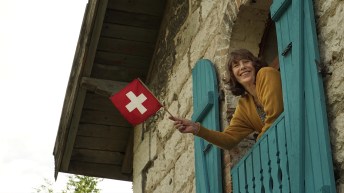
is my favourite of the five. And not just because it has trains. An aging woman discovers that her daily ritual of waving at passing trains hasn’t gotten unnoticed or unappreciated. The train’s conductor decides to write her a thank you note and their pen palling reignites her passion for litgvfe.

I’ve read one reviewer accuse La Femme et le TGV of stealing its tone from Amelie. While I agree that Amelie would give you a pretty good idea of what you can expect, I would argue that my favourite live-action short of 2016 takes some of what worked best from Amelie to deliver something funny, touching, and lovely.

Oscar-Nominated Animated Shorts, 2017

Borrowed Time: a sheriff returns to the site of a crash, the source of his guilt, the symbol BORROWED-TIME-2.gifof his grief. The animation is twelve steps above incredible, from the flecks of gray in his beard to his slightly crooked teeth and the just-noticeable ripple of his mustache in a gentle breeze, the animators clearly know what they’re doing. Directors Andrew Coats and Lou Hamou-Lhadj tell the story precisely and economically, every frame adding a tragic detail. Builds to an impressive emotional valve in just under 7 minutes.

Pearl: told from a hatchback car that has traveled the country with a dream and a song, 3060252-inline-1g-dont-be-surprised-if-googles-animated-short-pearl-wins-an-oscar-this-yearPearl is the story of a girl, her father, and their music, clearly a family gift. We got to see this short in the Oscar package at the fabulous Bytowne theatre, which means we saw it on the big screen, which is actually not how it was intended to be shown. Pearl is the first virtual reality movie to be nominated for an Oscar. Director Patrick Osborne chooses a blocky animation style paired with endearing music that makes me wish that I too had enjoyed the VR experience, because it’s a whirlwind of pride, sacrifice, and in virtual reality, you’re the one with camera: every viewing would literally be a slightly different movie.

Piper: this is the one most of you will already be familiar with, having screened in advance of Disney-Pixar’s Finding Dory. It’s about a baby sandpiper being taught to forage for her tumblr_og1b37dVCN1qd79gyo5_540.gifown food. The beach is not always as serene as it looks and an unexpected wave leads to some PTSD for one cute little birdie. But she learns confidence and resilience, and the joy of helping others, all in less than 6 minutes. The animation is stunning. The ocean’s foam impressed me, the movement of each individual grain of sand. In great Pixar tradition, writer-director Alan Barillaro offers us something truly beautiful.

Blind Vaysha: pictograph-style animation (Sean called it “deliberately ugly”, I would blind-vayshadescribe it more like wood-cuttings, if I was feeling generous) tells a parable of a little girl born effectively blind – her left eye seeing only the past, her right only the future, which means the present is one big blind spot. And guess what? There isn’t any happiness in the past or in the future, it’s all happening right now and if you can’t see that, you can’t really see anything. Director Theodore Ushev has a great theme and plays on it with swirling visuals, challenging the audience to experimentation.

Pear Cider & Cigarettes: after several warnings to remove children from the audience, this “graphic” offering by writer-director Robert Valley is narrated in the first-person about pearcider_a.gifRob’s charismatic but troubled friend, Techno. Techno’s near god-like status comes crashing down as he slowly poisons himself to death with alcohol. It’s definitely the only animated short with full-frontal nudity. It was originally a graphic novel, or novels, comprising several volumes, which is why this short film clocks in at a hefty 35 minutes, every single frame of which is hand-drawn by Valley himself, over the course of half a decade or so.
The verdict: Piper’s going to win. Borrowed Time is probably its only real competition, and I feel they’re both deserving. I’m not sure how many Academy voters will have seen Pearl in VR but even the theatrical cut is immersive and interesting. Can the animation team from Google really win an Oscar? While Blind Vaysha certainly has an eye-catching style, the story didn’t draw me in, and it ended too abruptly and without much resolution. Pear Cider and Cigarettes down right turned me off. If you’re going to bother animating a 30 minute sequence, you should also go to the trouble of writing, then editing your story- the narrative style just didn’t work for me. I feel unpatriotic down-voting both Canadian efforts, but them’s the breaks; Pixar’s still at the top of the heap. Take aim, animators.

Oscar Spotlight: Editing

The Academy Award for Best Film Editing is very closely correlated to Best Picture. For 33 years, 1981-2013, every Best Picture Winner was nominated for Film Editing. Two thirds of Best Picture winners also win for Editing.

[What broke the mould? In 2014, Birdman won Best Picture but was shut out of the Best Editing nominations. Those went to American Sniper, Boyhood, The Grand Budapest Hotel, The Imitation Game, and Whiplash; Whiplash won.]

Editing is the invisible art that even editors struggle to describe.

Nebraska editor Kevin Tent: It’s hard to articulate what editors do, but when it’s bad, you’ll know it. When it’s good, you’ll never know.

Gravity co-editor Mark Sanger: The editor needs to provide a canvas that complements all of the other aspects to tie them together. If an audience has engaged deeply enough with a story to nominate it for best picture, then they understand the pages were bound together in the editing.

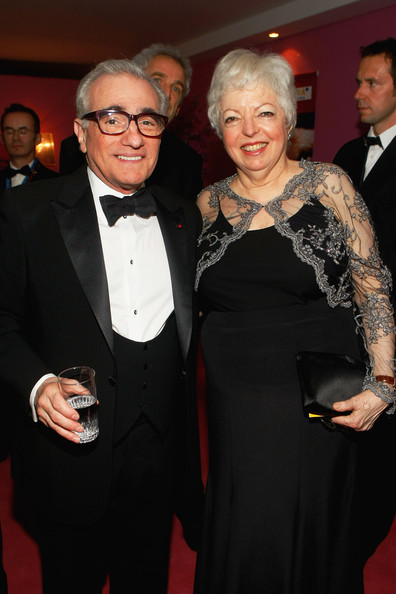
Any clearer? Basically, what Oscar voters are thinking is:  Are there special challenges that go into it? Multiple story lines? Non-linear? Does it flow well, is the story clear? Is the film visually exceptional? Is the movie long but doesn’t feel it? Directing a movie is telling (showing) a story; editing a movie is how well you can tell it. Sometimes good editing means you don’t notice it at all, it seamless pulls together all the elements of the movie. Other times, it might purposely draw attention to itself: Wolf of Wall Street’s editor, Thelma Schoonmaker says “In ‘Wolf,’ we’re doing shocking cutting deliberately, because their world is out of control, and wild.”

Only the principal editor is named on the award. He or she may sit down and do the first edit of a movie by themselves, but the director is almost always sitting beside them for the polish of the film, and their work becomes blurred with judgments about pacing, film language, and martinscorsesethelmaschoonmakerpowellgadves9f5idlmore. Lots of directors have a go-to editor as this person will be their right-hand in making the film complete. They get to know each other very well, and must share a vision for the film, while pushing each other to make the best film possible. Michael Kahn, the most nominated editor is Oscars history, and tied for most wins (3), is a frequent collaborator of Steven Spielberg – they’ve worked together for nearly 40 years. Schoonmaker and Scorsese are also collaborators over several decades. Some of these editor-director ‘marriages’ last longer than the real ones do in Hollywood.

You probably can’t truly judge an editor unless you’ve seen the raw material they had to work with, but there are some things to look out for: is it focused? graceful? do they keep you on the edge of your seat when there’s action? are you riveted during a great performance? does it keep your interest throughout? are you ever confused, or left wondering what’s happening in a scene? do they stay on a particularly good moment for as long as it holds emotionally, or cut away too soon? What’s left out is just as important as what’s kept. And sometimes staying, rather than cutting, is even more powerful. Yup, it’s a lot to think about and certainly would require more than one viewing to really judge. There are only about 220 members of the Editing branch of the Academy, and they’re the ones who pick the nominees. Then everyone gets to vote for who wins.

This year’s nominees:

John Gilbert, for Hacksaw Ridge: Gilbert was previously nominated for his work on The Lord of the Rings: The Fellowship of the Ring, but the Academy likes war movies in terms of editing. The battle scenes have lots of intense editing, and Gilbert agrees that these are what the Academy is responding to: “They’re made up of fragments of images, a lot of it is very short shots and high john-gilbert-1-1000x1482intensity. The idea was to put the audience in amongst it and people really feel it in the battle scenes, a lot of people sort of cover their eyes, there’s a lot of bloodshed and mayhem, and it’s quite sustained.” While the initial work of stringing the film together can be done quickly, perhaps in a week, the real meat comes afterword, when director and editor sit down together to make all the difficult choices. “I worked with Mel Gibson for about 10 weeks on it. I originally thought that 10 weeks was not going to be enough. About half the movie is battle scenes, with a lot of quick-cut action, and a lot of choices due to the amount of footage I had. Mel had been in during the shoot and we went over some sequences in great detail, looking at re-speeding shots, and trimming frames, taking quite a bit of time. There are always key scenes where small changes in performance and timing can be critical and we worked hard on them.” Gilbert is quick to point out that editing is a collaborative process: “The assistants break it down into scenes for me, and I skip through the circled takes to start with, just to have a look at what sort of coverage I’ve got. I like to get an idea in my mind about the shape of the scene, where I’m going to use the wide shots, where I’m going to use the close-ups, and how to best use the coverage I have. I like to find what I think are they key moments in the scene and make a note of any magic I find in the performances. I make a ‘selects’ sequence as I go, which I make in story order, and that becomes the basis for my first edit. It is also useful if the script supervisor has a good relationship with the director and is able to give me insight into what they were thinking, and any moments they loved when shooting.”

Joe Walker, for Arrival: Walker worked with Denis Villeneuve last year on Sicario and again this year on Blade Runner 2049, so they’re forming quite a successful partnership. He was previously nominated for his work on 12 Years A Slave. As Villeneuve and Walker wrapped up Sicario, Villeneuve passed him the script for Arrival, and he was immediately drawn to it for its “strong female lead. It was educated and it was grown-up, and I was fascinated by the joe-walker-800x600application of my craft to it, in so far as it’s right in the middle of what I think is our super power as editors, which is the manipulation of time.” Arrival is told with little glimpses of memory, other times, other places. How do you sew that all together? “Many things were just grabbed moments that were sort of very emotive and beautiful, a hand touching a baby’s hand in a cart, or an out-of-focus shot of a horse in a stable. They could have gone anywhere. Trying to build that into the narrative and marble this narrative through with these little glimpses of a memory, if you like.” Arrival doesn’t have a strictly linear approach, nor is it classically circular or backward or necessarily out of chronological order. It simply does not exist within our perception of time and order. It’s interwoven, with all moments touching each other, if you can think of time reaching around on itself. “To really be moved by the ending, we felt we had to adjust that. We had to make sure that the wall that we built at the beginning wasn’t so solid that we couldn’t kick it down, but also we had to choose a real moment where people will definitely get it. That’s right at the heart of editing and narrative storytelling, working out when you’re just ahead of the audience, or in parallel with the audience, and never behind. We always wanted to compliment the audience’s intelligence so that they could figure it out themselves.”

Jake Roberts, for Hell or High Water: Jake “NOT the Snake” Roberts has worked on some pretty great films, including Starred Up, Brooklyn, and Trespass Against Us, but this is his first Academy Award nomination. He was a film buff grown up and expected to be a “film maker” img_8854but fell into editing rather accidentally, and fell in love with it quite whole heartedly. “The alchemy that occurred when you juxtaposed certain images or performances and added music or sound effects was ‘filmmaking’ to me in the most literal sense. I’ve been editing ever since.” On the particular challenges of making a neo-Western like Hell or High Water: “The challenges were mostly about tone and pace. It’s a serious film but has plenty of laughs in it so we had to be careful not to let it get too heavy or too silly and walk a line between it’s extremes. Likewise we wanted the film to be languid in places and for the audience to be able to hear the space and the silences but equally for it to play plausibly as a mainstream thriller.” How does he evaluate editing? “Never stop asking questions of the material. What do I (as the audience) want to see next? What information, be it visual or expositional, do I need to follow the story? What don’t I need? What is repetitive? Why don’t I like that character as much as I should? Why does it feel slow here?”

Tom Cross, for La La Land: He’s only been the lead editor on films since 2010 but he’s already got one Academy Award under his belt, for – you guessed it – Whiplash. How does Cross describe his collaborator, director Damien Chazelle? “Very, very prepared. In that way, it really helps me as an editor to put the movie into the first cut. The other thing that is so great about Damien, as a director, is that he is a true believer in what film editing can do. He gets very excited about solving problems, whether they be story problems or a character problems. I shouldn’t really say “problems,” but issues. He gets very excited about solving certain issues lr-tomcross_whiplashthrough editing. To his credit, he’s a brilliant writer and a visionary director, but he also is not afraid to change something in his script, whether it be dialogue or action, in order to fit what the film has to be.” How does Whiplash compare to La La Land? “In the case of Whiplash, the directive was to tell a story at a break neck pace, and with a certain amount of precision. As if the character of Fletcher was editing the movie itself. In the case of La La Land, Damien had similar directives for the editing. He had different styles that he wanted to do scenes. He used certain romantic scenes that would play out at a slower pace, and maybe less cuts. He knew that in order for that to really work and have the right emotional impact, he would have to offset that in other scenes. Other scenes have quick cutting, or fast cutting, or are told with dissolve, or other optical techniques. I think that something that excites me about Damien’s work is that he really looks at how editing can help tell the story. He’s a real believer in varying the pace and varying the speed of the cuts in order to accentuate moments when he wants to have something play slower and more romantically.” Lots of the movie relies on old Hollywood techniques to help make the film feel more dream-like, sweeping camera movements and dissolving scenes. In that way, the editing too is a throw-back. Some scenes that are meant to be more ‘modern’ (like the concert footage with John Legend) feature a lot of cutting, but others, such as when Mia and Seb dance in the observatory, are a single, brave take. And for all La La Land’s big, showy, numbers, there are also quiet scenes that convey a lot of emotion. “There were items where the editing would have to take a back seat and be very invisible. That could be seen in the dinner scene where they break up. It was directed to me as an editor to use these four shot units—we had a medium shot of Sebastian, a medium of Mia, a close of Mia, and a close of Sebastian. That’s all you have.”

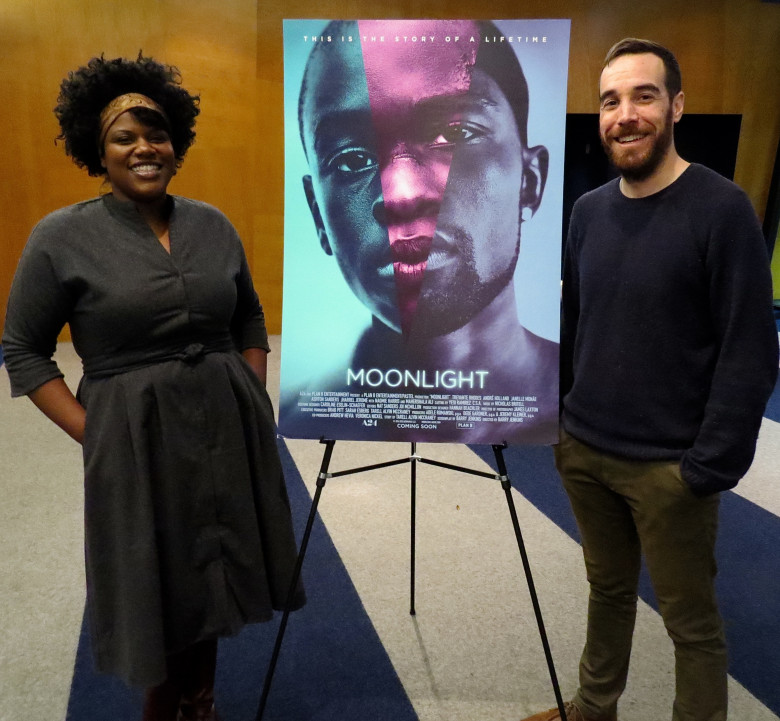
Nat Sanders and Joi McMillon for Moonlight: If Sanders and McMillon win, they’ll make history. moonlight-editorsActually, they already have; McMillon is the first African American woman to be nominated as an editor. She’d obviously also be the first to win! Sanders and McMillon divided the job between the two of them, with Sanders primarily focused on the first two segments and McMillon working on the third. The third, of course, was the toughie, and McMillon had to convince writer-director Barry Jenkins to move substantial pieces around in order to maximize and earn emotional involvement. Once he was on board “we found a place for everything, it became organic.” “Barry’s really focused on what life feels like,” Sanders said, specifying cutaways of a hand sifting through sand, or Naomie Harris moving in slow motion through the yard. Sanders and McMillon tinkered with sound design, and chose abrupt cuts to black, but kept a respect for the elegant camera work. “When you get such beautiful footage, you have to treat it like another performance,” Sanders said. He also explains the particular challenge of working for college pal Jenkins: “maintaining Barry’s filmmaking voice, which was observational and ponderous, and always wanting to preserve that, but still needing to keep things moving.”


So does that make things clearer, or muddy the waters? And who’s your pick for Oscar?